
Key takeaways
- Learn which primers bond with Venetian plaster on interior archways and curved returns, how to spot a mismatch, and the prep order that keeps the finish sound.
As an Amazon Associate I earn from qualifying purchases. This post may contain affiliate links at no extra cost to you.
Our top picks at a glance
3 products from this guide, in the order reviewed below.


As an Amazon Associate we earn from qualifying purchases. Prices and availability can change.
An archway is the hardest place in a house to put Venetian plaster, and the primer is where the job is decided. A flat wall forgives a weak bond, because gravity works with the coat. A curve pulls the plaster down, and a return edge gives the coat a place to lift, so the primer has to hold the plaster to the wall while it is still wet and heavy. This guide to which primer is compatible before you apply Venetian plaster on interior archways and curved wall returns walks through the primers that bond with lime and acrylic plasters, the ones that fight them, and the order of work that keeps the finish sound.
The core rule is simple: the primer must match the plaster chemistry and the wall below it. Lime plasters need a mineral-friendly base and a surface with enough grip for the coat to key into. Acrylic plasters need a sealed, uniform surface that will not drink the water out of the first coat. A primer that seals too hard can starve a lime plaster of the absorption it needs to carbonate. A primer that stays too open can let an acrylic plaster dry patchy on a curve, where the coat is already thinner at the edges. The sections below name the primers that work, the pairings that fail, and a step-by-step order for an archway.
Curved wall returns add one more demand: the primer must go on evenly around the curve, with no drips pooling at the inside edge and no thin spots at the crown. A roller leaves a stipple that shows through a thin plaster coat, so the primer on a curve is usually brushed or rolled and then laid off with a brush. Every product in this guide is named with the numbers the maker lists, so the choice can be checked against the wall in front of you rather than guessed.
Tools and materials
The five products below cover the primer decision from both sides: three primers that span water-based, oil-base, and mineral systems, and two plasters that show what each primer has to carry. Read the table first for a side-by-side view, then read each product section for the numbers that decide the pairing.
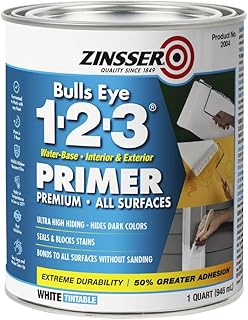
Zinsser Bulls Eye 1-2-3
- Water-based styrenated acrylic primer-sealer and stain blocker
- Coverage of 400 to 450 sq ft per gallon
- Touch dry in 30 minutes; topcoat in 1 hour; full hardness in 7 days
On an archway the primer has to do two jobs at once, and this water-based primer does both: it bonds to the drywall face and it dries fast enough that the curve can be worked the same day. Zinsser Bulls Eye 1-2-3 is a water-based styrenated acrylic primer-sealer and stain blocker, and it is the primer most often named when a Venetian plaster job needs a fast, reliable bond coat over drywall. The data sheet lists coverage of about 400 to 450 square feet per gallon, a touch dry time of about 30 minutes, topcoat in 1 hour, and full adhesion and hardness in 7 days. It bonds to glossy surfaces without scuff sanding, applies between 35 and 90 degrees Fahrenheit, and the maker lists it as mould and mildew resistant with volatile organic compounds under 100 grams per litre. It seals most stains, including grease, handprints, and light water stains, and it seals cedar and redwood tannin bleed when given 24 hours before painting. The solids run 34 percent by volume, and the recommended dry film thickness is 1.0 to 2.0 mils per coat.
KILZ Original Interior Oil-Base Primer
- Modified alkyd oil-base primer and stain blocker
- Coverage of 300 to 400 sq ft per gallon
- Touch dry in 30 minutes; recoat in 1 hour; apply between 45 and 90 degrees Fahrenheit
Where an archway carries old staining or sits near a fireplace, this oil-base primer earns its place by locking in marks that a water-based primer can let bleed through the plaster. KILZ Original Interior Oil-Base Primer is a modified alkyd primer that blocks heavy interior stains, including water, smoke, tannin, ink, pencil, felt marker, and grease, and it seals pet and smoke odours. The data sheet lists coverage of 300 to 400 square feet per gallon, a touch dry time of 30 minutes, recoat in 1 hour, and a weight of 10.3 pounds per gallon, with solids of 41.9 percent by volume and 64 percent by weight. The recommended wet film is 4.6 mils for a dry film of 1.9 mils at 350 square feet per gallon. It applies between 45 and 90 degrees Fahrenheit, and the maker notes it can be used on clean, dry, aged masonry that has cured at least 90 days. On a fireplace surround the oil base earns its place: it locks in soot and smoke staining that a water-based primer can let bleed through, and it sands to a smooth base for the plaster coats.
Meoded Quartz Primer
- Mineral primer for lime plaster systems
- Diluted with up to one quarter water
- Drying time of 3 to 5 hours before the plaster coat
For a true lime plaster on a curve, this mineral primer is the grip coat the system is built around, and skipping it is the most common reason a lime coat slides. Meoded Quartz Primer is the mineral primer the maker pairs with Marmorino Tintoretto, and it is the grip coat that makes lime plaster hold on a smooth wall. The application notes list one coat of diluted Quartz Primer, diluted with up to one quarter water, and a drying time of 3 to 5 hours before the plaster goes on. The primer goes over a new interior surface that has first been primed with a PVA acrylic primer and left to dry fully, so the system is two primer layers deep before any plaster touches the wall. The quartz grain in the primer gives the trowel something to bite into, which is what stops a lime coat from sliding on a slick drywall face. On an archway the primer matters even more, because gravity pulls the plaster down the curve, and a coat with no grip will sag before it sets.
Novacolor Marmorino KS
- Lime-based plaster coat made from hydrated lime putty and fine marble powder
- Yield of 0.8 to 1 kg per square metre in two coats
- Drying time of about 24 hours; sold in 1, 5, and 20 kg buckets
This lime plaster is the coat that sits on top of the primer decision, and its need for a dry, mature, dust-free surface is what makes the primer choice matter. Marmorino KS is a lime-based smoothing and finishing coat from Novacolor, built on well-seasoned hydrated lime putty, fine marble powder, and rheological modifiers that keep the mix workable on the trowel. The maker lists it as ready to use, with a satin effect that can read cloudy and soft or even and uniform, close to the traditional Marmorino Veneziano look. The data sheet lists a density of 1.60 grams per millilitre and volatile organic compounds under 1 gram per litre. On an archway the two-coat build matters: the first coat goes on with a stainless steel trowel and is worked with a wet sponge trowel before it dries, then the second coat is laid the same way and finished with the sponge trowel for a compact, slightly rough surface. New plaster below needs about four weeks to mature before this coat goes on, and the surface must be dry, dust-free, and free of damp and salt stains.
San Marco Marmorino Classico
- Lime and marble dust plaster, Series 947, zero VOC, ready to use
- Two coats; 1 kg covers 3 to 4 sq ft, 5 kg covers 15 to 20 sq ft, 20 kg covers 60 to 80 sq ft
- Touch dry in 2 to 3 hours; ready for the next coat after 12 hours
This is the forgiving plaster to pair with a primer decision on a curve, because its tool marks disappear as it is worked, which hides the small ridges a curved surface always leaves. Marmorino Classico is the San Marco lime plaster that many plasterers reach for first, because it is forgiving on the trowel and the tool marks tend to disappear as the coat is worked. The maker describes it as an authentic Italian lime and marble dust plaster with a satin polished finish, zero VOC, and ready to use with no mixing. The data sheet lists two coats, applied with a plastic trowel, a stainless steel trowel, or a sponge trowel, and the surface can take a polished marble-like route or a coloured roughcast route with a sponge trowel. Coverage runs 3 to 4 square feet per kilogram in two coats, so a 5 kg pail covers 15 to 20 square feet and a 20 kg pail covers 60 to 80. At 25 degrees Celsius and 65 percent relative humidity the coat is touch dry in 2 to 3 hours and ready for the next coat after 12 hours. It suits new and old hydraulic-binder plasters, old mineral paints that are dry and cohesive, and absorbent mineral surfaces.
The table below lines up the three primers and the two plasters by what the maker lists, so the pairing can be judged at a glance. Look at the drying time column first on a curve: a primer that dries in 30 minutes lets the plaster go on the same day, while a primer that needs hours pushes the plaster to the next day.
| Item | Key spec | Best for |
|---|---|---|
| Zinsser Bulls Eye 1-2-3 | Water-based primer, 400-450 sq ft per gallon | Fast-drying bond coat |
| KILZ Original Primer | Oil-base primer, 300-400 sq ft per gallon | Heavy stain and odor sealing |
| Meoded Quartz Primer | Mineral primer, dilute up to one quarter water | Grip coat under lime plaster |
| Novacolor Marmorino KS | Lime plaster, 0.8-1 kg per sq m in two coats | Polished satin finish on arches |
| San Marco Marmorino Classico | Lime plaster, 2 coats, 1 kg covers 3-4 sq ft | Forgiving satin finish, historic look |
Step by step
Step 1: Read the wall and the old finish
Start by reading the archway itself, because the primer choice follows the wall, not the other way around. Run a hand over the curve and the returns and note where the surface is smooth, where it is rough, and where old paint is peeling or chalking. Press a strip of masking tape onto the old finish, rub it flat, and pull it off: if paint comes away on the tape, the old finish is not bonded well enough to carry plaster, and it has to come off before any primer goes on. Check the crown of the arch for cracks, because a curve concentrates movement there, and mark every crack with a pencil so none is missed. Look at the returns, the short flat faces that turn back into the opening, and note whether they are drywall, plaster, or wood trim, because each takes primer differently. Note any water stains, smoke marks, or grease near the arch, since those decide whether a stain-blocking primer is needed. This reading takes an hour and it shapes every choice that follows, so do not rush it.
Step 2: Repair the curve before any primer
Fix the surface before priming, because primer cannot bridge a crack or level a hollow on a curve. Open every crack with a utility knife, rake out loose material, and fill with joint compound, pressing it in with a flexible putty knife and feathering the edges so the patch disappears into the curve. Let the compound dry fully, up to 24 hours, then sand it smooth with fine sandpaper and wipe the dust off with a damp cloth. On a curve, sand with a sanding sponge rather than a flat block, because the sponge follows the shape and will not cut flat spots into the arch. Check the repair by raking light across it at a low angle: any ridge or hollow shows up as a shadow, and it must be filled and sanded again. A plaster coat is only about a millimetre thick in places, so every flaw in the wall below will read through the finish.
Step 3: Pick the primer that matches the plaster
Match the primer to the plaster chemistry and to the wall condition found in Step 1. For an acrylic plaster such as Modern Masters VP100, a water-based primer-sealer like Zinsser Bulls Eye 1-2-3 bonds to the drywall and seals the surface so the first plaster coat dries evenly. For a lime plaster such as Marmorino KS or Marmorino Classico, a mineral primer like Meoded Quartz Primer gives the lime coat the grip it needs, and the primer goes on diluted with up to one quarter water. Where the wall carries heavy staining, smoke, or grease, an oil-base primer like KILZ Original locks the stain in before the plaster goes on. Never put a lime plaster straight over a hard-sealing oil-base primer without checking the maker guidance, because the lime coat needs some absorption to carbonate and bond. When in doubt, prime a small patch on the least visible return, let it dry, and lay a plaster sample over it before committing to the whole arch.
Step 4: Prime the curve in thin, even coats
Prime the archway in thin, even coats, working the curve in sections so no edge dries before the next section starts. Cut in the inside edge of the arch and the returns with a brush first, then roll or brush the flat faces, keeping a wet edge as you move around the curve. On a tight radius, use a brush rather than a roller, because a roller sleeve cannot follow the curve and will leave a stipple that shows through thin plaster. Lay the primer off in one direction, following the curve, so the brush marks run with the shape instead of across it. Keep the coat thin: a thick primer coat on a curve will drip at the crown and pool at the inside edge, and both defects will read through the plaster. Let the primer dry to the time the maker lists, 30 minutes to touch for the water-based primer and 3 to 5 hours for the mineral primer, before judging whether a second coat is needed.
Step 5: Check the primed surface and lay a plaster sample
Before the plaster goes on, check the primed surface the way the plaster will see it. Run a hand over the curve and feel for drips, rough spots, or dry patches where the primer went on thin. Rake light across the arch at a low angle and look for ridges, roller marks, or dust stuck in the coat. Sand any rough spot lightly with fine sandpaper and wipe the dust away, then spot-prime the sanded area and let it dry. Lay a plaster sample on the least visible return, using the same trowel and the same number of coats planned for the job, and let it dry fully. If the sample bonds firmly, dries evenly, and shows no lifting at the edges, the primer pairing is sound and the full job can start. If the sample lifts, cracks, or dries patchy, stop and re-read the primer choice before going further.
Common mistakes
Priming over a glossy old finish without scuffing
A glossy old paint coat looks smooth, but a primer laid over it can sit on the surface instead of bonding to it, and the plaster above will follow the primer off the wall. Scuff the old finish with fine sandpaper until the shine is gone, wipe the dust away, and then prime. On a curve the scuffing matters more, because the plaster pulls at the bond as it dries.
Using a stain-blocking primer under a lime plaster without a sample
An oil-base stain blocker seals the wall hard, and a lime plaster laid over it can struggle to bond, because lime needs some absorption to carbonate. Always lay a sample patch first when this pairing is on the table. If the sample lifts or powders, switch to a mineral primer and keep the oil-base primer for the stained area only, under a compatible system.
Priming the curve too thick
A thick primer coat runs at the crown of the arch and pools at the inside edge, and both defects print through a thin plaster coat. Two thin coats always beat one thick coat on a curve. If a drip has already dried, sand it flat, wipe the dust, and spot-prime before moving on.
Skipping the sample patch on the return
The return is the least visible part of the arch, which makes it the best place for a sample and the worst place to discover a failure. A sample patch takes an hour and answers the bonding question before the whole arch is at risk. Never skip it, even when the primer and plaster come from the same maker.
Priming before the repairs are dry
Joint compound that is still damp under primer will dry slowly, shrink, and crack the primer coat, and the plaster above will follow the crack. Wait the full drying time the compound maker lists, up to 24 hours, and check by touch and by colour: a patch that is still dark in the centre is still wet.
FAQ
Can I use a standard wall primer under Venetian plaster on an archway?
A standard wall primer can work under an acrylic plaster if it seals the surface evenly and bonds to the drywall, and the water-based primer-sealer in this guide is built for that job. Under a lime plaster, a standard primer is a weaker choice, because lime needs a mineral-friendly base and a surface with grip. Match the primer to the plaster chemistry first, then to the wall condition, and lay a sample patch before committing.
Do I need a different primer for the curved parts than for the flat wall?
The primer is usually the same product on the curve and the flat wall, but the application changes. A brush follows a tight radius better than a roller, and thin coats matter more on a curve, where drips and thin spots show fast. If the curve is old plaster and the flat wall is drywall, the two surfaces may need different prep, even with the same primer.
How long should primer dry before Venetian plaster goes on?
Follow the time the primer maker lists. The water-based primer in this guide is touch dry in 30 minutes and ready for topcoat in 1 hour, while the mineral primer needs 3 to 5 hours. Cool air and high humidity stretch every drying time, so wait longer when the room is cold or damp, and never judge dryness by the surface alone on a curve, where the coat can be thicker at the edges.
What happens if the primer and the plaster do not bond?
The plaster can lift at the edges of the curve, crack along the crown, or dry in patches that show the primer through the finish. The fix is to remove the failed coat, re-read the primer choice, and lay a sample patch with a different primer before starting again. A sample patch costs an hour; a failed arch costs a full redo.
Can I prime over old paint on an archway?
Old paint can stay if it is sound, clean, and well bonded, and a tape pull shows no paint coming away. Scuff the shine off with fine sandpaper, wipe the dust, and prime. If the paint is peeling, chalking, or flaking, it has to come off first, because primer cannot hold paint that is already letting go of the wall.
Conclusion
The primer decision on an archway is a pairing decision, not a brand decision. Read the wall, repair the curve, match the primer to the plaster chemistry, lay thin even coats, and prove the bond with a sample patch on a return before the full job starts. A water-based primer-sealer carries acrylic plaster on drywall, a mineral primer carries lime plaster on a smooth wall, and an oil-base primer locks in stains that would otherwise bleed through. Get the primer right and the plaster has a sound base to grip; get it wrong and the curve will show the failure first. Take the time the prep demands, and the arch will hold its finish for years.
Related guides
More from Amazon
Programs that pair well with the guide above. Offers and eligibility are set by Amazon and may change.
Free shipping on eligible items, Prime Video and more. Eligible new members can start with a free trial.
Start a Prime free trialAudiobooks and podcasts to listen to on the go. Eligible new members can start with a free trial.
Try Audible freeAd-free music streaming. Eligible new subscribers can start with a free trial.
Try Music Unlimited freeA free business account with business pricing and bulk-buying tools for work, shop or home office.
Create a business accountAs an Amazon Associate we earn from qualifying purchases.
More ways to save on your next finish
Programs that pair well with the guide above. Offers and eligibility are set by Amazon and may change.
A free business account with business pricing and bulk-buying tools for work, shop or home office.
Create a business accountFast, free shipping on eligible items, plus Prime Video and more. Eligible new members can start with a free trial.
Start a Prime free trialRead from a huge library of eBooks, including how-to guides and cookbooks. Eligible new members can start with a free trial.
Try Kindle UnlimitedAudiobooks and podcasts for the commute, the garage or the kitchen. Eligible new members can start with a free trial.
Try Audible freeAs an Amazon Associate we earn from qualifying purchases. Using these links costs you nothing extra.









Write Your Review
No reviews yet. Be the first to share your experience!