
Key takeaways
- Find out which primer bonds well under a travertine effect with Venetian plaster on small sample boards, and how to check grip and drying before the first coat.
As an Amazon Associate I earn from qualifying purchases. This post may contain affiliate links at no extra cost to you.
Our top picks at a glance
3 products from this guide, in the order reviewed below.


As an Amazon Associate we earn from qualifying purchases. Prices and availability can change.
which primer is compatible before you create a travertine effect with Venetian plaster on small sample boards is a question worth settling before any plaster leaves the tin. A sample board is a small surface, so every flaw shows. The wrong primer lets the first coat slide, dry in patches or peel at the edges, and the board then teaches the wrong lesson about the finish.
Primer choice for travertine work is not only about sticking power. Travertine plaster is laid thicker than a polished Venetian coat, and it is scraped and veined while it is still workable. The primer below it must hold that weight, keep suction even across the board, and dry hard enough that the scraper does not tear the ground. A primer that suits a thin polished coat can still fail under a textured travertine coat.
This guide walks through the primers that pair well with travertine-effect Venetian plaster on small sample boards. It covers quartz primers, maker-matched primers, a general sealer for tricky boards, and the plaster and tools that complete the board. It also shows how to check bond and drying on a board before committing to a full wall.
Tools and materials
Meoded Quartz Primer
- Quartz-filled acrylic primer made for smooth plasterboard and painted walls
- Gives Venetian plaster a keyed surface to grip
- Dries in a few hours before the first plaster coat
This is the lead choice for sample boards because the quartz grain gives a thin plaster coat something to hold. On a small MDF or plasterboard panel the primer also evens out absorption, so the first coat of Travertino does not dry in patches. Roll it on thinly, let it dry fully, and the board keeps a steady suction from edge to edge.
On a board the quartz grain also shows in the finish. A primer rolled too thick leaves a sandy texture that prints through a thin first coat, so keep the film thin and even. When the primer is right, the first Travertino coat goes on without dragging, and the scraper later finds a firm ground that does not tear. That firm ground is what a sample board is meant to prove.
Valpaint Primer 1200
- Primer from the Valpaint ROCOCO cycle, used before Travertino coats
- Prepares absorbent and previously painted surfaces for lime plaster
- See product page for pack sizes and drying times
Valpaint pairs this primer with its own ROCOCO cycle, so it is the natural partner when the finish coat is Valpaint Travertino. On a sample board it seals the face and leaves a uniform ground for the 1.5 to 2 mm coat that follows. Use it when the board will carry the Valpaint system from primer to finish.
Because this primer belongs to the Valpaint cycle, it removes one unknown from the board. The plaster, the primer and the finish all come from one maker, so a failure on the board points to the method rather than to a mismatch of materials. Keep a board of this pairing as the reference, and judge other pairings against it.
Stucco Italiano Travertino
- Natural mineral lime-based wall coating for indoor and outdoor use
- Ready-to-use paste, 24 kg container, white base with 90 colour options
- Yield 1800 to 2000 g per square metre in two coats
- Dry to the touch in 2 hours at 20 C; carbonation in 48 hours
This is the plaster that forms the travertine look itself. Its lime base and marble powder give the rough-looking but smooth-touching surface that recalls cut travertine. On a sample board the two-coat build shows the full effect: a first coat for body and a second coat for scraping and veining.
The two-coat build of this plaster is worth watching on a board. The first coat gives body and the second gives the texture, and the yield figure lets you weigh the paste before it is mixed. On a small board the second coat is where the travertine look appears, so do not judge the plaster by the first coat alone.
Meoded Stucco Lamundo
- Lime-based Venetian plaster for high-gloss polished finishes
- Supplied in 20 kg containers
- See product page for colour range and coverage
Lamundo is the smooth polished plaster that can sit beside Travertino on a comparison board. It shows how a high-gloss Venetian finish differs from the open, veined travertine surface. Keep it on a separate board so the two finishes can be judged side by side.
A comparison board with Lamundo is useful because it shows what travertine is not. Lamundo dries to a smooth, high-gloss face, while Travertino keeps an open, veined surface. Placed side by side, the two boards make the choice of finish visible at a glance, which helps when the wall design is still open.
Marshalltown Venetian Plastering Trowel MXS11SSD
- Stainless steel Venetian plastering trowel with a golden steel blade
- DuraSoft handle for long trowelling sessions
- See product page for blade size
The golden stainless blade stays flat across a small board and leaves few edge lines. For travertine work the same trowel lays the coat, then its edge, held at a right angle, scrapes the surface to open the veins. A clean blade matters more than a costly one.
A trowel used for both laying and scraping must be wiped often. Dried plaster on the edge will score the board and leave dark lines that look like veins but are only scratches. Keep a damp cloth beside the board and wipe the blade after every few passes, and the board will show the true texture of the plaster.
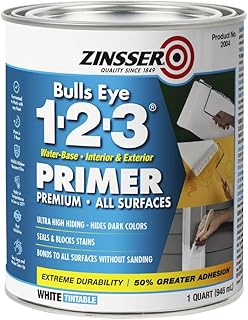
Zinsser Bulls Eye 1-2-3
- Water-based primer-sealer that sticks to glossy and slick surfaces
- Dries in about one hour and can be top-coated the same day
- Suitable for interior and exterior use
This water-based primer-sealer is the fallback when a board face is glossy, slick or already painted. It sticks where a lime primer might slide, and it dries in about an hour. Use it on sealed MDF edges and on boards that already carry a coat of paint.
This sealer earns its place on boards that already carry paint or a glossy face. It dries in about an hour, so a board can be sealed in the morning and plastered the same day. Use it where the board face is slick, and keep it away from fresh lime systems where a quartz primer does the job better.
| Primer | Best board | Key strength |
|---|---|---|
| Meoded Quartz Primer | Raw MDF and plasterboard | Quartz grain keys the lime coat |
| Valpaint Primer 1200 | Boards in the Valpaint cycle | Maker-matched ground for Travertino |
| Zinsser Bulls Eye 1-2-3 | Glossy or painted boards | Sticks to slick faces, dries fast |
| Stucco Italiano Travertino | Primed sample boards | Lime coat that forms the stone look |
| Meoded Stucco Lamundo | Comparison boards | Smooth polished contrast to travertine |
| Marshalltown MXS11SSD | All sample boards | Flat blade for laying and scraping |
Step by step
Step 1: Pick the board and seal the edges
Start with a flat, dry board. MDF panels and plasterboard offcuts are the usual choices for samples, and both need edge sealing because their cut edges drink primer and plaster at a different rate from the face. Brush a coat of primer along every cut edge and let it dry before touching the face. A board that is sealed at the edges keeps the face coat even, and the sample then reads true. Mark the back of the board with the primer name and the date, so later boards can be compared without guessing which ground sits below each finish.
A board that is labelled on the back saves confusion later. Write the board number, the primer name and the date in pencil, and keep a short note of the room temperature. Boards made on a cold day dry slower, and the note explains why two boards of the same pairing look different. The label costs a minute and saves a wrong conclusion.
Step 2: Match the primer to the plaster system
Choose the primer from the same maker as the finish coat when one exists. Valpaint Primer 1200 belongs with Valpaint ROCOCÒ TRAVERTINO, and that pairing is written into the maker cycle. When the finish is Stucco Italiano Travertino, a quartz primer such as Meoded Quartz Primer gives the lime coat a keyed ground. Mixing systems is possible, but the board is the place to find out whether the mix holds. Lay one board per primer, keep the plaster coat the same on each, and compare the bond after drying.
When two primers are being compared, keep every other factor the same. Use the same board material, the same plaster batch and the same trowel, and lay the coats on the same day. If the boards differ in more than the primer, the comparison cannot say which primer did the work. A fair board check changes one factor at a time.
Step 3: Roll the primer thin and even
Pour a small amount of primer into a tray and load a short-pile roller lightly. Roll the board face in one direction, then cross-roll to even the film. A thick primer coat can skin over and trap moisture below, while a thin coat leaves dry spots that pull the plaster unevenly. Aim for a full, even film with no ridges at the roller edges. Let the primer dry for the full time on its label, even if the surface feels dry to the touch sooner. A primer that is still soft below the surface will move when the trowel passes over it.
Roller marks in the primer will print through a thin plaster coat, so the cross-roll matters. Roll in one direction, then at a right angle, and finish with a light pass in one direction to level the film. Check the primed face in raking light before it dries, and smooth any ridge while the primer is still wet.
Step 4: Check suction with a water drop
Before the plaster coat, place a few drops of clean water on the primed face and watch them. On a well-primed board the drops should sit for a short while and then soak in slowly and evenly. If the water vanishes at once, the board is still too absorbent and needs a second primer coat. If the water beads and stays, the primer film is too slick and the plaster may slide. This simple check takes a minute and saves a wasted board. Record what you see on the back of the board next to the primer name.
The water drop check works best on a spare corner of the board, not in the middle of the face. Place three drops in a row and watch them for a minute. Drops that soak in at the same rate show even suction, while drops that behave differently show a patchy primer film that needs another thin coat.
Step 5: Lay the first Travertino coat
Mix the Travertino paste until it is smooth and lump-free, then load the trowel and lay a first coat across the board. Keep the coat even and slightly thicker than the grain size, and work from one edge to the other without stopping mid-board. For Stucco Italiano Travertino the yield runs 1800 to 2000 g per square metre in two coats, so a small board needs only a modest amount. Let the first coat firm up until it resists a light touch, then lay the second coat that will carry the travertine texture.
The first coat should be laid without stopping, because a stop mid-board leaves a line where the wet edge dried. Load the trowel, start at one edge and work to the other in steady passes. If the board is wide, work in bands and blend each band into the last while it is still wet.
Step 6: Scrape, vein and let the board dry
When the second coat is laid and smoothed almost like a marmorino, begin to scrape the surface with the trowel blade held at a right angle, moving in horizontal strokes. This opens the small voids and bands that recall travertine stone. When the surface is about four-fifths dry, polish the smooth parts lightly with the metal trowel. Then leave the board alone. Travertine coats need a full drying time, and moving the board or stacking it too soon will mark the face. Store boards upright, apart from each other, until the surface is fully hard.
Drying time on a board is not only about the face. The edges and the back dry at different rates, and a board moved too soon will flex and crack the coat. Leave the board upright in a room with steady air, away from direct heat, and do not judge the finish until the surface is hard right through.
Common mistakes
Skipping the edge seal
Cut board edges absorb far more primer and plaster than the face. When the edges are left raw, the plaster coat dries faster at the rim and pulls away, leaving a pale ring and a curled edge. Seal every cut edge with primer first and let it dry before the face coat.
The ring at the rim is the first sign of an unsealed edge. It shows as a pale band where the coat dried faster, and it cannot be fixed by a second coat. Seal the edges, let them dry, and the face coat will dry as one surface.
Using a primer from a different system without a board check
A primer that works under one plaster can fail under another, because lime plasters and acrylic plasters grip in different ways. Never carry a new primer straight to a wall. Lay a board first, let it dry fully, and try to lift a corner of the plaster with a blade. If it lifts cleanly, the pairing is wrong.
A blade check after full drying is the honest way to judge a pairing. Try to lift a corner of the plaster with a blade. A good bond holds firm, while a weak bond lifts in a sheet. Do this check on the board, not on the wall.
Rolling the primer on too thick
A heavy primer coat looks safe but dries as a soft skin. The trowel then drags that skin and the plaster coat follows it in ridges. Roll thin, cross-roll to even the film, and add a second thin coat if the first leaves dry spots, rather than one heavy coat.
If the primer film shows roller ridges, smooth them while the primer is wet. Ridges left to dry will print through the plaster and read as faults in the finish. A minute spent on the wet primer saves a wasted board.
Plastering before the primer has dried through
A primer that feels dry on top can still be soft below. Plaster laid over it will sink, slide and dry with dark patches where the moisture sat. Follow the full drying time on the label, and allow extra time in a cold or damp room.
In a cold room, allow a full extra day for the primer to dry through. A primer that feels dry on top can still be soft below, and plaster laid over it will sink and dry with dark patches. Patience at this stage protects the whole board.
Scraping too early or too late
Scrape the second coat while it is still workable but firm enough to hold a line. Scrape too early and the surface tears; scrape too late and the blade skates without opening the veins. Work a small area first on a spare board to find the right moment for the room temperature that day.
Practise the scrape on a spare board first. The right moment depends on the room temperature and the thickness of the coat, and it changes from day to day. A spare board lets you find that moment without risking the board that matters.
FAQ
Can I use any primer under Travertino plaster on a sample board?
No. The primer must suit a lime-based coat laid 1.5 to 2 mm thick. A quartz primer or the maker-matched primer for the plaster system is the safe choice. A general wall primer made for paint may be too slick or too absorbent, and the plaster can slide or dry in patches.
A primer made for paint is often too slick or too absorbent for a lime coat laid 1.5 to 2 mm thick. The plaster needs a keyed ground that holds its weight, and a paint primer rarely gives it. Use a quartz primer or the maker-matched primer, and keep a general sealer for glossy boards only.
How many primer coats does a sample board need?
Most boards need one even coat, rolled thin. Raw MDF faces and very absorbent plasterboard may need a second thin coat, or an edge seal plus a face coat. Check suction with a water drop after the first coat dries, and add a second coat only where the water vanishes at once.
Raw MDF faces drink primer fast, so a second thin coat is common. Plasterboard faces are less thirsty and usually need one coat. Judge by the water drop check after the first coat dries, and add a second coat only where the water vanishes at once.
Can I use Zinsser Bulls Eye 1-2-3 under Venetian plaster?
Yes, it is a useful sealer for glossy, slick or already painted boards, because it sticks where a lime primer might not. It dries in about an hour. It is a fallback for tricky boards rather than the first choice for a fresh lime plaster system.
Zinsser Bulls Eye 1-2-3 is a water-based sealer that sticks to glossy and painted faces. It is the right choice when the board face is slick, and it dries in about an hour. For a fresh lime system on a raw board, a quartz primer is the better first choice.
How long should primer dry before the plaster coat?
Follow the full drying time on the primer label, not the touch-dry time. Quartz primers and water-based sealers usually need a few hours. In a cold or damp room allow longer. A primer that is still soft below the surface will move under the trowel.
Touch-dry is not dry through. The surface of a primer can feel dry while the film below is still soft, and plaster laid over it will move and sink. Follow the full drying time on the label, and allow longer in a cold or damp room.
Why did my sample board peel at the edges?
The usual cause is raw cut edges that were never sealed. The edges absorb primer and plaster faster than the face, so the coat dries unevenly and pulls away. Seal all cut edges with primer, let them dry, and then prime the face.
Peeling at the edges almost always points to raw cut edges. The edges absorb faster than the face, so the coat dries unevenly and pulls away. Seal every cut edge with primer before the face coat, and the peeling will stop.
Conclusion
Picking the right primer for a travertine effect on a sample board comes down to three things: a ground that grips, suction that stays even, and a primer that has dried right through. A quartz primer suits most lime Travertino coats, a maker-matched primer suits its own system, and a water-based sealer covers glossy or painted boards. Lay one board per primer, keep the plaster coat the same, and judge the bond after full drying. The board that holds firm, dries evenly and takes the scrape without tearing is the pairing to carry to the wall.
Keep the boards after the wall is done. They are a record of which primer held, which coat dried evenly and which scrape gave the truest stone look. When the next wall is planned, the boards will answer the primer question in minutes, without a new round of guessing. A small set of well-made boards is worth more than a shelf of unlabelled panels.
Related guides
More from Amazon
Programs that pair well with the guide above. Offers and eligibility are set by Amazon and may change.
Free shipping on eligible items, Prime Video and more. Eligible new members can start with a free trial.
Start a Prime free trialAudiobooks and podcasts to listen to on the go. Eligible new members can start with a free trial.
Try Audible freeAd-free music streaming. Eligible new subscribers can start with a free trial.
Try Music Unlimited freeA free business account with business pricing and bulk-buying tools for work, shop or home office.
Create a business accountAs an Amazon Associate we earn from qualifying purchases.
More ways to save on your next finish
Programs that pair well with the guide above. Offers and eligibility are set by Amazon and may change.
A free business account with business pricing and bulk-buying tools for work, shop or home office.
Create a business accountFast, free shipping on eligible items, plus Prime Video and more. Eligible new members can start with a free trial.
Start a Prime free trialRead from a huge library of eBooks, including how-to guides and cookbooks. Eligible new members can start with a free trial.
Try Kindle UnlimitedAudiobooks and podcasts for the commute, the garage or the kitchen. Eligible new members can start with a free trial.
Try Audible freeAs an Amazon Associate we earn from qualifying purchases. Using these links costs you nothing extra.








Write Your Review
No reviews yet. Be the first to share your experience!