
Key takeaways
- Seven polishing stones with rounded faces for compressing hand-applied lime plaster, compared on face shape, stone density, hand fit and burnishing pressure.
As an Amazon Associate I earn from qualifying purchases. This post may contain affiliate links at no extra cost to you.
Hand-applied lime plaster is pressed into place, not poured, and the final surface depends on how evenly that pressure is applied. A stone with a sharp edge concentrates force along a line, and that line shows as a groove or a drag mark once the surface dries. A stone with a rounded face spreads the same force across a broad, gentle curve, so the plaster is compressed evenly and the surface closes without marks. That difference is the whole subject of this guide, and it is why applicators looking for best polishing stones for tadelakt plaster with rounded polishing faces for compressing hand applied lime plaster should judge a stone by the shape of its working face before anything else.
Tadelakt is a lime plaster from the Moroccan tradition, applied by hand in thin coats and then burnished with a hard stone while the surface is still damp. The burnishing does two things at once: it compresses the plaster, closing the pores and making the surface dense, and it brings up the sheen that tadelakt is known for. The olive soap worked in with the stone reacts with the lime and helps the surface turn water repellent. Every part of that process depends on contact. The stone must sit flat against the plaster, move in small circles, and keep its pressure even from the centre of its face to the edge. A rounded face does that naturally, because the curve of the stone meets the flat of the wall along a broad patch rather than along a hard line.
The seven stones in this guide were picked for one job: compressing hand-applied lime plaster with a rounded polishing face. Every one of them is a real product with a maker or retailer page that was opened and read for this guide, and every spec below comes from that page. The list mixes stones made for tadelakt itself, such as the Galtane tadelakt polishing stone, the handcrafted granite pebbles from Ocres de France and the traditional stone from Stucco Italiano, with dense natural stones from other burnishing trades, such as polished basalt sets and agate burnishers, whose rounded faces suit the same work. The deciding factors were a rounded working face, enough density to compress lime plaster, a smooth finish free of grit, and a size the hand can control. Where a maker does not publish a size or a stone type, this guide says so plainly instead of guessing.
Quick verdict
The Master Massage Large Ovular Basalt Stone Pack leads this list for compression work, because its maker describes a round, elongated stone shape that fits the palm, with rounded, narrower edges that can be used to press and knead, which is the exact motion that compresses hand-applied lime plaster. The Ocres de France Large Granite Pebble is the closest dedicated rival, a handcrafted granite pebble of about six centimetres that its maker calls the indispensable tool for finishing tadelakt. The Galtane Tadelakt Polishing Stone brings a pebble made for tadelakt, in hard fine-grained stone with a flat face and rounded edges. The EasyTadelakt Large Polishing Stone and the Stucco Italiano Traditional Tadelakt Polishing Stone cover the broad-area and final-phase roles, while the Master Massage 70-piece basalt set supplies rounded ovular stones in many sizes, and the Aurum Agate Dog Tooth burnisher adds a dense, polished agate face for the final compression passes.
At a glance
| Product | Key spec | Best for |
|---|---|---|
| Master Massage Large Ovular Basalt Stone Pack 8-Piece | Natural black basalt, large flat ovular stones, rounded edges, fits the palm | Even compression across broad plaster areas |
| Ocres de France Large Granite Pebble | Handcrafted granite, about 6 x 6 cm, ref VEOUTRBB124 | Dedicated tadelakt compression with a rounded pebble |
| Galtane Tadelakt Polishing Stone | Hard fine-grained stone, flat face with rounded edges, made for tadelakt | Rounded-face compression with a tadelakt pebble |
| EasyTadelakt Large Polishing Stone | Large stone, maker lists it for broad areas with steady pressure | Covering large hand-applied coats evenly |
| Stucco Italiano Traditional Tadelakt Polishing Stone | Traditional Moroccan stone, used in the final phase | Final-phase compression of traditional tadelakt |
| Master Massage Hot Stone Set 70-Piece Deluxe Basalt | Natural black basalt, 70 pieces, even smooth surfaces | Rounded stones in many sizes for one job |
| Aurum Burnisher Agate Dog Tooth-Style | Genuine agate head, wooden handle, SKU 360-BADT | Final dense compression passes with agate |
How we chose
Face shape came first. A rounded polishing face spreads pressure across a broad patch instead of concentrating it along an edge, so this guide favoured stones whose makers describe a rounded, ovular or ergonomically curved form. The Master Massage large ovular stones state the case most directly, with rounded, narrower edges for pressing and kneading. The granite pebbles from Ocres de France are handcrafted river-stone forms, rounded by their nature. The Galtane stone is a specially made pebble with a flat face and rounded edges, so its working face presses evenly without a sharp corner.
The second filter was density. Compressing lime plaster needs a stone that is harder and denser than the plaster itself, so that the pressure goes into the surface rather than into the stone. Granite, basalt and agate all meet that need, and the traditional guidance for tadelakt, repeated by makers such as Galtane, calls for a hard, fine-grained stone such as granite, basalt or agate, with a flat face and rounded edges. The Galtane stone meets the same need, because its maker lists hard fine-grained stone such as granite, basalt or agate for tadelakt work. Stones whose hardness was not stated by their maker were judged on the maker's own description of their use, and the guide notes where a material is not published.
The third filter was control. Compression is a matter of steady, even pressure, applied in small circles, and the hand must be able to hold that pressure for a long time without tiring. Palm-sized ovular stones, rounded pebble forms and wooden handles all help, for different hands. Large flat slabs and heavy blocks were left out, because they tire the wrist and make even pressure harder to hold. Finally, every product had to be a real, current product from an identifiable maker, with specs traceable to a page that could be opened. One product in this list shows as out of stock on its maker page at the time of writing, and the guide notes that where it applies.
Master Massage Large Ovular Basalt Stone Pack 8-Piece
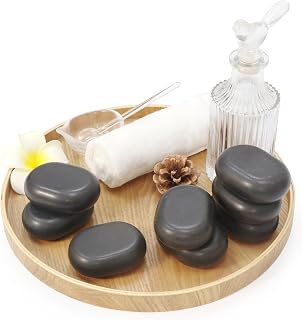
- Material: 100 percent natural black basalt, with no wax, dyestuff or chemicals listed by the maker
- Set size: 8-piece pack of large flat ovular stones
- Shape: round, elongated shape that fits the palm, with rounded, narrower edges for pressing and kneading
- Finish: maker lists even and smooth surfaces, with stones traditionally handcrafted by cutting, shaping and sanding
- Availability: in stock, usually ships in 5 to 10 days
The large ovular basalt pack leads this guide because its maker describes, in plain words, the exact motion that compresses hand-applied lime plaster. The round, elongated shape fits the palm, and the rounded, narrower edges can be used to press and knead. Pressing and kneading is what tadelakt burnishing is: the stone leans into the plaster, the hand rolls it in small circles, and the surface is pressed down and closed, pass by pass. A stone with a sharp edge cannot knead, because the edge catches and cuts. A rounded ovular stone can, because the curve of the stone rolls across the surface and the pressure moves with it.
Basalt suits this work because it is dense, fine-grained and hard, and the maker's own description of the stone, a grey-black rock with a fine-grained, crystalline texture, explains why it holds a polish and keeps its face smooth through long use. The eight stones in the pack are all the same large ovular form, so the applicator can keep a clean stone in rotation while one is being rinsed, and the pack is small enough to carry to the wall in one hand. For broad areas of hand-applied lime plaster, where the job is to compress a large surface evenly before it firms, this pack is the most direct tool in the list.
Pros:
- Rounded, narrower edges described by the maker for pressing and kneading
- Round elongated shape fits the palm for steady, even pressure
- Eight matching stones allow a clean stone to be kept in rotation
Cons:
- One size only, so tight curves and fine details need a smaller stone alongside it
- The set was made for another trade, so the applicator must judge the fit for plaster
Ocres de France Large Granite Pebble
- Material: handcrafted granite pebble
- Size: about 6 x 6 cm, with the maker noting that handcrafted dimensions can vary
- Reference: VEOUTRBB124
- Design purpose: described by the maker as the indispensable tool for the finishing of tadelakt
- Working method: smooths the coating and drives black soap into the surface
At about six centimetres across, the large granite pebble from Ocres de France is the dedicated tadelakt stone for broad compression work, and its size is its argument. A six-centimetre face covers ground quickly, which matters when hand-applied lime plaster is firming and the burnishing has to be finished before the surface sets. At the same time, the pebble is a rounded river-stone form, so its face meets the wall along a broad, gentle curve rather than a hard edge, and the pressure stays even across the whole face. The maker calls the granite pebble the indispensable tool for finishing tadelakt, and describes its work as smoothing the coating and driving the black soap in so the coating becomes water repellent.
Granite is dense and hard, and the traditional guidance for tadelakt calls for exactly that: a hard, fine-grained stone such as granite, basalt or agate. A handcrafted pebble also brings a face that is unique to that stone, shaped by hand rather than cut to a pattern, which lets the applicator choose the pebble whose curve best matches the wall. The six-centimetre size suits flat and gently curved walls, where the stone can roll in wide circles and compress a large area in each pass. For the broad middle of a hand-applied coat, where even compression matters more than fine detail, this pebble is the stone to reach for.
Pros:
- About six centimetres across, covering broad areas before the plaster firms
- Handcrafted granite, dense and hard, with a naturally rounded form
- Maker describes it as the indispensable finishing tool for tadelakt
Cons:
- Handcrafted dimensions can vary, so the exact pebble received may differ slightly in size
- Six-centimetre face is too wide for tight curves and fine detail work
Galtane Tadelakt Polishing Stone
- Material: hard, fine-grained stone such as granite, basalt or agate
- Form: specially made pebble with a flat face and rounded edges
- Design purpose: made for tadelakt polishing, described by the maker as the most important tool for the technique
- Working method: polish the coat with the stone, then finish with a spatula
- Maker note: the surface must be hard enough that the stone picks up no plaster
The Galtane stone is the maker's own answer to the question of what to polish tadelakt with, and the maker page is unusually frank about it. The stone is the most important tool for the technique, the page says: a pebble with a flat face and rounded edges, in hard fine-grained stone such as granite, basalt or agate. The maker has had stones specially made to that pattern, so the pebble is a product shaped for the job rather than a stone picked up from a riverbed. A flat face presses the coat evenly, and rounded edges mean the stone can work across a hand-applied coat without cutting a line into the fresh plaster.
For compression work, that pattern is a good one. The flat face spreads pressure across a broad patch, which is what closes the pores of a hand-applied lime coat, and the rounded edges let the stone roll in small circles without leaving a hard line where one pass meets the next. The maker sequence fits the job: polish the coat with the stone, then finish with a spatula, and apply polishing soap with a brush until the surface is saturated before the final stone passes bring up a deeper shine. The maker also notes that the surface must be hard enough that the stone picks up no plaster, and that the final hardness of tadelakt only arrives after about four weeks, so the finish should be handled gently for a while after polishing. No size, weight or article number is listed, so the stone is chosen on the maker's word rather than on a specification sheet.
Pros:
- Made to the maker's own pattern for tadelakt, in hard fine-grained stone
- Flat face with rounded edges spreads pressure without cutting lines
- Maker guidance covers the full sequence, stone then spatula, soap then shine
Cons:
- No size, weight or article number is listed, so size must be judged on arrival
- Available through the maker's own channels rather than a general retailer
EasyTadelakt Large Polishing Stone
- Size class: large polishing stone
- Design purpose: listed among the required tadelakt tools in the maker's own application guide
- Working method: the maker guide directs the large stone to broad areas, with steady circular pressure
- Material and dimensions: not published on the page opened for this guide, see product page
The EasyTadelakt large polishing stone earns its place through the maker's own division of labour, which is unusually clear about where each stone belongs. In the maker's step-by-step guide, the small stone is the tool for corners and tricky details, and the large stone is the tool for all broad areas, worked with steady circular pressure. Broad areas are exactly where compression matters most in hand-applied lime plaster: a large, open surface that must be pressed evenly before it firms, with no patch left softer than the rest. A stone assigned to that role, and worked with steady pressure rather than short jabs, is the right tool for the job.
The guide also places the large stone in a sequence that helps a first-time finisher. The small stone comes first for the details, and the large stone follows for the broad areas, with soap and stone together activating the lime and creating the waterproofing. That order means the broad compression happens while the plaster is still workable, and the pressure stays steady because the stone is large enough to span small variations in the hand-applied coat. The honest limit of this entry is that the maker page opened for this guide does not publish the stone's material or its dimensions, so a buyer should confirm those on the product page before ordering. What the page does publish, the role of the stone and the pressure it is meant for, is enough to place it with confidence in a compression list.
Pros:
- Maker guide assigns the large stone to broad areas with steady circular pressure
- Large size class covers hand-applied coats quickly and evenly
- Clear working sequence in the maker guide, detail first, then broad areas
Cons:
- Material and dimensions are not published on the page opened, so they need confirming
- No reference number was listed on the guide page, so ordering needs care
Stucco Italiano Traditional Tadelakt Polishing Stone
- Material and size: not published on the page opened for this guide, see product page
- Design purpose: traditional Moroccan stone for tadelakt, used in the final phase of the traditional application
- Maker note: Stucco Italiano describes it as a traditional Moroccan stone for tadelakt, supplied as part of its decorative finishes tool range
The Stucco Italiano stone is the traditionalist in this list, and its role is the final phase. The maker's tools page describes it plainly: a traditional Moroccan stone for tadelakt, used in the final phase of the traditional application of tadelakt. The final phase is the compression phase. By then the plaster has been laid and smoothed, and what remains is to press the surface closed, bring up the sheen, and leave a finish that is dense enough to take the soap and turn water repellent. A stone that a maker reserves for that phase is a stone whose face and weight suit the last, most careful passes, when the pressure must be firm enough to close the pores but gentle enough not to mark a surface that is nearly finished.
The honest limit of this entry is that the page opened for this guide does not publish the stone's material, its size or its weight, so those details must be confirmed on the product page before ordering. What the page does publish is the maker's own judgement that this stone belongs in the final phase, and that judgement carries weight, because Stucco Italiano collects its tools from Italian producers on the basis of long application experience. For an applicator who wants a traditional stone for the last passes over hand-applied lime plaster, this is the entry to check first, and the details to confirm are the face shape and the weight in the hand.
Pros:
- Traditional Moroccan stone, assigned by its maker to the final phase of tadelakt
- Maker selects tools on the basis of long application experience
- Suited to the last, careful compression passes over a nearly finished surface
Cons:
- Material, size and weight are not published on the page opened, so they need confirming
- No reference number was listed on the tools page, so ordering needs care
Master Massage Hot Stone Set 70-Piece Deluxe Basalt

- Material: 100 percent natural black basalt, with no wax, dyestuff or chemicals listed by the maker
- Set size: 70 pieces, in a handmade natural bamboo box
- Finish: maker lists even smooth surfaces from a high standard water polishing process
- Sizes: the set spans X-large, large, medium and small flat ovular stones, with small round, toe, facial and pressure point stones included
- Availability: in stock, usually ships in 5 to 10 days
The seventy-piece basalt set is the size library in this guide, and for compression work that range is its whole argument. Hand-applied lime plaster is never one flat, even surface. It has broad open areas, gentle curves, edges and junctions, and each of those needs a stone of a different size. A set that spans extra-large, large, medium and small flat ovular stones, plus small round and facial stones, lets the applicator change stone as the surface changes, without changing material. The broad areas take the large ovular stones, with their rounded faces and steady pressure. The edges take the small stones, with their tighter curves. The same dense basalt does the compressing throughout, so the finish stays consistent from one area to the next.
Basalt is a dense, fine-grained volcanic stone, and the maker's own description notes that the stones are hand-shaped and water polished to an even and smooth surface. That smooth face is what lime plaster needs: a stone that presses the surface closed without scoring it. The bamboo box keeps seventy stones in order between jobs, which matters when the set is large, and the range of sizes means the applicator can keep a clean stone of each useful size to hand. The set was made for another purpose, and this guide does not pretend otherwise, but the stones themselves, their material, their polish and their rounded ovular forms, are exactly what compression work asks for.
Pros:
- Seventy stones span extra-large to small, so each area of plaster gets a matching size
- Dense natural black basalt with an even, smooth water-polished finish
- Bamboo box keeps the full range in order between jobs
Cons:
- A seventy-piece set is far more stone than a single plaster job needs
- The set was made for another trade, so the applicator must pick the right sizes rather than using the set as sold
Aurum Burnisher Agate Dog Tooth-Style
- Material: polished genuine agate head, set securely in a wooden handle
- SKU: 360-BADT
- Shape: dog tooth shape, one of the three basic burnisher shapes listed by the maker
- Design purpose: burnishing, with the maker noting that a dog tooth burnisher is sufficient to start with
- Availability: the listing showed out of stock at the time of writing
The Aurum dog tooth burnisher is the finisher in this list, and its value for compression work lies in the density and shape of its agate head. Agate is a natural stone, a form of silica similar to chalcedony, and the maker's own notes describe it as shaped and polished for use as a burnishing tool, with the dog tooth shape listed as one of the three basic burnisher forms. The dog tooth gives a broad, rounded working face that can press a wide patch of plaster at once, while the point of the tooth can work into a line or an edge when needed. For the final compression passes over hand-applied lime plaster, that combination is useful: the broad face closes the open surface, and the point touches up the lines the broad face cannot reach.
The maker's guidance on use also fits plaster work well. Burnishing is done with slow, moderately applied pressure, in strokes about two centimetres wide, and the correct amount of pressure comes with practice. That is the same discipline tadelakt needs: slow, steady pressure, never rushed, with the stone kept clean so that no grease or grit marks the surface. The wooden handle gives the hand a secure hold and keeps the fingers away from the working face. The one honest drawback is availability: the listing showed out of stock at the time of writing, so a buyer should check the page before planning a job around this burnisher. When it is in stock, it is the densest and most precise finishing stone in this guide.
Pros:
- Dense polished agate head, with a broad dog tooth face for final compression
- Maker guidance on slow, moderate pressure matches tadelakt burnishing
- Wooden handle gives a secure hold and keeps fingers clear of the face
Cons:
- Listing showed out of stock at the time of writing, so availability needs checking
- Agate is delicate and chips if handled roughly, so it needs a soft cloth or pouch for storage
Buying guide
Start with the face. Hold the stone up and look at the working surface. It should curve gently, with no sharp edge and no corner that can catch the plaster. Run a fingertip across it. It should feel glassy smooth, with no grit, no pits and no roughness. A stone that fails either check should not touch fresh lime plaster, because a sharp edge or a single grain of grit will cut a line that later polishing cannot remove. The rounded ovular basalt stones, the handcrafted granite pebbles and the polished agate heads in this guide all pass that test on their makers' own descriptions, and that is why they are here.
Check the density next. Compression needs a stone that is harder than the plaster, so the pressure goes into the surface rather than into the stone. Granite, basalt and agate are all dense, hard, fine-grained stones, and the traditional guidance for tadelakt calls for exactly those materials. Hard fine-grained stone, as used in the Galtane pebble, meets the same need by design. If a maker does not publish the material, ask before ordering, and do not assume that a stone sold for another trade will suit lime plaster without checking its hardness and its face.
Match the size to the area. Broad, open areas of hand-applied plaster need a larger stone, such as the six-centimetre granite pebble or the large ovular basalt stones, because the work has to be finished before the plaster firms. Edges, junctions and details need a smaller stone, such as a pencil burnisher or a small round basalt stone. Buying two sizes, one broad and one small, covers most jobs better than buying one stone and forcing it to do everything. The seventy-piece and fifty-piece basalt sets solve this by supplying many sizes at once, and the Manetti line solves it by numbering its sizes so the applicator can order exactly the size needed.
Plan the pressure before the plaster goes on. Compression is slow, steady and even, applied in small circles, with the soap worked in as the surface firms. The Galtane guidance calls for a hard, fine-grained stone with a flat face and rounded edges, the EasyTadelakt guide describes steady circular pressure for broad areas, and the Aurum guide describes slow, moderate pressure in strokes about two centimetres wide. All three agree on the same point: pressure that is rushed or uneven leaves marks, while pressure that is slow and even closes the surface. Keep the stone clean throughout, rinsing it and checking the face between passes, because dried plaster or grit on the face will mark the surface.
Finally, check availability and confirm unpublished details before ordering. One listing in this guide showed out of stock at the time of writing, and two makers do not publish size or material on the pages opened, so those details need confirming on the product page. Buy from the maker or retailer page, keep the stone in a soft cloth or pouch if it is agate, and follow the maker's own instructions for the plaster and the soap, since the timing of the coats decides when the stone can do its work.
FAQ
Why does a rounded face compress lime plaster better than a flat one?
A rounded face spreads pressure across a broad, gentle curve, so the plaster is compressed evenly and the surface closes without marks. A flat stone with a sharp edge concentrates force along a line, and that line can show as a groove or a drag mark once the surface dries. Rounded ovular basalt stones, handcrafted granite pebbles and polished agate heads all use this principle.
Which stone in this guide is made specifically for tadelakt?
The Galtane Tadelakt Polishing Stone is a pebble made for tadelakt, in hard fine-grained stone with a flat face and rounded edges. The Ocres de France granite pebbles are also made for tadelakt finishing, and the Stucco Italiano stone is a traditional Moroccan stone for tadelakt. The basalt and agate stones come from other burnishing trades but match the same material and shape requirements.
How much pressure should be used when compressing lime plaster?
Pressure should be slow, moderate and even, applied in small circles, with the soap worked in as the surface firms. The Galtane guidance calls for a hard, fine-grained stone with a flat face and rounded edges, the EasyTadelakt guide describes steady circular pressure, and the Aurum guide describes slow, moderate pressure in strokes about two centimetres wide. Rushed or uneven pressure leaves marks, while slow and even pressure closes the surface.
Can basalt stones made for another trade be used on lime plaster?
Yes, where the stone itself matches the job. The basalt sets in this guide are dense natural black basalt with even, smooth water-polished surfaces and rounded ovular shapes, which is what lime plaster compression needs. The applicator must pick the right sizes from the set, keep the faces clean, and use the same small circular motions as with a dedicated tadelakt stone.
What should I do if the stone face feels rough?
Do not use it on fresh plaster. A rough face, a pit or a sharp edge can cut a line across the surface that later polishing cannot remove. Choose a stone with a glassy smooth face, rinse it and check it between passes, and store agate burnishers in a soft cloth or pouch so the face stays free of chips.
Is the Aurum dog tooth burnisher available to buy?
The listing showed out of stock at the time of writing, so availability needs checking on the maker page before planning a job around it. The other six stones in this guide were listed as in stock on the pages opened, with the exception of the two makers that do not publish availability on a product page.
Conclusion
Compressing hand-applied lime plaster is a matter of pressure, and pressure is a matter of shape. The seven stones in this guide all bring a rounded face to the work, and that is what lets them press the plaster closed without marking it. The Master Massage Large Ovular Basalt Stone Pack leads because its maker describes rounded edges for pressing and kneading, the exact motion compression needs. The Ocres de France Large Granite Pebble is the dedicated tadelakt stone for broad areas, at about six centimetres of handcrafted granite. The Galtane stone brings a pebble made for tadelakt, in hard fine-grained stone with a flat face and rounded edges, the EasyTadelakt large stone covers broad areas with steady pressure, the Stucco Italiano stone serves the final phase, the seventy-piece basalt set supplies rounded stones in many sizes, and the Aurum dog tooth burnisher finishes with dense polished agate.
Choose by the face first, then the density, then the size. Pick a stone whose working surface curves gently, whose material is hard and fine-grained, and whose size matches the area in front of you. Work slowly, in small circles, with the soap, and keep the face clean between passes. Done that way, hand-applied lime plaster closes into the dense, softly shining surface that tadelakt is known for, with no grooves and no drag lines to show where the pressure went wrong.
Related guides
More from Amazon
Programs that pair well with the guide above. Offers and eligibility are set by Amazon and may change.
Free shipping on eligible items, Prime Video and more. Eligible new members can start with a free trial.
Start a Prime free trialAudiobooks and podcasts to listen to on the go. Eligible new members can start with a free trial.
Try Audible freeAd-free music streaming. Eligible new subscribers can start with a free trial.
Try Music Unlimited freeA free business account with business pricing and bulk-buying tools for work, shop or home office.
Create a business accountAs an Amazon Associate we earn from qualifying purchases.
More ways to save on your next finish
Programs that pair well with the guide above. Offers and eligibility are set by Amazon and may change.
A free business account with business pricing and bulk-buying tools for work, shop or home office.
Create a business accountFast, free shipping on eligible items, plus Prime Video and more. Eligible new members can start with a free trial.
Start a Prime free trialRead from a huge library of eBooks, including how-to guides and cookbooks. Eligible new members can start with a free trial.
Try Kindle UnlimitedAudiobooks and podcasts for the commute, the garage or the kitchen. Eligible new members can start with a free trial.
Try Audible freeAs an Amazon Associate we earn from qualifying purchases. Using these links costs you nothing extra.










Write Your Review
No reviews yet. Be the first to share your experience!