
Key takeaways
- Compare the best bonding primers for Venetian plaster on painted drywall accent walls, with system compatibility, drying times and coverage explained in detail.
As an Amazon Associate I earn from qualifying purchases. This post may contain affiliate links at no extra cost to you.
Our top picks at a glance
5 products from this guide, in the order reviewed below.



As an Amazon Associate we earn from qualifying purchases. Prices and availability can change.
A Venetian plaster accent wall looks simple from across the room, yet the layer you never see decides whether the finish stays put for years or starts to lift at the edges within a season. Venetian plaster is far heavier than ordinary paint, and it is troweled on in thin coats that need a firm grip from the very first pass. Painted drywall gives the plaster almost nothing to hold on to, because the paint film is smooth, sealed and often glossy, so a bonding primer has to do two jobs at once: lock on to the old paint and give the plaster a textured, absorbent surface to bite into. Choosing the best bonding primers for Venetian plaster for preparing painted drywall accent walls with plaster system compatibility means looking at the primer and the plaster as one system, not as two separate purchases. A primer that belongs to the same product family as the plaster, or one whose chemistry is made for mineral finishes, removes most of the guesswork and keeps the whole build predictable from the first coat to the final burnish.
System compatibility matters because Venetian plaster is not a single product. Lime based plasters, acrylic plasters and mineral silicate finishes each ask for a different kind of base. A lime plaster wants a mineral primer that stays breathable and alkaline friendly, while an acrylic plaster is happy over a high adhesion acrylic primer with a fine grit. When the primer and the plaster come from the same maker, the maker has already matched the absorption, the texture and the drying sequence, and the instructions read as one continuous job instead of two unrelated ones. When they come from different makers, the applicator has to check the same points by hand: does the primer stay open long enough, does it leave a fine tooth, does it even out the absorption of patched and unpatched drywall, and does it cure fully before the plaster goes on. The primers below were picked because they answer those questions clearly on their own product pages and data sheets, with stated coverage, drying times and suitable surfaces, so you can compare them on facts rather than on habit.
Painted drywall brings its own set of problems to an accent wall. Flat paint is usually the easiest surface to prime, because it is porous enough to accept a bonding coat without sanding. Satin, semi gloss and gloss paint are harder, because the sheen seals the surface and the primer has to grip a slick film. Old paint can also be chalky, patched in places, or layered over several earlier colors, which makes absorption uneven across the wall. A good bonding primer evens out that absorption so the plaster does not dry faster over a patch than over the surrounding paint, which is one of the most common causes of visible seams and shading differences in a finished accent wall. The primers in this guide cover that range: mineral primers for lime plaster systems, quartz primers that add a fine grit for trowel work, and high adhesion acrylic bonding primers for sealed and glossy paint.
Best products
Meoded Quartz Primer
Meoded Quartz Primer is the primer that sits at the center of the Meoded plaster system, and it is the natural first pick for an accent wall that will carry a Meoded lime or acrylic plaster. It is a water based, 100 percent acrylic, quick drying textured primer, made to be the only primer used underneath all Meoded interior and exterior decorative plasters. The fine quartz texture in the primer gives the plaster a uniform surface to grip, and that texture also helps the trowel draw the plaster more evenly across the wall, which matters on an accent wall where every pass of the trowel shows in the final polish.
- Base: water based, 100 percent acrylic textured primer
- Dry time: three to five hours before plaster
- Coverage: 300 to 500 square feet per gallon
- Application: brush, roller or spray
- Best for: accent walls finished with Meoded plasters
The maker is clear about the order of work on painted drywall. New drywall gets a PVA primer first and is left to dry fully, while a sound flat painted wall can take the Quartz Primer directly after cleaning and repair. Glossy surfaces need a light sanding, a dusting down, and a water based multipurpose primer before the Quartz Primer goes on, which is the sequence that keeps a slick accent wall from rejecting the plaster. On porous surfaces the primer can be diluted with up to one quarter water, and one quart covers between 75 and 125 square feet, so a single accent wall rarely needs more than a gallon. The primer is low in volatile organic compounds and cleans up with warm soapy water, and the container must be kept from freezing. For a painted drywall accent wall inside a Meoded system, this is the primer with the fewest open questions, because the maker states the surface preparation, the dilution, the drying time and the coverage in one place.
San Marco Marcotherm Primer
San Marco Marcotherm Primer is a water soluble sealer and primer with quartz sand grains, made in Italy for mineral surfaces, and it is the primer San Marco pairs with its Marmorino and Stucco Veneziano finishes. The sand grains give the primer a fine texture that anchors the next coats of plaster, and the water soluble formula penetrates and consolidates the surface while evening out absorption across patches, filler and old paint. That even absorption is exactly what a painted drywall accent wall needs, because a wall that absorbs unevenly will show the plaster drying at different rates, and the finish will carry those differences as faint bands.
- Base: water soluble sealer and primer with quartz sand grains
- Dry time: about six hours before the next coat
- Coverage: see product page for size and coverage details
- Application: roller or brush
- Best for: mineral finishes such as Marmorino on patched or non-homogeneous walls
The primer goes on clear and dries white, which has a practical side effect that applicators value: if any damp remains in the wall, the primer will not dry white in those spots, and the damp area shows itself before the plaster goes on. It can be tinted with a colorimeter to match the finish, which helps with coverage on accent walls in strong colors. San Marco application guidance pairs this primer with non-homogeneous surfaces such as old paint, fillers and patches, while standard plaster and gypsum board take a different sealer from the same maker. For an accent wall where the drywall has been patched in several places and the paint history is mixed, Marcotherm Primer is a strong pick, because its stated job is to make an uneven wall behave like one even surface before the plaster arrives.
Romabio MicroGrip Primer
Romabio MicroGrip Primer is a pure potassium silicate primer with fine mica granulation, and it works in a different way from acrylic primers: it creates a permanent chemical bond with mineral substrates through petrification, the water glass effect, rather than relying on a sticky film alone. That chemistry makes it a natural partner for mineral paints, lime based products and slaked lime plasters, and the maker lists new or painted drywall among its suitable surfaces. It is a single coat primer for interior and exterior use, with a very flat finish, and it is made as an anchoring and consolidation coat for mineral finishes on drywall, masonry and wood.
- Base: pure potassium silicate with fine mica granulation of 0.125 millimetres
- Dry time: eight to twelve hours
- Coverage: 70 to 120 square feet per liter
- Application: brush, roller or airless sprayer
- Best for: mineral and lime finishes on painted drywall
The primer must be diluted with water before use, at twenty to thirty percent dilution, and it is sold in one liter, two and a half liter and fifteen liter buckets. A fifteen liter bucket covers between 1,050 and 1,800 square feet, so one bucket is far more than a single accent wall needs, and the one liter size is the practical choice for a small feature wall. Application temperatures run from 55 to 88 degrees Fahrenheit for air temperature, and the surface should stay above 41 degrees. The long drying time of eight to twelve hours means the wall needs a full overnight wait before plastering, which suits a careful schedule but not a rushed one. For a painted drywall accent wall that will carry a true mineral or lime Venetian plaster, MicroGrip Primer is one of the few primers whose bond is chemical rather than purely mechanical, and that is a real advantage on a wall that will be burnished hard.
Vasari Mineral Primer
Vasari Mineral Primer is a low odor, zero VOC lime based primer made as a preliminary bonder coat before lime based plasters and lime paints, and it is designed for the Vasari system of Lime Paint, Veneziano, Marmorino and Carrera finishes. Its composition is natural lime and powdered marble, which gives it a medium texture that helps lime plaster grip, and it can be applied on new drywall, water based paint, cement and other porous surfaces. For an accent wall that will carry a Vasari lime plaster, this primer keeps the whole build inside one mineral family, with no acrylic film sitting between the lime plaster and the wall.
- Base: lime based primer with natural lime and powdered marble
- Dry time: see product page for drying guidance
- Coverage: 240 to 300 square feet per gallon for one coat
- Application: brush, roller or spray
- Best for: lime plaster and lime paint accent walls in the Vasari system
The primer is thicker than most primers, and it can be laid on in a standard paint thickness or in a heavier coat that hides light texture and small surface faults. That body is useful on a painted drywall accent wall that has minor ripples from earlier roller work, because the primer can smooth the visual field before the plaster starts. New plaster or masonry must cure for thirty days before this primer goes on, and cured plaster should be hard with a slight sheen and a maximum pH of twelve. Existing painted surfaces will accept the primer as long as the old paint is latex or acrylic; oil paint needs a water based primer first, then the Mineral Primer. The primer is sold by the quart, gallon and five gallon sizes, with five gallons covering 1,200 to 1,500 square feet per coat. For a painted drywall accent wall in a lime system, Vasari Mineral Primer is the primer that matches the chemistry of the plaster above it, and that match is the simplest form of system compatibility.
Zinsser Bulls Eye 1-2-3
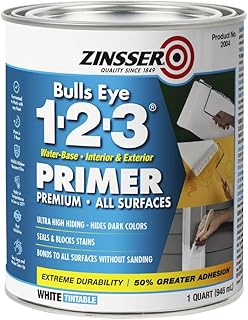
Zinsser Bulls Eye 1-2-3 is a water based all purpose primer that bonds to glossy surfaces without sanding, and it earns its place on a painted drywall accent wall precisely because it handles the sealed paint that mineral primers sometimes struggle with. It is a primer, sealer and stain blocker in one, and the maker lists plaster, concrete, gloss enamels, hardboard, glass and tile among the surfaces it bonds to. On a painted accent wall where the old paint is glossy or where the history of the wall is unknown, this primer gives a reliable grip layer before the plaster system primer goes on, and many applicators use it as the first coat under a quartz primer on slick walls.
- Base: water based modified acrylic primer
- Dry time: touch dry in 30 minutes, recoat in one hour
- Coverage: 400 to 450 square feet per gallon
- Application: brush, roller or spray
- Best for: glossy or sealed painted drywall as a first grip coat
Full adhesion and hardness develop in seven days, which is a point worth planning around: the plaster can go on after the one hour recoat time, but the primer film keeps hardening underneath, so the wall should not be rushed into heavy use. The primer can be tinted to improve hide under darker plaster colors, and it can be thinned with no more than ten fluid ounces of clean water per gallon if needed. It is not meant for floors or for surfaces that stay wet, and it should be topcoated within thirty days. On a painted drywall accent wall, Bulls Eye 1-2-3 is the practical answer to the question of what to do when the old paint is glossy, unknown or lightly chalky, and its fast drying time keeps a one day preparation schedule realistic.
INSL-X Stix
INSL-X Stix is a waterborne bonding primer made from urethane modified acrylic, and it is built for the hardest to coat surfaces, including glossy paints, tile, glass and pre-coated siding. That focus makes it a strong choice for a painted drywall accent wall where the old paint is a hard gloss enamel that has resisted every other primer. It levels to a smooth surface, cleans up with soap and water, and it can be top coated with almost any product, which keeps the door open for the plaster system primer that follows it.
- Base: waterborne urethane modified acrylic primer
- Dry time: touch dry in 30 minutes, recoat in three to four hours
- Coverage: 300 to 400 square feet per gallon
- Application: brush, roller or spray
- Best for: glossy enamel painted drywall that needs a tenacious bond
The primer has a volume solids content of 40 percent, with a wet film thickness of 4.0 to 5.3 mils drying to 1.6 to 2.1 mils, and it hardens at temperatures as low as 35 degrees Fahrenheit, which helps in cool rooms and in shoulder season work. It should not be thinned, and it must be top coated for exterior use, though an interior accent wall has no such concern. Airless sprayers should run at 2,200 to 2,500 PSI with a 0.013 to 0.017 tip, and the primer is ready for a topcoat in three to four hours, with full cure in three to four days. For a painted drywall accent wall where the old paint is a glossy enamel, Stix is the primer that applicators reach for when a standard primer has already failed an adhesion check, and its stated performance on glossy paint is the reason it belongs in this guide.
Sherwin-Williams Extreme Bond Primer
Sherwin-Williams Extreme Bond Primer is a waterborne urethane modified acrylic primer made for hard, slick and glossy surfaces with minimal surface preparation, and the maker states that sanding may not be necessary for most clean, paintable surfaces. That is a useful claim on a painted drywall accent wall, because sanding a whole accent wall is dusty, slow work, and a primer that grips without it saves a full preparation step. It is a one coat primer with a fast dry time, and it accepts high performance coatings such as epoxies and urethanes, which speaks to the strength of the bond it forms.
- Base: waterborne urethane modified acrylic primer
- Dry time: touch dry in 30 minutes, recoat in one hour
- Coverage: 450 to 500 square feet per gallon
- Application: brush, roller or airless spray
- Best for: slick glossy painted drywall with minimal sanding
The primer carries a VOC content under 50 grams per liter, with volume solids of 32 percent, and it is sold in quart, gallon and five gallon sizes. It must be topcoated within fourteen days, and the recoat time stretches to twenty four hours when a high performance finish follows. The maker lists PVC piping, plastics, glass, wall laminates, glossy surfaces, aluminum, kitchen cabinets, fiberglass, varnished woodwork, glazed block, ceramic wall tile, previously painted surfaces and fluoropolymer coatings among its uses, which shows how broad its grip range is. For a painted drywall accent wall where the goal is to move from old glossy paint to a plaster system with as little sanding as possible, Extreme Bond Primer is the primer that states that job most directly on its data sheet, and its coverage of 450 to 500 square feet per gallon makes it economical on a large feature wall.
| Primer | Base and key trait | Coverage per gallon | Dry time |
|---|---|---|---|
| Meoded Quartz Primer | Water based acrylic with fine quartz texture | 300 to 500 square feet | Three to five hours |
| San Marco Marcotherm Primer | Water soluble sealer with quartz sand grains | See product page | About six hours |
| Romabio MicroGrip Primer | Potassium silicate with fine mica | About 280 to 480 square feet | Eight to twelve hours |
| Vasari Mineral Primer | Lime based primer with powdered marble | 240 to 300 square feet | See product page |
| Zinsser Bulls Eye 1-2-3 | Water based modified acrylic bonding primer | 400 to 450 square feet | Recoat in one hour |
| INSL-X Stix | Urethane modified acrylic bonding primer | 300 to 400 square feet | Recoat in three to four hours |
| Sherwin-Williams Extreme Bond Primer | Urethane modified acrylic bonding primer | 450 to 500 square feet | Recoat in one hour |
How to choose
Match the primer to the plaster system first
The first decision is not which primer is strongest in general, but which primer belongs with the plaster you have already chosen. A lime plaster system wants a mineral primer, an acrylic plaster system wants an acrylic or quartz primer, and a silicate finish wants a silicate primer. When the primer and the plaster share a maker, the system has already been matched for absorption, texture and drying order, and the instructions will tell you exactly how long to wait between coats. When they come from different makers, read both data sheets side by side and check three points: the primer must stay breathable enough for the plaster above it, it must leave a fine tooth for trowel work, and it must cure fully before the plaster goes on. A primer that seals the wall completely can trap moisture under a lime plaster, while a primer that stays too absorbent can pull water out of the plaster before it has time to set. Getting this match right is worth more than any single product claim, because it decides how the whole wall behaves.
Read the old paint before you pick a primer
Painted drywall is not one surface. Flat paint is porous and easy to prime, satin and semi gloss paint are sealed and need a bonding primer, and gloss enamel is the hardest of all. Chalky paint, where a finger rubbed across the wall picks up a pale dust, needs a consolidating primer that binds the chalk back to the wall, and a standard bonding primer on chalky paint can peel away with the chalk underneath it. Patches of filler absorb differently from the surrounding paint, so a primer that evens out absorption is worth more on a patched wall than a primer that simply sticks. Take a few minutes to wash a small area, let it dry, and press a strip of masking tape firmly to the paint, then pull it off sharply: if paint comes away with the tape, the wall needs cleaning, a light sanding and a bonding primer, not just a fresh coat of plaster. That small check tells you more about which primer to buy than any label can.
Weigh drying time against the working schedule
Drying time is not a minor detail on an accent wall, because it sets the rhythm of the whole job. A primer that is ready to recoat in one hour lets the applicator prime in the morning and start plastering the same day, which suits a tight schedule and a single room. A primer that needs eight to twelve hours, or a full day, forces an overnight wait, and that wait is not wasted time: the longer drying primers in this guide, such as the silicate and lime based ones, use that time to form a chemical bond that a fast acrylic primer cannot match. Plan the job around the slowest drying product in the system, not the fastest, and keep the room at the temperature the data sheet asks for, because cool air and high humidity stretch every drying time the maker states. A wall that feels dry to the touch is not always ready for plaster, and the recoat time on the data sheet is the number to follow, not the touch dry time.
Common mistakes
The most common mistake on a painted drywall accent wall is skipping the adhesion check and going straight to plaster. The plaster looks fine for the first days, then a corner or an edge starts to lift, and by the time the problem shows, the only repair is to strip the plaster back and start again. A second mistake is using a PVA drywall primer as the only primer under Venetian plaster: PVA seals the wall and gives a smooth paint base, but it leaves no tooth for the trowel, and the plaster can slide and smear instead of gripping. A third mistake is priming over dust, grease or silicone polish without cleaning first; no bonding primer can grip through a layer of contamination, and the failure will follow the dirty patch exactly. Another frequent error is applying the primer too thickly in the hope of building texture faster, which leaves a soft film that stays tacky and can wrinkle under the plaster. Thin, even coats, applied at the coverage the maker states, always beat one heavy coat. Finally, many accent walls fail because the primer was not allowed to cure: the plaster went on while the primer was still soft, and the two layers moved at different rates as they dried. Following the recoat time on the data sheet, and waiting longer in cool or damp rooms, avoids all of these failures for the cost of a little patience.
FAQ
Do I need to sand painted drywall before priming for Venetian plaster?
Flat painted drywall usually needs no sanding, only cleaning and repair, because the paint surface is porous enough for a bonding primer to grip. Satin, semi gloss and gloss paint should be lightly sanded with fine grit paper, then dusted down, because the sheen seals the surface and the primer needs a dull, clean face to bond to. Some high adhesion bonding primers state that sanding may not be necessary on clean, paintable surfaces, but a light sanding never hurts adhesion and it also reveals loose paint that would have failed later. Always sand with the room ventilated and wear a mask, and wipe the wall down after sanding so no dust sits between the primer and the paint.
Can I use a regular drywall primer under Venetian plaster?
A regular PVA drywall primer is made to seal new drywall for paint, not to hold heavy plaster, and it should not be the only primer under Venetian plaster. It can play a useful first role: on new drywall, a PVA primer evens out absorption between the paper face and the joint compound, and then a quartz primer or a mineral primer goes on top to give the plaster its grip. The sequence matters, and the plaster system primer is the layer that must touch the plaster. Skipping that layer and plastering straight over PVA is one of the most common causes of plaster sliding, poor trowel control and weak adhesion on accent walls.
How long should I wait after priming before applying Venetian plaster?
Follow the recoat time on the primer data sheet, because it is measured for that exact product. Fast acrylic bonding primers are ready in one hour, quartz primers for Venetian plaster usually need three to six hours, and silicate primers need eight to twelve hours. Cool air, high humidity and thick application all stretch those times, so wait longer when the room is cold or damp. The wall should feel fully dry and firm, with no cool or tacky patches, before the first plaster coat goes on. Rushing this step is the single most common cause of delamination on painted drywall accent walls.
What is system compatibility in a Venetian plaster build?
System compatibility means the primer, the plaster and the sealer are made to work together, either because they come from the same maker or because their chemistry matches. A lime plaster over a lime based mineral primer is a compatible system, and an acrylic plaster over a quartz acrylic primer is another. Compatibility covers absorption, so the plaster does not dry too fast or too slow, texture, so the trowel has something to grip, and alkalinity, so the primer does not react badly with a high pH lime plaster. When the system is compatible, the maker instructions read as one job with one drying sequence; when it is not, the applicator has to check each of those points by hand.
Should the primer be tinted to match the plaster color?
Tinting the primer to a shade close to the plaster color is good practice on an accent wall, especially in strong or dark colors, because it improves coverage and hides any thin spots in the first plaster coat. Quartz primers and mineral primers can often be tinted, and the maker will state how much colorant the primer accepts. Keep the tint light enough that the primer still reads as a primer: an over tinted primer can change how the plaster absorbs and how the color develops. A primer tinted to roughly the same depth as the finish coat is the usual target, and it saves one full plaster coat on many accent walls.
Conclusion
A painted drywall accent wall rewards the applicator who regards the primer as part of the plaster system, not as an afterthought. The primers in this guide cover the real range of painted drywall: mineral and quartz primers for lime and acrylic plaster systems, silicate primers for a chemical bond under mineral finishes, and high adhesion acrylic bonding primers for glossy or sealed paint that needs a tenacious grip. Match the primer to the plaster first, read the old paint before you buy, and plan the job around the drying time the maker states. Do that, and the plaster will have the firm, even, textured base it needs to hold its polish for years.
Related guides
More from Amazon
Programs that pair well with the guide above. Offers and eligibility are set by Amazon and may change.
Free shipping on eligible items, Prime Video and more. Eligible new members can start with a free trial.
Start a Prime free trialAudiobooks and podcasts to listen to on the go. Eligible new members can start with a free trial.
Try Audible freeAd-free music streaming. Eligible new subscribers can start with a free trial.
Try Music Unlimited freeA free business account with business pricing and bulk-buying tools for work, shop or home office.
Create a business accountAs an Amazon Associate we earn from qualifying purchases.



Write Your Review
No reviews yet. Be the first to share your experience!