
Key takeaways
- Compare portable wheeled air compressors for texture hopper guns that supply pneumatic plaster texture sprayers across rooms and job sites with large tanks.
As an Amazon Associate I earn from qualifying purchases. This post may contain affiliate links at no extra cost to you.
A texture sprayer that stays in one workshop needs a compressor that stays in one place. A texture sprayer that moves from room to room, or from one job site to the next, needs a compressor that moves with it, and the wheels under the tank decide whether that move is a quick roll or a heavy lift. A wheeled tank also changes how the work flows: the compressor sits beside the wall being sprayed, the hose stays short, and the pressure at the gun stays close to the pressure at the regulator, because a short hose loses less pressure than a long one.
The best air compressors for texture hopper guns for supplying pneumatic plaster texture sprayers with portable wheeled tanks all roll on wheels, carry between five and thirty gallons of stored air, and deliver enough airflow at forty pounds per square inch for a hopper gun on small panels and spot work. The seven machines below range from a five gallon Makita that one person wheels across a room to a thirty gallon Husky that rolls across a workshop floor, and each one is judged on how easily it moves, how much air it carries, and how well it keeps a hopper gun spraying evenly.
Best products
California Air Tools 10020C
- Tank capacity: 10 gallons, steel
- Air delivery: 6.4 CFM at 40 PSI, 5.3 CFM at 90 PSI
- Maximum pressure: 125 PSI
- Motor: 2.0 HP
- Noise level: 70 dBA
- Pump: oil-free
- Features: wheels, 70/30 duty cycle
- Best for: the best balance of airflow, tank size, and quiet running
The California Air Tools 10020C leads this roundup because it balances everything a portable texture job needs: six point four cubic feet per minute at forty pounds per square inch, a ten gallon steel tank, wheels, and a seventy decibel noise level. That airflow covers light orange peel and heavier knockdown patterns, the ten gallon tank holds enough air for a run of small panels with short pauses, and the quiet running suits indoor work in occupied buildings. The oil-free pump needs no oil checks, and the wheels make the ten gallon unit easy to move from room to room.
The seventy over thirty duty cycle means the pump is designed to run for seventy minutes out of every hundred, with thirty minutes of rest, so the operator should plan short breaks between panels rather than running the gun without stopping. Used that way, the 10020C gives a quiet, steady supply that suits decorative work in occupied spaces, and it rolls to the next room in seconds when the work moves on.
California Air Tools 8010
- Tank capacity: 8 gallons, steel
- Air delivery: 3.1 CFM at 40 PSI, 2.2 CFM at 90 PSI
- Maximum pressure: 120 PSI
- Motor: 1.0 HP
- Noise level: 60 dB
- Pump: oil-free
- Features: wheels
- Best for: the quietest steel tank machine here
The California Air Tools 8010 is an eight gallon steel machine that runs at sixty decibels, the quietest figure in this roundup alongside its aluminum sibling, and it carries wheels for easy movement across a workshop floor. Three point one cubic feet per minute at forty pounds per square inch suits light orange peel and small panels, sprayed in short bursts with pauses while the tank refills. The oil-free pump needs no oil checks, and the steel tank is a durable, simple design that has served workshops for years.
The eight gallon tank is enough for a small panel or a couple of patches before the motor needs to catch up, and the quiet running makes the 8010 a good match for indoor work where the compressor sits close to the operator. For a plasterer who wants a quiet, wheeled machine for small panels and who does not need the strongest airflow, the 8010 is the simplest quiet choice in this roundup.
California Air Tools 8010A
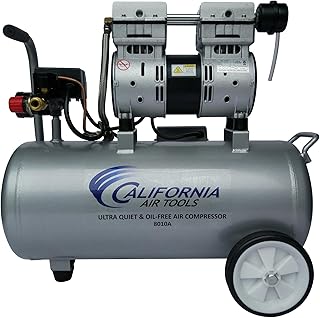
- Tank capacity: 8 gallons, aluminum
- Air delivery: 3.1 CFM at 40 PSI, 2.2 CFM at 90 PSI
- Maximum pressure: 120 PSI
- Motor: 1.0 HP
- Noise level: 60 dB
- Weight: 37.3 lbs
- Pump: oil-free
- Features: wheels
- Best for: the lightest wheeled machine here
The California Air Tools 8010A is the aluminum version of the 8010, with the same eight gallon capacity, the same three point one cubic feet per minute at forty pounds per square inch, and the same sixty decibel noise level, but the aluminum tank brings the weight down to thirty-seven point three pounds. That weight makes the 8010A the lightest wheeled machine in this roundup, easy to lift over a threshold or into a van, and the aluminum tank will not rust the way a steel tank can. The wheels carry the weight across flat ground, and the oil-free pump needs no oil checks.
Three point one cubic feet per minute at forty pounds per square inch suits light orange peel and small panels, sprayed in short bursts with pauses while the tank refills. For a plasterer who carries the compressor up stairs, across lawns, or into vans, the thirty-seven pound weight is the reason to pick the aluminum 8010A over the steel 8010. The two machines are otherwise the same, and the choice comes down to weight and rust resistance.
Husky C201H
- Tank capacity: 20 gallons
- Air delivery: 5.2 SCFM at 40 PSI, 4.0 SCFM at 90 PSI
- Maximum pressure: 175 PSI
- Motor: 1.3 HP
- Weight: 73 lbs
- Pump: oil-free
- Features: wheels, quick connection, seven minute fill from empty
- Best for: a large tank on a light frame
The Husky C201H pairs a twenty gallon tank with five point two cubic feet per minute at forty pounds per square inch, and it does so at seventy-three pounds, which is light for a twenty gallon machine. The wheels carry the weight across a workshop or a driveway, and the seven minute fill from empty means the machine is ready soon after it is switched on. The one hundred seventy-five pound per square inch maximum pressure is the highest in this roundup, and the quick connection fitting lets the hose click on and off without tools.
Five point two cubic feet per minute at forty pounds per square inch covers light orange peel and medium knockdown patterns, and the twenty gallon tank means the gun can run through several panels before the motor needs to work hard. The oil-free pump keeps the routine simple. For a plasterer who wants a large reserve without a heavy machine, and who rolls the compressor from room to room across a big job, the C201H is the lightest way to carry twenty gallons of ready air.
Husky C303H
- Tank capacity: 30 gallons, vertical
- Air delivery: 6.8 SCFM at 40 PSI, 5.1 SCFM at 90 PSI
- Maximum pressure: 175 PSI
- Pump: oil-free
- Power: 120 volt, 15 amp
- Features: wheels
- Best for: the largest wheeled tank in this roundup
The Husky C303H is the largest machine in this roundup, with a thirty gallon vertical tank and six point eight cubic feet per minute at forty pounds per square inch, the second strongest airflow here. The vertical tank takes up little floor space, the oil-free pump removes oil changes from the routine, and the one hundred seventy-five pound per square inch maximum pressure leaves plenty of headroom above the twenty-five to fifty pound per square inch range a hopper gun uses. The wheels let the unit roll across a workshop floor, though at thirty gallons it is a machine to roll rather than lift.
A thirty gallon tank is the size that workshop guides call a realistic minimum for multi-room or ceiling work, and for small decorative panels it means the motor spends most of its time resting while the gun works. The six point eight cubic feet per minute at forty pounds per square inch covers the full range of patterns, from light orange peel to heavy knockdown. For a plasterer who sprays panels in batches and wants the largest wheeled reserve in this roundup, the C303H is the natural pick.
Stealth SAQ-12018
- Tank capacity: 20 gallons
- Air delivery: 6.0 CFM at 40 PSI, 5.0 CFM at 90 PSI
- Maximum pressure: 150 PSI, cut-out
- Motor: 1.8 HP
- Noise level: 68 dB
- Weight: 121 lbs
- Pump: oil-free
- Features: eight inch rubber wheels, two quick couplers
- Best for: the quietest twenty gallon option with the biggest wheels
The Stealth SAQ-12018 delivers six cubic feet per minute at forty pounds per square inch from a twenty gallon tank at sixty-eight decibels, the lowest noise figure among the large machines in this roundup. The eight inch rubber wheels are the largest in this roundup, and they roll over workshop floors, across thresholds, and over rough ground without catching, which matters when the compressor moves between rooms on a job site. The two quick couplers let the gun hose stay connected alongside a second hose, and the oil-free pump keeps maintenance to draining the tank and cleaning the intake filter.
At one hundred twenty-one pounds the Stealth is heavy, and the wheels are part of the design rather than an accessory. Six cubic feet per minute at forty pounds per square inch sits right at the lower edge of the range for heavier knockdown patterns, so the Stealth suits orange peel and light to medium knockdown better than heavy popcorn work. For small decorative panels, where the gun runs in short passes, the twenty gallon tank covers the work with room to spare, and the quiet running and large wheels make it the easiest twenty gallon machine here to live with.
Makita MAC5200
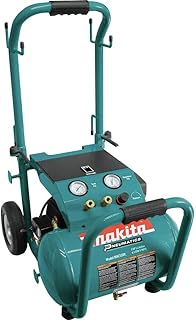
- Tank capacity: 5.2 gallons
- Air delivery: 6.9 CFM at 40 PSI, 6.5 CFM at 90 PSI
- Maximum pressure: 140 PSI
- Motor: 3.0 HP, 2.1 HP running
- Weight: 88 lbs net
- Pump: oil-lubricated
- Features: wheels and folding handle, two 1/4 in. universal quick couplers included
- Best for: the strongest airflow in the smallest wheeled package
The Makita MAC5200 packs six point nine cubic feet per minute at forty pounds per square inch, the strongest airflow in this roundup, into a five point two gallon machine that one person can wheel across a room. The folding handle and wheels make it easy to move between a mixing table and a spraying area, and the two included universal quick couplers mean the hose connects straight to the gun without a trip to buy fittings. The Big Bore pump is the reason for the strong airflow, moving more air per stroke than the small pancake pumps.
The small tank is the limit to respect. Five point two gallons empties fast under a gun that draws six to seven cubic feet per minute, so the motor runs often and the operator should spray in short passes with brief pauses while pressure recovers. For a single small panel at a time, with pauses to reload the hopper and check the pattern, the MAC5200 keeps up, and it moves more easily than any other machine here with the same airflow. For back-to-back panels without a break, a larger tank from this roundup will serve better.
| Compressor | Tank | CFM at 40 PSI | Best for |
|---|---|---|---|
| California Air Tools 10020C | 10 gal | 6.4 | Best balance of airflow and quiet |
| California Air Tools 8010 | 8 gal | 3.1 | Quietest steel tank machine |
| California Air Tools 8010A | 8 gal | 3.1 | Lightest wheeled machine |
| Husky C201H | 20 gal | 5.2 | Large tank on a light frame |
| Husky C303H | 30 gal | 6.8 | Largest wheeled tank |
| Stealth SAQ-12018 | 20 gal | 6.0 | Quietest twenty gallon, big wheels |
| Makita MAC5200 | 5.2 gal | 6.9 | Strongest airflow, smallest package |
How to choose
Wheel size decides where the machine can go
Wheels look the same in a listing, but their size decides whether the compressor rolls over a threshold or catches on it. The Stealth SAQ-12018 carries eight inch rubber wheels, the largest in this roundup, and they roll over rough ground and across doorways without catching. Smaller wheels suit flat workshop floors and struggle on gravel, grass, or uneven site ground. Before buying, think about the worst surface the compressor will cross, not the best one, and pick the wheel size that handles it.
Balance tank size against the distance the machine travels
A thirty gallon tank holds more air, but it also weighs more and moves more slowly. The Husky C303H carries thirty gallons and rolls across a workshop floor, while the Makita MAC5200 carries five point two gallons and wheels across a room with one hand. For work that stays in one room, a large tank is the better pick, because the motor rests more and the pattern stays steady. For work that moves from room to room or site to site, a smaller, lighter machine that rolls easily is the better pick, even if the tank refills more often.
Keep the hose short by keeping the compressor close
A wheeled compressor earns its keep by sitting beside the wall being sprayed, which keeps the hose short. A short hose loses less pressure between the compressor and the gun, so the gauge at the compressor and the pressure at the gun stay close together. A long hose drops pressure, tangles across fresh work, and pulls the gun off line. The wheels are what make the short hose possible, so roll the compressor to the work instead of stretching the hose to it.
Match the airflow to the pattern, not the tank
Tank size and airflow solve different problems. The tank decides how long the gun sprays before the motor has to catch up, and the airflow decides whether the gun keeps its pattern while it sprays. A large tank with a weak pump still starves the gun, because the tank empties faster than the pump refills it. Read the forty pound per square inch figure first, and treat six cubic feet per minute at that pressure as the mark for knockdown work. Light orange peel needs four to six cubic feet per minute, while heavier knockdown and popcorn patterns need six to nine.
Common mistakes
The most common mistake is buying the largest tank and ignoring the wheels. A thirty gallon machine with small, hard wheels is hard to move across a threshold or over rough ground, and it ends up parked in one place while the operator stretches a long hose to the work. The long hose drops pressure, and the pattern suffers. The fix is to check the wheel size and the handle before the tank size, and to pick a machine that rolls easily over the worst surface on the job.
A second mistake is running the regulator too high. More pressure does not mean a better pattern, and running a hopper gun at sixty or seventy pounds per square inch blows the texture thin, throws material past the panel, and fills the air with overspray. The working band is twenty-five to fifty pounds per square inch, and the right setting is found by spraying a scrap panel and adjusting in small steps until the pattern looks even.
A third mistake is skipping the water drain. Compressors condense water inside the tank, and that water travels down the hose into the gun, where it thins the mix and leaves pale spots in the texture. Draining the tank at the end of every spraying day takes a minute and keeps the air dry. A small inline filter near the gun adds a second layer of protection on damp days.
A fourth mistake is lifting a wheeled compressor instead of rolling it. A twenty or thirty gallon machine weighs over a hundred pounds, and lifting it strains backs and risks a dropped machine. The wheels and handle are there for a reason, and a ramp or a second pair of hands beats a lift every time. For stairs, a lighter machine like the thirty-seven pound California Air Tools 8010A is the better pick.
A fifth mistake is spraying a full panel without a scrap panel check. Mix thickness, nozzle size, air pressure, and gun distance all interact, and a change in any one of them shifts the pattern. A scrap panel the same size as the work panel, sprayed with the same mix and the same settings, shows the pattern before the real panel is committed, and it takes only a minute to run.
FAQ
What size wheeled compressor is best for a texture hopper gun?
The best size depends on the work. A ten to fifteen gallon wheeled machine suits small panels and spot work, giving several passes per fill without the weight of a thirty gallon unit. A twenty to thirty gallon wheeled machine suits batches of panels or multi-room work, where the motor rests more and the pattern stays steady. The machines in this roundup run from five point two to thirty gallons, and the right pick depends on how many panels run in a row and how far the machine travels.
Do bigger wheels really make a difference?
Bigger wheels make a real difference on rough ground. The Stealth SAQ-12018 carries eight inch rubber wheels, the largest in this roundup, and they roll over thresholds, gravel, and uneven site ground without catching. Small wheels suit flat workshop floors and catch on anything rougher. If the compressor moves between rooms or across a yard, the wheel size deserves as much attention as the tank size.
How much air does a hopper gun need at forty pounds per square inch?
A common hopper gun needs four to ten cubic feet per minute at forty pounds per square inch, depending on the pattern. Light orange peel work runs on four to six cubic feet per minute, while heavier knockdown and popcorn patterns need six to nine. A compressor that delivers at least six cubic feet per minute at forty pounds per square inch covers the full range for small panels, and the California Air Tools 10020C, Husky C303H, Stealth SAQ-12018, and Makita MAC5200 in this roundup all meet that mark.
Can a wheeled compressor be used on stairs?
A wheeled compressor can be carried up stairs, but the weight matters. The California Air Tools 8010A weighs thirty-seven point three pounds and carries easily, while the Stealth SAQ-12018 weighs one hundred twenty-one pounds and needs two people or a ramp. For work on upper floors, a lighter machine is the better pick, and the wheels still help once the machine is on the flat.
Is an oil-free pump better for texture work?
An oil-free pump removes oil changes from the routine and removes any chance of oil mist reaching the air line, which is a small but real benefit when the air carries a plaster mix onto a decorative surface. Six of the seven machines in this roundup use oil-free pumps. The Makita MAC5200 uses an oil-lubricated pump, which runs cooler and often lasts longer under heavy use, but it needs its oil level watched.
How do I keep a wheeled compressor rolling smoothly?
Keep the wheels clean, check the tyre pressure on pneumatic wheels, and oil the axle bearings now and then. A wheel that drags or wobbles makes the machine hard to move and puts strain on the handle. Storing the compressor with the wheels off the ground on damp floors also keeps the bearings dry and the rubber in good shape.
Conclusion
A wheeled tank turns a compressor from a fixed machine into a working partner that follows the sprayer from room to room, and the machines in this roundup cover every size of that job. The California Air Tools 10020C leads on balance, with six point four cubic feet per minute at forty pounds per square inch, a ten gallon tank, and seventy decibel running. The Husky C303H leads on capacity at thirty gallons, the Stealth SAQ-12018 leads on quiet running and wheel size, and the Makita MAC5200 leads on airflow in the smallest package. For light, easy carrying, the California Air Tools 8010A at thirty-seven pounds is the pick, and the Husky C201H carries twenty gallons on the lightest frame here. Pick the tank that matches the run of panels, the wheels that match the ground, and the airflow that matches the pattern, and the compressor will be beside the work whenever the gun is.
Related guides
More from Amazon
Programs that pair well with the guide above. Offers and eligibility are set by Amazon and may change.
Free shipping on eligible items, Prime Video and more. Eligible new members can start with a free trial.
Start a Prime free trialAudiobooks and podcasts to listen to on the go. Eligible new members can start with a free trial.
Try Audible freeAd-free music streaming. Eligible new subscribers can start with a free trial.
Try Music Unlimited freeA free business account with business pricing and bulk-buying tools for work, shop or home office.
Create a business accountAs an Amazon Associate we earn from qualifying purchases.
More ways to save on your next finish
Programs that pair well with the guide above. Offers and eligibility are set by Amazon and may change.
A free business account with business pricing and bulk-buying tools for work, shop or home office.
Create a business accountFast, free shipping on eligible items, plus Prime Video and more. Eligible new members can start with a free trial.
Start a Prime free trialRead from a huge library of eBooks, including how-to guides and cookbooks. Eligible new members can start with a free trial.
Try Kindle UnlimitedAudiobooks and podcasts for the commute, the garage or the kitchen. Eligible new members can start with a free trial.
Try Audible freeAs an Amazon Associate we earn from qualifying purchases. Using these links costs you nothing extra.



Write Your Review
No reviews yet. Be the first to share your experience!