
Key takeaways
- Are quartz grit plaster primers a sound buy this Black Friday? Seven grit primers weighed for Venetian plaster, lime finishes and stucco, with a clear verdict.
What's inside
As an Amazon Associate I earn from qualifying purchases. This post may contain affiliate links at no extra cost to you.
Every decorative plaster job begins with a question that is easy to overlook: what is the plaster going to hold onto? A polished Venetian coat, a smooth lime finish, or a fine marmorino layer all need a base with bite, and a bare sheet of drywall, a painted wall, or a smooth concrete face gives them almost none. A quartz grit primer answers that question. It is a liquid coat carrying fine mineral aggregate, and it dries to a lightly abrasive surface that a trowel coat can grip mechanically. Without it, plaster can drag under the trowel, dry unevenly, or come away from the wall in time.
Are quartz grit plaster primers worth buying on black friday is therefore a practical question rather than a shopping question, and the short answer is yes, provided the primer matches the plaster that will cover it. A fine quartz primer under a polished Venetian coat is money well spent. A coarse grit primer under that same polished coat is a mistake, however low its tag. The seven primers in this guide were each checked against the maker's own data sheet or product page, and every figure quoted here comes from those documents, so the verdict at the end rests on published facts rather than on habit or brand loyalty.
The sale weekend suits primer buying for a simple reason: primer is a consumable, and a single project often needs several containers. A room of Venetian plaster, a tadelakt bathroom, or a full facade of render can take far more primer than a first estimate suggests, and primer keeps for months when it is sealed and kept frost-free. Stocking up during the event covers the next two or three jobs, but only when the primer in the container is the right one for the plaster above it. Grain size is the deciding factor, and this guide states the grain of every product it lists.
Quick verdict
Yes, with one condition: buy the grain that matches the finish. For polished Venetian plaster and smooth lime finishes, the Stucco Italiano Quartz Primer is the strongest pick in this guide, with a medium-grit acrylic formula, a stated consumption of 160 to 170 ml per sq m, and a 24 month shelf life. For exterior render systems, the Baumit UniPrimer is the sound choice, a quartz-filled primer made for mineral renders with a consumption of 0.2 to 0.25 kg per sq m on base coats. For renovation work over an old coating, the KEIM Soldalit Fixativ gives a silicate base that bonds chemically with mineral surfaces.
Readers who want a single primer for a mixed job should weigh the SikaWall-15 Tinted Primer, which colours the base toward the finish, or the Larsen Weld-Crete, a PVA bonding agent with published bond figures for cement plaster on concrete. The Zinsser Bulls Eye 1-2-3 completes the set as a fast-drying first coat over walls that mix old paint with bare plaster. Buy during the event when the primer fits the plaster, the wall area has been measured, and the container count covers the job; skip the purchase when the grain is wrong, however tempting the offer.
| Product | Key spec | Best for |
|---|---|---|
| Stucco Italiano Quartz Primer | Medium grit; 160 to 170 ml per sq m; 5 L and 15 L | Smooth lime and Venetian plaster finishes |
| Baumit UniPrimer | Quartz sand; 0.2 to 0.25 kg per sq m; solids about 58 percent | Exterior mineral render systems |
| Sto-Primer | Filled undercoat; grain 500 µm; 0.30 kg per sq m | Render base coats under finishing renders |
| KEIM Soldalit Fixativ | Silica sol and water glass; pH about 11; 0.15 L per sq m | Silicate priming on mineral substrates |
| SikaWall-15 Tinted Primer | 100 percent acrylic, tinted; 150 to 250 sq ft per gal | Under acrylic stucco finishes, colour-matched base |
| Larsen Weld-Crete | PVA bonding agent; 200 to 300 sq ft per gal; 615 psi bond | Cement plaster over sound concrete |
| Zinsser Bulls Eye 1-2-3 | Styrenated acrylic; 400 to 450 sq ft per gal; topcoat in 1 hr | Fast priming over mixed old paint and bare plaster |
How we chose
Each primer below was checked against a document the maker publishes: a technical data sheet or a product page that states the grain or aggregate, the coverage, and the drying time. A product entered this guide only when all three figures could be read from such a document. Anything sold on a bare claim, without a published grain size or a stated consumption, was left out, because the grain is the whole point of a quartz grit primer.
The seven products were chosen to cover the real spread of the category. One is a medium-grit acrylic primer made for lime and Venetian plaster, one is a quartz-filled primer for exterior renders, one is a filled undercoat with a stated 500 µm grain, one is a silicate fixative that primes by chemical bond, and the last three are acrylic and PVA primers that sit under stucco and plaster systems. Coverage figures are quoted exactly as the maker states them, and drying times are quoted at the maker's stated temperature, since a primer overcoated too early can soften under the next coat.
The verdict in this guide follows the same rule in every section: the primer is judged against the plaster it must carry. A primer that is too coarse under a polished coat will show through, and a primer that is too fine under a heavy render will not hold it. That is why the notes under each product state the plaster it suits, the grain it carries, and the waiting time before the next coat.
Stucco Italiano Quartz Primer
- Medium-grit acrylic undercoat for decorative lime and cement plasters
- Composition of special acrylic polymers, very fine quartz sand, additives and water
- Consumption 160 to 170 ml per sq m undiluted
- Touch dry 2 hours at 20 C; dry below the surface in 24 hours
- Dilute up to 15 percent with water; apply between 8 C and 35 C
- Packaging 5 L and 15 L; shelf life 24 months
The Stucco Italiano Quartz Primer leads this guide because it is the most direct answer to the question it asks. It is a medium-grit, acrylic-based undercoat, made as the complementary primer for the maker's lime and cement-based plasters, and its data sheet states the exceptions plainly: fine marmorino, metallic marmorino and grassello need a finer-grained primer instead. That honesty is useful. It tells the reader exactly where this primer belongs and where it does not.
The figures are complete. Consumption is 160 to 170 ml per sq m of undiluted product, the coat is touch dry in 2 hours at 20 C and dry below the surface in 24 hours, and the product can be diluted by up to 15 percent with water, with frequent mixing so the quartz sand does not settle. Application is by roller, on vertical surfaces inside and outside, at temperatures from 8 C to 35 C and relative humidity under about 85 percent. Packaging is 5 L and 15 L, and the shelf life is 24 months in the original sealed packaging, stored between 5 C and 35 C in a dry, dark place.
Pros: Made for lime and cement plasters; stated grain and consumption leave no guessing; clear statement of which finishes need a finer primer instead; two-year shelf life.
Cons: Medium grit is too coarse for fine marmorino and polished grassello; the quartz settles and needs mixing during dilution and application.
Baumit UniPrimer
- Ready-to-use quartz-filled aqueous primer for mineral renders
- Composition of organic binder, quartz sand, silicone additives, filler, water and pigment
- Consumption about 0.2 to 0.25 kg per sq m on base coats; 0.4 kg per sq m on render coats
- Solids content about 58 percent; pH about 8.5; density about 1.65 kg per cubic decimetre
- Dilute with up to 5 percent water if needed; apply above 5 C
- Containers 5 kg and 25 kg; shelf life 12 months
Baumit UniPrimer is the exterior render primer of this set, and it is built for that job from the composition up. The maker lists its contents as organic binder, quartz sand, silicone-containing additives, filler, water and pigment, and describes it as a ready-to-use, solvent-free primer that regulates absorption and improves adhesion for all Baumit render finishes. It is used as part of Baumit external wall insulation systems, and it suits absorbent mineral plasters and renders and other chalk or cement-bound materials that are solid, load-bearing, clean and dry.
Consumption is about 0.2 to 0.25 kg per sq m on base coats and about 0.4 kg per sq m on render coats, which works out to roughly 100 to 125 sq m per 25 kg bucket on base coats and 20 to 25 sq m per 5 kg bucket. The substrate must be pre-treated at least 24 hours before the topcoat render goes on. Dilution is limited to 5 percent water, and the air, material and background temperature must stay above 5 C during application and drying, and below 30 C. Storage is 12 months in unopened buckets, cool but not under 5 C, and an opened bucket should be closed at once and used within 4 weeks.
Pros: Quartz sand gives a real mechanical key for renders; clear consumption figures for base and render coats; regulates suction without blocking vapour diffusion; part of a full render system.
Cons: A 24 hour wait before the topcoat slows the job; exterior render is its home, so it is not the pick for fine interior Venetian work; opened buckets must be used within 4 weeks.
Sto-Primer
- Filled, pigmented, organic undercoat for mineral and organic substrates
- Density 1.4 to 1.6 g per cubic centimetre; grain size 500 µm
- Consumption about 0.30 kg per sq m as an intermediate coat
- Overcoatable after about 12 hours at 20 C and 65 percent relative humidity
- Dilute with up to 10 percent water; apply between 5 C and 30 C
- Vapour diffusion resistance 0.21 to 0.32 m
Sto-Primer is the measured, middle-of-the-road undercoat in this guide. It is a filled, pigmented, organic undercoat for exterior use on mineral and organic substrates, made for organic and silicone resin renders, modified mineral renders, dispersion silicate renders, and finishing renders with Lotus-Effect technology. Its grain size is stated as 500 µm, which places it between the fine quartz primers for polished work and the coarse bonding coats for renovation, and its density of 1.4 to 1.6 g per cubic centimetre reflects the heavy mineral filling.
Application follows a clear sequence. Strongly absorbent substrates are primed first with a StoPlex W or StoPrim Micro product, then Sto-Primer goes on as the intermediate coat in the colour shade of the finish, and the finishing render follows. Consumption as an intermediate coat is about 0.30 kg per sq m. The product is ready to use and may be diluted with up to 10 percent water, or 5 percent where calcium carbonate efflorescence from mineral substrates must be held back. At 20 C and 65 percent relative humidity it is overcoatable after about 12 hours. Application temperatures run from 5 C to 30 C, and in damp and cold weather the maker points to its QS variants instead.
Pros: Stated 500 µm grain gives a known key; pigmented to the finish colour; regulates absorption and prolongs the open time of the render; alkali-resistant and vapour permeable.
Cons: Only weather-resistant to a limited extent without a finish, so it must be overcoated; the two-stage preparation adds a step on very absorbent walls; exterior render is its field, not polished interior plaster.
KEIM Soldalit Fixativ
- Silicate primer and diluent based on silica sol and water glass
- Density 1.0 to 1.1 g per cubic centimetre; pH about 11; organic content 5 percent or less
- Consumption about 0.15 L per sq m as a primer; apply undiluted
- Apply at 5 C or above; containers 5 L and 20 L; shelf life 12 months
KEIM Soldalit Fixativ primes by chemistry rather than by grit, and that is why it belongs in a quartz grit roundup: it is the silicate answer to the same problem, used where a mineral finish must bond with a mineral wall. It is a mixture of silica sol and water glass, with an organic content of 5 percent or less, a pH near 11, and a density of 1.0 to 1.1 g per cubic centimetre. As a primer it is applied undiluted, at a consumption of about 0.15 L per sq m, and it also serves as the diluent for KEIM Soldalit silicate paint.
The primer works by silicification: the water glass reacts with the mineral substrate and forms an inseparable bond, rather than sitting on the surface as a film. That is why the coat stays highly breathable, with a vapour diffusion resistance that the wider KEIM silicate family states at sd 0.02 m or less, and why it will not peel from trapped moisture. The minimum application temperature is 5 C, containers are 5 L and 20 L, and the shelf life is about 12 months in a sealed container kept cool and frost-free.
Pros: Chemical bond with mineral substrates, not a surface film; very low consumption per sq m; doubles as a diluent for the silicate finish; highly breathable.
Cons: Carries no aggregate, so it gives no mechanical key on smooth non-mineral surfaces; tied to silicate finishes; alkaline, so skin and glass nearby need protection.
SikaWall-15 Tinted Primer
- 100 percent acrylic tinted primer for stucco finishes
- Coverage 750 to 1,250 sq ft per 5 gallon pail; 150 to 250 sq ft per gallon
- Dry at least 24 hours before the finish coat
- Apply by sprayer, roller or brush; tint to match the finish colour
SikaWall-15 earns its place as the colour-matched option. It is a 100 percent acrylic primer, tinted, made to sit under SikaWall acrylic stucco finishes. The tint is its real advantage: because the primer carries colour toward the finish, a thin spot or a small chip in the top coat is far less visible than it would be over a white primer, and the finish colour reads more evenly across the wall.
Coverage is 750 to 1,250 sq ft per 5 gallon pail, or 150 to 250 sq ft per gallon, by sprayer, roller or brush. The maker states a minimum drying time of 24 hours before the finish goes on, which is longer than the fast acrylics in this set and worth planning around. It is part of a system: the primer prepares conventional stucco, SikaWall base coats, poured concrete and unit masonry for the finish, evening out suction so the top coat dries at one rate across the wall.
Pros: Tinted base hides thin spots and evens the finish colour; solid coverage per pail; made for the full stucco system.
Cons: Needs a full day before the finish coat; tied to acrylic stucco finishes rather than lime plaster; tint choice must be settled before ordering.
Larsen Weld-Crete
- PVA homopolymer bonding agent for cement plaster and stucco
- Coverage 200 to 300 sq ft per gallon
- Tensile bond 615 psi average at 28 days per ASTM C932; shear 740 psi
- Blue film shows where it has been applied; dry about 1 hour
- Interior and exterior use; freeze-thaw stable for 5 cycles
Larsen Weld-Crete has been on the market for decades, and its figures are the most thoroughly stated of any bonding agent in this guide. It is a PVA homopolymer bonding agent that joins Portland cement plaster and stucco to sound concrete, and the maker publishes bond figures from laboratory measurement: an average tensile bond of 615 psi at 28 days under ASTM C932, flexural strength of 603 psi, and shear of 740 psi. Coverage runs 200 to 300 sq ft per gallon, and the blue film it leaves makes it easy to see which areas have been coated and which have been missed.
The product is a bonding agent rather than a grit primer in the strict sense: it carries no quartz aggregate, and its bond is chemical and adhesive rather than mechanical. It belongs in this roundup because the job it does is the same job a quartz grit primer does on concrete: it makes plaster stick to a surface that would otherwise reject it. It dries in about an hour, it can be used inside and outside, and it stays stable through 5 freeze-thaw cycles. The maker lists packaging from quarts through 55 gallon drums, so it scales from a patch repair to a commercial job.
Pros: Published bond figures from standard measurement; visible blue film shows missed spots; fast drying; interior and exterior use.
Cons: No aggregate, so it gives no mechanical key on very smooth surfaces; must go onto sound concrete, not over loose or powdery material.
Zinsser Bulls Eye 1-2-3
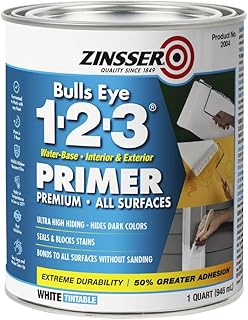
- Water-based styrenated acrylic primer-sealer
- Coverage 400 to 450 sq ft per gallon; about 350 sq ft per gallon on porous surfaces
- Touch dry 30 to 35 minutes; topcoat in 1 hour; full hardness 7 days
- Alkali resistant to pH 12.5; apply between 35 F and 90 F
- Sizes 1 quart, 1 gallon and 5 gallon
Zinsser Bulls Eye 1-2-3 is the fast generalist of the set. It is a water-based styrenated acrylic primer-sealer that bonds to glossy surfaces without scuff sanding, and its alkali tolerance to pH 12.5 makes it suitable over fresh masonry and plaster that would lift an ordinary primer. Coverage is 400 to 450 sq ft per gallon on smooth surfaces and about 350 sq ft per gallon on porous ones, which is the widest coverage in this roundup.
Speed is its main selling point. Touch dry time is 30 to 35 minutes, the next coat can go on after 1 hour, and full hardness arrives in 7 days. Application temperatures run from 35 F to 90 F, with relative humidity under 85 percent. For a plaster job, its role is the preparatory coat over a mixed wall: patches of old paint beside bare plaster, or a wall that has been repaired in several places and needs one even base before the primer that carries the grit goes on. It is not a grit primer itself, and it should not be mistaken for one, but as the first coat in a two-coat preparation it earns its place.
Pros: Fastest recoat time in this guide; bonds glossy surfaces without sanding; high alkali tolerance for fresh masonry; widest coverage per gallon.
Cons: Carries no aggregate, so it gives no mechanical key on its own; needs a grit primer over it where the plaster needs a toothed surface.
Buying guide
Start with the plaster, not the primer. A polished Venetian coat needs a fine or medium quartz primer, because a coarse grit will print through the polished surface and spoil the finish. A medium lime plaster or a rustic stucco needs a medium grit, because a fine primer will not give a heavy coat enough to hold. A render coat over concrete needs a bonding primer with silica aggregate or a PVA bonding agent, because the render is thick and heavy and the wall beneath it is dense. Match the grain to the coat above it first, and the rest of the choice follows.
Check the substrate next. Bare drywall, fresh plaster, old paint and bare concrete each ask for a different primer. A silicate fixative such as KEIM Soldalit Fixativ is the answer where a mineral finish must bond with a mineral wall. A PVA bonding agent such as Weld-Crete is the answer where sound concrete must carry cement plaster. A tinted acrylic primer is the answer where an acrylic stucco finish must read evenly. Where the wall is a mix of old paint and bare patches, a fast primer-sealer first, then the grit primer, is the sound sequence.
Read the drying time before planning the day. The fast acrylics in this guide allow a topcoat in 1 hour, while the silicate and tinted primers ask for 12 to 24 hours. A primer that is overcoated too early can soften, and a primer that is left too long can collect dust that breaks the bond. The maker's stated temperature range matters too: most of these primers need the air and the wall above 40 F or 5 C, and several should not be applied in direct sun or onto a sun-heated wall.
Work out how much primer the job needs before ordering. Measure the wall area, then divide by the coverage the maker states for the surface in question, remembering that a porous or rough surface takes far more primer than a smooth one. A primer that states 200 to 320 sq ft per gallon on ordinary surfaces may cover only about 80 sq ft per gallon on porous rough stucco, so the arithmetic must use the figure for the actual wall. Order a little more than the calculation suggests, since running out halfway across a wall leaves a visible line where the fresh primer meets the dry edge.
Stir a quartz primer often. The aggregate is heavier than the liquid, and it settles to the bottom of the container while the work goes on. A primer applied from the top of an unstirred container can go on almost grit-free, which defeats its purpose, while the last of the container can go on far too thick. Stir at regular intervals, keep a wet edge, and do not stretch the primer further than the maker states in an effort to cover more wall.
Storage is simple but not optional. Keep containers sealed, cool and frost-free. Most of the primers here carry a shelf life of 12 to 36 months unopened, and an opened container should be closed at once and used within a few weeks. A primer that has frozen, skinned over, or developed a sour smell should not be used, however much is left in the container.
During a sale event, the decision rule is plain. Buy when the primer fits the plaster, when the wall area is measured, and when the container count covers the job with a little to spare. Skip the purchase when the grain is wrong, when the primer belongs to a system the reader does not own, or when the container would sit unopened past its shelf life. A primer bought on those terms is a sound purchase at any time of year, and the event simply lowers the outlay.
FAQ
What does a quartz grit primer actually do?
It lays a thin coat of fine mineral aggregate on a smooth or slick surface, so the plaster above it has something to grip. The aggregate dries to a lightly abrasive texture, similar to fine sandpaper, and the plaster locks onto that texture mechanically. It also evens out suction, so the plaster dries at one rate across the wall instead of drying fast over thirsty patches and slow over sealed ones.
Can a quartz grit primer go over old paint?
It depends on the primer and the paint. A silicate bonding coat is made to bridge sound existing organic coatings, and a fast acrylic primer-sealer can prepare a mixed wall first. A plain quartz acrylic primer should go onto a clean, sound surface, and any loose, flaking or powdery paint should be removed before priming. When in doubt, a small sample panel on an inconspicuous area shows whether the bond holds.
How long must a quartz grit primer dry before plastering?
It varies by product. The acrylic quartz primers in this guide are touch dry in 30 minutes to 2 hours and fully dry in 24 hours. The KEIM silicate fixative needs the wall to be dry before the finish, and the SikaWall tinted primer needs at least 24 hours before the finish. The maker's data sheet states the figure for its own product, and that figure is the one to follow.
Is a fine or a medium quartz primer better for Venetian plaster?
Fine, for a polished Venetian coat. The fine aggregate gives a key that will not show through the polished surface. A medium aggregate is the better choice for medium lime plaster, rustic stucco and heavier decorative coats, where a fine key would not hold the weight. Using the medium grade under a polished coat risks a visible texture in the finish, so the grade should be matched to the coat.
Do quartz grit primers work outside?
Some do and some do not. The Baumit UniPrimer and the KEIM silicate products are made for exterior render systems, and the SikaWall primers sit under exterior stucco. The artSparx quartz primers are aimed at interior decorative plaster. The maker's stated field of application is the guide: if the data sheet lists exterior use, the primer is made for it, and if it does not, it should stay inside.
Should a reader buy several containers during the sale?
Yes, when the job is measured and the primer matches the plaster. Primer is a consumable, a single project often needs several containers, and an unopened container keeps for 12 to 36 months when sealed and frost-free. The purchase is a poor one only when the grain is wrong for the finish, when the primer belongs to a system the reader does not own, or when the container would sit past its shelf life.
Conclusion
The answer is yes, with the grain as the deciding factor. A quartz grit primer is worth buying during the sale weekend when it matches the plaster above it: the Stucco Italiano Quartz Primer for smooth lime and Venetian finishes, the Baumit UniPrimer for exterior renders, the Sto-Primer for render base coats, and the KEIM Soldalit Fixativ where a mineral finish must bond with a mineral wall. The SikaWall-15 adds a tinted base under acrylic stucco, the Larsen Weld-Crete brings published bond figures to cement plaster on concrete, and the Zinsser Bulls Eye 1-2-3 gives a fast first coat over a mixed wall.
Buy when the primer fits the plaster, the wall area is measured, and the container count covers the job. Skip the purchase when the grain is wrong or the primer belongs to a system the reader does not own. On those terms, the primer is a sound buy at any time of year, and the sale weekend simply lowers the outlay for a product the job genuinely needs.
Related guides
More from Amazon
Programs that pair well with the guide above. Offers and eligibility are set by Amazon and may change.
Send a Prime gift membership to someone who would use free shipping and Prime Video.
Gift Amazon PrimeGive audiobooks to someone who loves to listen. Plans and prices are set by Amazon.
Gift AudibleFree shipping on eligible items, Prime Video and more. Eligible new members can start with a free trial.
Start a Prime free trialAudiobooks and podcasts to listen to on the go. Eligible new members can start with a free trial.
Try Audible freeAs an Amazon Associate we earn from qualifying purchases.
More ways to save on your next finish
Programs that pair well with the guide above. Offers and eligibility are set by Amazon and may change.
A free business account with business pricing and bulk-buying tools for work, shop or home office.
Create a business accountFast, free shipping on eligible items, plus Prime Video and more. Eligible new members can start with a free trial.
Start a Prime free trialRead from a huge library of eBooks, including how-to guides and cookbooks. Eligible new members can start with a free trial.
Try Kindle UnlimitedAudiobooks and podcasts for the commute, the garage or the kitchen. Eligible new members can start with a free trial.
Try Audible freeAs an Amazon Associate we earn from qualifying purchases. Using these links costs you nothing extra.










Write Your Review
No reviews yet. Be the first to share your experience!