
Key takeaways
- Compare air compressors for texture hopper guns on small decorative panels, with quick-connect hose fittings, portable steel tanks and CFM matched to each gun.
As an Amazon Associate I earn from qualifying purchases. This post may contain affiliate links at no extra cost to you.
Our top picks at a glance
6 products from this guide, in the order reviewed below.
As an Amazon Associate we earn from qualifying purchases. Prices and availability can change.
A small decorative texture panel is a different job from a whole wall. The panel is a single board or a small section of wall, the spray run lasts a minute or two, and the gun is used in short bursts with pauses while the panel is checked, turned, and set aside. That rhythm changes what the compressor has to do. It does not need a huge tank or a pump that runs all day. It needs to be light enough to carry into a tight room, quiet enough to run beside a workbench, and ready to spray the moment the panel is in place. The best air compressors for texture hopper guns for spraying small decorative texture panels with quick connect air hose fittings are the light, portable machines that snap onto a hose in seconds, deliver enough air for a short spray run, and refill while the next panel is prepared.
Quick-connect fittings matter more on panel work than on any other kind of texture job. A panel sprayer moves the gun on and off the hose often: the hose comes off while the panel is loaded into a frame, goes back on for the spray, and comes off again while the panel dries. A threaded fitting takes time and two hands. A quick-connect fitting snaps on with one hand and seals at once, so the change takes seconds and the air stays in the tank while the hose is off. Every compressor in this group either comes with quick-connect couplers or takes standard quick-connect fittings, and the ones with two couplers let a blow gun stay connected beside the texture gun.
Small panels also forgive a small tank. A panel needs only a short spray, so a 2-gallon or 2.5-gallon tank can cover a whole panel before the pump has to catch up, and the pump refills while the next panel is set up. The seven compressors below were chosen for that pace: light machines with verified air delivery, quick-connect fittings, and a size that fits a small workshop or a spare room.
Best products
California Air Tools 2010A
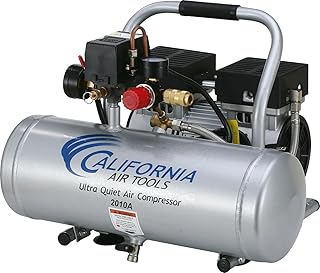
- Motor: 1.0 HP
- Tank: 2 gal aluminum tank
- Air delivery: 3.10 CFM at 40 PSI, 2.20 CFM at 90 PSI
- Maximum pressure: 120 PSI
- Sound level: 60 dB
- Weight: 35 lbs
- Pump: oil-free dual-piston pump, 1680 RPM
- Power: 110V, 8.5 A
- Fill time: 50 seconds from empty
- Recovery time: 14 seconds from 90 to 120 PSI
- Duty cycle: 70/30
The California Air Tools 2010A leads this group because it is the lightest machine here that still delivers a useful amount of air, and it is the quietest. At 35 lbs it can be carried with one hand from the workshop to the room where the panels are sprayed, and the 2-gallon aluminum tank keeps the weight down without giving up strength. The aluminum tank is lighter than a steel tank of the same size, and it will not rust from the inside the way a steel tank can. At 60 dB the 2010A runs at the sound level of a normal conversation, so it can sit beside the workbench while panels are sprayed and checked.
Air delivery is 3.10 CFM at 40 PSI and 2.20 CFM at 90 PSI, which is enough for a small panel and a small nozzle. The fill time from empty is 50 seconds, and the recovery from 90 to 120 PSI takes only 14 seconds, so the machine is ready again almost as soon as the panel is set aside. The 70/30 duty cycle allows long running periods, and the oil-free dual-piston pump needs no oil care. The 2010A is not the machine for a whole wall: its small tank will drain fast on a long spray run. For a stack of small decorative panels, sprayed one at a time with pauses in between, it is the most practical machine in this group.
Rolair JC10 Plus

- Motor: 1 HP
- Tank: 2.5 gal tank
- Air delivery: 2.35 CFM at 90 PSI
- Maximum pressure: 125 PSI
- Sound level: 60 dB
- Weight: 45 lbs
- Pump: oil-less dual-piston pump, 1725 RPM
- Power: 7.5 A
- Fill time: 55 seconds from 0 to 125 PSI
- Frame: roll cage
The Rolair JC10 Plus is a small, tough machine built around a roll cage that protects the tank, the pump, and the fittings. At 45 lbs it is light enough to carry, and the cage means it can be set down on a workshop floor or a driveway without worrying about a dented tank or a cracked fitting. It delivers 2.35 CFM at 90 PSI from an oil-less dual-piston pump running at 1725 RPM, and it fills from empty to 125 PSI in 55 seconds. At 60 dB it is as quiet as the 2010A, so it can run in a small room without drowning out conversation.
The JC10 Plus suits panel work because it is built to be moved and knocked about. The roll cage takes the bumps that come with carrying a compressor from a van into a house and from room to room, and the oil-less pump needs no oil checks before work starts. Air delivery is modest, so it suits small panels and a small nozzle, sprayed in short bursts with pauses while the next panel is prepared. It draws only 7.5 amps, the lowest in this group, so it runs on any household circuit without a second thought. For a plasterer who sprays panels in a workshop and needs a machine that can take a knock, the JC10 Plus is the toughest small compressor here.
Makita MAC700
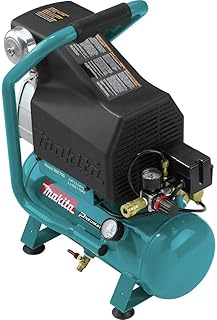
- Motor: 2.0 HP
- Tank: 2.6 gal tank
- Air delivery: 3.8 CFM at 40 PSI, 3.3 CFM at 90 PSI
- Maximum pressure: 130 PSI
- Weight: 52 lbs
- Pump: oil-lubricated cast-iron Big Bore pump, 1730 RPM
- Power: 12.4 A
The Makita MAC700 is the strongest small machine in this group. It delivers 3.8 CFM at 40 PSI and 3.3 CFM at 90 PSI from a 2.0 HP motor and an oil-lubricated cast-iron Big Bore pump, which is more air than any other machine here in the same size class. That extra air means a panel can be sprayed in one steady pass instead of two short bursts, and the pattern stays even across the whole panel. The 2.6-gallon tank is small, but the pump is strong enough to keep up with a short spray run, and the 130 PSI maximum leaves plenty of headroom above the pressure a hopper gun needs.
At 52 lbs the MAC700 is heavier than the two machines above it, and the oil-lubricated pump needs its oil level checked before work starts. In return it gives a cast-iron pump built for long service and a low running speed of 1730 RPM, which keeps heat down during a day of short spray runs. The MAC700 suits a plasterer who sprays panels with a larger nozzle or a thicker mix, where the extra air delivery makes the difference between a panel finished in one pass and a panel that needs a second coat. It is still light enough to carry with one hand, and it fits on a workbench or under it without taking over the room.
DeWalt DWFP55126

- Motor: 0.9 HP
- Tank: 6 gal pancake tank
- Air delivery: 3.7 SCFM at 40 PSI, 2.6 SCFM at 90 PSI
- Maximum pressure: 165 PSI
- Weight: 30 lbs
- Pump: oil-free dual-piston pump
- Power: 120V, 10 A
- Sound level: 75.5 dBA
The DeWalt DWFP55126 is the lightest 6-gallon compressor in this group, and the pancake tank gives it a low, stable shape that sits flat on a floor and will not tip over when the hose is pulled. At 30 lbs it can be carried with one hand, and the 6-gallon tank stores far more air than the small machines above it, so a panel can be sprayed without the pump starting at all. Air delivery is 3.7 SCFM at 40 PSI and 2.6 SCFM at 90 PSI, which is enough for a small panel, and the 165 PSI maximum gives the tank a useful reserve above working pressure.
The oil-free dual-piston pump needs no oil care, and the machine draws 10 amps, so it runs on a normal household circuit. At 75.5 dBA it is louder than the quiet machines in this group, so it is better parked in a hallway or a garage with a hose running to the panel than set down right beside the workbench. The DWFP55126 suits a plasterer who wants a light machine with a generous tank, so the gun can spray a whole panel from stored air and the pump can refill while the next panel is prepared. It is the best balance of tank size and weight in this group.
Porter-Cable C2002

- Motor: 0.8 HP
- Tank: 6 gal pancake tank
- Air delivery: 3.7 SCFM at 40 PSI, 2.6 SCFM at 90 PSI
- Maximum pressure: 150 PSI
- Weight: 30 lbs
- Pump: oil-free
- Power: 120V, 10 A
- Sound level: 82 dB
- Pressure switch: cut-in 120 PSI, cut-out 150 PSI
The Porter-Cable C2002 is the long-running classic of the 6-gallon pancake class, and it has stayed in workshops for years because it is simple, light, and easy to live with. At 30 lbs it carries with one hand, and the pancake tank sits flat and stable on any floor. It delivers 3.7 SCFM at 40 PSI and 2.6 SCFM at 90 PSI, which is the same air delivery as the DeWalt above it, and the 150 PSI maximum is more than a hopper gun needs. The oil-free pump needs no oil care, and the machine draws 10 amps on a standard circuit.
The C2002 is louder than the DeWalt, at 82 dB, so it is best kept a little further from the workbench, with a hose running to the gun. The cut-in at 120 PSI and cut-out at 150 PSI give a short, regular pump cycle that fits the pace of panel work: the pump runs briefly while a panel is prepared, then stops while the panel is sprayed from the stored air in the tank. The C2002 suits a plasterer who wants a proven, simple machine at a modest weight, and who sprays panels one at a time with pauses in between. It is not the strongest machine here, but it is one of the most dependable.
Bostitch BTFP02012

- Tank: 6 gal pancake tank
- Air delivery: 2.6 CFM at 90 PSI
- Maximum pressure: 150 PSI
- Weight: 30 to 31 lbs
- Pump: oil-free
The Bostitch BTFP02012 is the simplest machine in this group, and its simplicity is its strength. It is a 6-gallon pancake compressor with an oil-free pump, a 150 PSI maximum, and a weight of 30 to 31 lbs. It delivers 2.6 CFM at 90 PSI, which is enough air for a small panel and a small nozzle, sprayed in short bursts. The pancake tank sits flat and stable, the machine carries with one hand, and there is nothing to maintain beyond draining the tank at the end of the day.
The BTFP02012 suits a plasterer who sprays a few panels at a time and wants a machine that is easy to carry, easy to store, and easy to use. It will not keep up with a large nozzle or a thick mix, and the pump will run often on a long spray run, so it is best used at the pace the machine sets: spray a panel, set it aside, let the pump refill the tank, and spray the next one. For a small workshop where the compressor lives on a shelf between jobs, the BTFP02012 takes up little room and is always ready to go.
California Air Tools 8010
- Motor: 1.0 HP
- Tank: 8 gal steel tank
- Air delivery: 3.10 CFM at 40 PSI, 2.20 CFM at 90 PSI
- Maximum pressure: 120 PSI
- Sound level: 60 dB
- Weight: 48 lbs
- Pump: oil-free dual-piston pump
- Power: 110V, 8.5 A
- Fill time: 165 seconds from empty
- Recovery time: 60 seconds from 90 to 120 PSI
- Frame: wheel kit
The California Air Tools 8010 closes this group with the largest tank here and the quietest running. At 60 dB it runs at the sound level of a normal conversation, so it can sit in the same room as the panels while they are sprayed and checked, and it will not disturb anyone else in the house. The 8-gallon steel tank stores enough air to spray several small panels before the pump needs to run, and the oil-free dual-piston pump needs no oil care. At 48 lbs it is heavier than the pancake machines, but the wheel kit makes it easy to roll across a floor.
Air delivery is 3.10 CFM at 40 PSI and 2.20 CFM at 90 PSI, with a 60-second recovery from 90 to 120 PSI. That is enough for small panels worked at a relaxed pace, with the pump refilling while each panel is checked and set aside. The 8010 draws only 8.5 amps, so it runs on a shared household circuit. For a plasterer who sprays decorative panels indoors and wants the quietest machine with the largest tank in this group, the 8010 is the right choice. It trades speed for silence and for a tank that keeps the gun spraying through a whole panel without the pump starting.
| Product | Tank | CFM at 40 PSI | CFM at 90 PSI | Max pressure | Weight |
|---|---|---|---|---|---|
| California Air Tools 2010A | 2 gal | 3.10 | 2.20 | 120 PSI | 35 lbs |
| Rolair JC10 Plus | 2.5 gal | – | 2.35 | 125 PSI | 45 lbs |
| Makita MAC700 | 2.6 gal | 3.8 | 3.3 | 130 PSI | 52 lbs |
| DeWalt DWFP55126 | 6 gal | 3.7 | 2.6 | 165 PSI | 30 lbs |
| Porter-Cable C2002 | 6 gal | 3.7 | 2.6 | 150 PSI | 30 lbs |
| Bostitch BTFP02012 | 6 gal | – | 2.6 | 150 PSI | 30-31 lbs |
| California Air Tools 8010 | 8 gal | 3.10 | 2.20 | 120 PSI | 48 lbs |
How to choose
Pick the weight you will actually carry
Panel work means carrying the compressor from the van to the room, from room to room, and back again. A machine that weighs 30 lbs gets carried without a second thought. A machine that weighs 52 lbs gets carried with effort, and a machine that weighs 88 lbs does not get carried at all. Before choosing, think about where the panels will be sprayed and how many stairs are involved. A light machine with a small tank is the right choice when the compressor moves often. A heavier machine with a large tank is the right choice when the compressor stays in one place and the hose does the moving. The weight on the maker's sheet is the weight of the machine alone, so the hose and the gun add to the load on every trip.
Check the couplers before you buy
Quick-connect fittings are the heart of this job, and not every compressor comes with the same couplers. Some machines have one coupler, some have two, and some have a locking regulator that keeps the pressure setting from drifting. A machine with two couplers lets the texture gun and a blow gun stay connected at the same time, so the panel can be blown clean and sprayed without swapping hoses. A machine with one coupler needs the hose swapped each time, which takes seconds with a quick-connect fitting and much longer with a threaded fitting. Check that the couplers on the compressor match the fittings on the hose and the gun, because a mismatch means an adapter, and an adapter is one more joint that can leak.
Match the air delivery to the panel and the nozzle
A small panel needs only a short spray, so a small compressor can do the job, but the nozzle size still decides how much air the gun draws. A small nozzle draws little air and suits a machine that delivers 2.5 CFM at 90 PSI. A larger nozzle draws more air and needs a machine that delivers 3.5 CFM or more at 40 PSI. The gun's manual states the air it needs, and that figure should be compared with the compressor's delivery at the pressure the gun works at. A compressor that is too small for the nozzle will drain its tank halfway through a panel and leave the second half of the pattern thinner than the first. A compressor that is larger than the nozzle needs is fine, but it costs weight and money that the job does not need.
Mind the noise in a small room
Panel work often happens in a small room, a workshop, or a spare bedroom, and a loud compressor in a small room is hard to live with. A machine rated at 60 dB can run in the same room as the work without drowning out conversation. A machine rated at 80 dB or more will fill the room with noise every time the pump runs, and it may need to be parked outside the room with a long hose. The trade-off is that the quietest machines are often the ones with the smallest air delivery, so the choice is between a quiet machine worked at a slower pace and a louder machine that sprays faster. For decorative panels, where the finish is judged up close, a quiet machine that lets the plasterer hear the spray and check the pattern is often worth the slower pace.
Common mistakes
The most common mistake on panel work is choosing a compressor that is too big for the job. A large compressor with a 10-gallon tank and a high air delivery will spray a panel with ease, but it will also be heavy, loud, and hard to fit in a small room. A small panel needs only a short spray, so a light machine with a 2-gallon or 6-gallon tank is enough, and the money saved on weight and size can go to a better gun or a better hose.
Another mistake is ignoring the hose. A quick-connect fitting is only quick if the hose has matching fittings, and a hose that is too narrow will starve the gun even when the compressor is strong enough. The hose should be as short as the room allows and wide enough to carry the air the gun needs. A third mistake is spraying with the regulator set too high. High pressure throws the mix too hard, makes the pattern coarse, and empties the tank fast. The regulator should be set to the lowest pressure that gives an even pattern, and the setting should be written down so it can be repeated for the next batch of panels.
A fourth mistake is forgetting to drain the tank. Water collects in the tank every time the pump runs, and a tank that is never drained will rust from the inside and spit water into the air line. Water in the air line spoils the texture and leaves marks on the panel. The drain valve should be opened at the end of each working day, and the tank should be left open overnight to dry out.
FAQ
What size compressor do I need for small decorative texture panels?
A small panel needs only a short spray, so a compressor with a 2-gallon to 6-gallon tank and 3 CFM or more at 40 PSI is enough for most panel work. A 2-gallon machine such as the California Air Tools 2010A suits a single panel at a time, while a 6-gallon pancake such as the DeWalt DWFP55126 stores enough air to spray a panel without the pump starting. The nozzle size decides the air delivery needed: a small nozzle draws little air, and a larger nozzle needs a stronger machine. For a stack of panels sprayed one after another, a machine with a fast recovery time is more useful than a machine with a large tank.
Are quick-connect fittings standard on air compressors?
Most portable compressors use quick-connect couplers, but the type varies. Some machines have one coupler, some have two, and the coupler style can differ between makers. The hose and the gun need matching fittings, so the couplers on the compressor should be checked against the fittings already owned. A push-to-connect coupler snaps on with one hand and seals at once, which is the fastest change on panel work. If the couplers do not match, an adapter can be fitted, but every extra joint is a place where air can leak.
How do I keep the texture pattern the same on every panel?
An even pattern across a batch of panels comes from a steady working pressure, a steady mix, and a steady gun distance. Set the regulator to the lowest pressure that gives an even spray and do not change it during the batch. Mix each batch the same way, because a thicker mix sprays differently from a thinner one. Hold the gun at the same distance from the panel and move at the same speed for every panel. If the pattern changes halfway through a batch, the first thing to check is the pressure at the gun, because a falling tank pressure is the most common cause.
Can I spray texture panels indoors with a small compressor?
Yes, and a small quiet compressor is often the best choice for indoor panel work. A machine rated at 60 dB runs at the sound level of a normal conversation and can sit in the same room as the panels. The room should be ventilated, and the floor and nearby surfaces should be covered, because texture spray drifts further than most people expect. A small compressor also fits in a room that a large machine would crowd, and its hose can reach the panel without running through a doorway.
Why does my compressor keep running while I spray a panel?
A compressor runs constantly when the gun uses air faster than the pump can replace it. That usually means the nozzle is too large for the compressor, the regulator is set too high, or the hose has a leak. Check the gun's stated air need against the compressor's delivery at 40 PSI, lower the regulator to the lowest pressure that gives an even pattern, and check every fitting for a leak. A small leak at a coupler can waste enough air to keep the pump running through a whole panel.
Conclusion
Small decorative panels reward a light, quiet compressor with quick-connect fittings and enough air for a short spray run. The California Air Tools 2010A is the best all-round choice in this group, at 35 lbs and 60 dB with a 14-second recovery, and it carries with one hand from the workshop to the room. The Makita MAC700 delivers the most air in the small class, at 3.8 CFM at 40 PSI, and suits a larger nozzle or a thicker mix. The Rolair JC10 Plus is the toughest small machine here, with a roll cage that takes the knocks of daily carrying.
For a plasterer who wants a generous tank in a light package, the DeWalt DWFP55126 stores 6 gallons of air in a 30 lb machine that sits flat and stable on the floor. For a plasterer who wants the quietest machine with the largest tank, the California Air Tools 8010 runs at 60 dB with an 8-gallon tank and sprays several panels before the pump needs to run. Whichever machine is chosen, the rule stays the same: match the air delivery to the nozzle, keep the hose short and the fittings matched, and set the regulator once and leave it alone. A compressor chosen that way will keep the pattern even from the first panel in the batch to the last.
Related guides
More from Amazon
Programs that pair well with the guide above. Offers and eligibility are set by Amazon and may change.
Free shipping on eligible items, Prime Video and more. Eligible new members can start with a free trial.
Start a Prime free trialAudiobooks and podcasts to listen to on the go. Eligible new members can start with a free trial.
Try Audible freeAd-free music streaming. Eligible new subscribers can start with a free trial.
Try Music Unlimited freeA free business account with business pricing and bulk-buying tools for work, shop or home office.
Create a business accountAs an Amazon Associate we earn from qualifying purchases.
More ways to save on your next finish
Programs that pair well with the guide above. Offers and eligibility are set by Amazon and may change.
A free business account with business pricing and bulk-buying tools for work, shop or home office.
Create a business accountFast, free shipping on eligible items, plus Prime Video and more. Eligible new members can start with a free trial.
Start a Prime free trialRead from a huge library of eBooks, including how-to guides and cookbooks. Eligible new members can start with a free trial.
Try Kindle UnlimitedAudiobooks and podcasts for the commute, the garage or the kitchen. Eligible new members can start with a free trial.
Try Audible freeAs an Amazon Associate we earn from qualifying purchases. Using these links costs you nothing extra.



Write Your Review
No reviews yet. Be the first to share your experience!