
Key takeaways
- Seven top air compressors for texture hopper guns supplying pneumatic plaster texture sprayers, compared by CFM at 90 PSI, tank size, weight, noise and duty.
As an Amazon Associate I earn from qualifying purchases. This post may contain affiliate links at no extra cost to you.
Our top picks at a glance
4 products from this guide, in the order reviewed below.


As an Amazon Associate we earn from qualifying purchases. Prices and availability can change.
A texture hopper gun is only as good as the air behind it. The gun needs a steady stream of air at a steady pressure to break thick material into an even pattern, and a compressor that cannot hold its output will show up on the wall as heavy and light bands, sputtering and thin spots. The hopper guns in this programme ask for between three and a half and eleven cubic feet per minute, and the compressors in this guide cover that whole range, from a small one horsepower quiet unit to a gas powered five and a half horsepower machine. This guide covers the best air compressors for texture hopper guns for supplying pneumatic plaster texture sprayers, with every figure taken from a maker manual, a maker listing or a retailer specification sheet.
The number that matters most is cubic feet per minute at ninety pounds per square inch, because that is the pressure a hopper gun works at and the figure every maker publishes. A compressor that delivers six cubic feet per minute at forty pounds per square inch but only two at ninety will not run a gun that needs four at ninety, however large its tank looks. Tank size matters next, because the tank stores air between pump cycles and smooths out the short bursts a texture gun demands. A twenty gallon tank will carry a gun through a long pass without the pump starting, while a two and a half gallon tank will cycle often and need a pump that can keep up. Weight, noise and power source decide where the compressor can work: a quiet sixty decibel unit suits an occupied house, a gas unit suits a site with no power, and a one hundred ninety pound unit needs wheels and a flat path.
The seven compressors below span the full range of hopper gun work. The smallest delivers two point four cubic feet per minute at ninety pounds per square inch and suits a light hand held gun on patch work, while the largest delivers twelve point five cubic feet per minute at ninety and can feed two guns at once. Between them sit the workshop standards: twenty gallon horizontal units, twin stack units and high pressure pancake units, each with a documented tank size, motor size and maximum pressure. Choose by matching the cubic feet per minute at ninety pounds per square inch to the gun first, then the tank to the job, and the rest of the choice follows.
Best products
California Air Tools 20020
- Tank capacity: 20 gallons, steel tank
- Motor: 2.0 horsepower, oil-free dual piston pump
- Air delivery: 6.40 cubic feet per minute at 40 PSI, 5.30 cubic feet per minute at 90 PSI
- Maximum pressure: 125 pounds per square inch
- Noise level: 70 decibels
- Power: 110 volt, 14 amp
- Weight: about 114 pounds
- Features: wheels, horizontal tank
The California Air Tools 20020 leads this group on stored air, with a twenty gallon steel tank and a two horsepower oil-free dual piston pump that delivers five point three cubic feet per minute at ninety pounds per square inch. That output feeds a hand held hopper gun with headroom to spare, and the twenty gallon tank carries the gun through long passes without the pump cycling every few seconds. The oil-free pump needs no oil changes and runs at seventy decibels, which is quiet enough for an occupied house, and the wheel kit moves the unit around a room on a flat floor. At about one hundred fourteen pounds it is heavy to lift, but the horizontal tank and wheels make it a roll rather than a carry. Maximum pressure of one hundred twenty five pounds per square inch gives the regulator room to hold a steady ninety at the gun, and the one hundred ten volt, fourteen amp supply runs on a standard household circuit. For a crew spraying texture in a house all day, the 20020 is the compressor that keeps the gun fed without noise complaints.
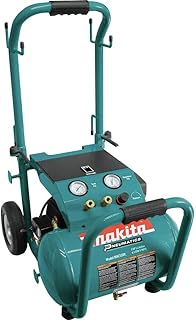
Makita MAC5200 Big Bore
- Tank capacity: 5.2 gallons
- Motor: 3.0 horsepower maximum, 2.1 horsepower running
- Air delivery: 6.9 cubic feet per minute at 40 PSI, 6.5 cubic feet per minute at 90 PSI
- Maximum pressure: 140 pounds per square inch
- Pump: cast iron Big Bore pump, oil lubricated
- Power: 120 volt, 13.8 amp
- Weight: 88 pounds
The Makita MAC5200 Big Bore delivers six point five cubic feet per minute at ninety pounds per square inch from a three horsepower maximum motor, the highest output per gallon of tank in this group. The five point two gallon tank is small, but the cast iron Big Bore pump recovers fast, and the one hundred forty pounds per square inch maximum pressure stores enough air to carry a hopper gun through a burst. The oil lubricated pump runs cooler than an oil-free pump under continuous load, which suits a long day of texture work, and the roll cage construction protects the unit on a job site. At eighty eight pounds the MAC5200 is a two person lift onto a truck, but on site it sits close to the work and feeds the gun through a short hose. For a contractor who wants maximum air from a compact frame and already owns a hopper gun that needs six cubic feet per minute or more, the MAC5200 is the strongest small tank choice.
Makita MAC5501G Big Bore Gas
- Tank capacity: 10 gallons, twin tanks
- Engine: Honda GX160 four stroke, 5.5 horsepower
- Air delivery: 14 cubic feet per minute at 40 PSI, 12.5 cubic feet per minute at 90 PSI
- Maximum pressure: 135 pounds per square inch
- Pump: cast iron pump with Big Bore cylinder, oil lubricated
- Weight: 190 pounds
- Overall length: 46 inches
The Makita MAC5501G Big Bore Gas is the most powerful compressor in this group, with a Honda GX160 four stroke engine driving a cast iron Big Bore pump to twelve point five cubic feet per minute at ninety pounds per square inch. That output can feed two hopper guns at once, or one gun with a wide margin, and the ten gallon twin tanks store enough air to smooth out the heaviest bursts. Maximum pressure of one hundred thirty five pounds per square inch and a V twin style pump that runs cooler give the unit the stamina for a full day on a site with no mains power, which is the reason to choose gas over electric. At one hundred ninety pounds and forty six inches long it is the largest machine here, and it needs a flat path and two people to load, but on a new build site or a remote wall it is the only compressor in this guide that works without a socket. For a crew spraying texture outdoors away from power, the MAC5501G is the air supply that does not ask for anything except fuel.
Rolair JC10 Plus
- Tank capacity: 2.5 gallons
- Motor: 1 horsepower, oil-free direct drive
- Air delivery: 3.8 cubic feet per minute at 40 PSI, 2.4 cubic feet per minute at 90 PSI
- Displaced air: 5.3 cubic feet per minute
- Motor speed: 1725 revolutions per minute
- Pressure settings: 95 to 125 pounds per square inch factory settings
- Noise level: 60 decibels
- Weight: 45 pounds
- Features: roll cage
The Rolair JC10 Plus is the quietest compressor in this group at sixty decibels, and the lightest at forty five pounds, which makes it the pick for patch work and small rooms where the compressor sits beside the operator. The one horsepower oil-free direct drive motor delivers two point four cubic feet per minute at ninety pounds per square inch, which suits a light hand held hopper gun on small areas, and the two and a half gallon tank is enough for short bursts with a pump that cycles often. The motor runs at one thousand seven hundred twenty five revolutions per minute, which keeps noise and wear down, and the roll cage protects the unit when it is carried through a house. Factory pressure settings of ninety five to one hundred twenty five pounds per square inch hold a steady supply to the gun, and the five point three cubic feet per minute displaced air figure shows the pump moves more air than the delivered figure alone suggests. For a single room, a repair or a ceiling panel, the JC10 Plus is the compressor that stays quiet and stays out of the way.
DeWALT D55146
- Tank capacity: 4.5 gallons
- Motor: 1.6 horsepower, oil-free pump
- Air delivery: 5.2 standard cubic feet per minute at 90 PSI
- Maximum pressure: 200 PSI cut-out, 225 PSI maximum tank storage
- Cut-in pressure: 160 pounds per square inch
- Noise level: 78 decibels
- Weight: 83 pounds
- Power: 120 volt
- Features: wheels, folding handle, dual hose connections
The DeWALT D55146 stores more pressure than any other compressor in this group, with a two hundred twenty five pounds per square inch maximum tank storage pressure and a two hundred pounds per square inch cut-out. That stored pressure is the reason a four and a half gallon tank can feed a hopper gun as well as a larger tank at lower pressure: the regulator draws from a deeper reserve, and the gun sees a steady ninety pounds per square inch through a long pass. Delivery of five point two standard cubic feet per minute at ninety pounds per square inch from a one point six horsepower oil-free pump suits a mid size hopper gun, and the dual hose connections let two tools run from one tank. Wheels and a folding handle move the eighty three pound unit around a site, and the seventy eight decibel noise level is the price of the high pressure pump. For a contractor who wants the most usable air from a compact wheeled tank, the D55146 is the high pressure choice.
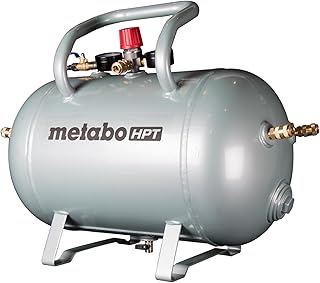
Metabo HPT The Tank
- Tank capacity: 6 gallons, pancake style
- Motor: 1.3 horsepower industrial motor
- Air delivery: 4.0 cubic feet per minute at 90 PSI
- Maximum pressure: 200 pounds per square inch
- Cut-in pressure: 170 pounds per square inch
- Noise level: 79 decibels
- Weight: 41 pounds
- Power: 120 volt
The Metabo HPT The Tank is the lightest high pressure compressor in this group at forty one pounds, with a six gallon pancake tank and a two hundred pounds per square inch maximum pressure. Delivery of four cubic feet per minute at ninety pounds per square inch feeds a standard hopper gun, and the one point three horsepower industrial motor is built for job site work. The pancake tank keeps the unit stable on a floor, and the two hundred pounds per square inch maximum pressure stores a large mass of usable air in a small volume, so the gun sees a steady supply through a burst. Cut-in pressure of one hundred seventy pounds per square inch means the pump restarts early and recovers fast, and the maker states the unit can run two framing nailers or several finish nailers at once, which shows the air reserve is real. For a texture crew that carries the compressor from room to room and wants high pressure without the weight, The Tank is the portable pick.
Ingersoll Rand SS3F2-GM Garage Mate
- Tank capacity: 30 gallons, horizontal tank
- Motor: 2 horsepower, single stage, oil lubricated
- Air delivery: 5.7 cubic feet per minute at 90 PSI
- Maximum pressure: 135 pounds per square inch
- Duty: 100 percent continuous duty with synthetic lubricant
- Weight: 185 pounds
- Features: handles, semi-pneumatic tires
- Noise level: 80 decibels
The Ingersoll Rand SS3F2-GM Garage Mate is the workshop compressor in this group, with a thirty gallon horizontal tank and a two horsepower single stage oil lubricated pump that delivers five point seven cubic feet per minute at ninety pounds per square inch. The thirty gallon tank stores enough air to feed a hopper gun through a whole panel batch without the pump starting, and the one hundred percent continuous duty rating with synthetic lubricant means the pump can run without a rest cycle on a long day. Maximum pressure of one hundred thirty five pounds per square inch gives the regulator room to hold ninety at the gun, and the handles and semi-pneumatic tires move the one hundred eighty five pound unit around a flat workshop floor. At eighty decibels it is not a quiet machine, but in a workshop the noise is less important than the air reserve. For a panel shop or a garage where the compressor stays in one place and feeds texture work all day, the Garage Mate is the heavy reserve choice.
| Product | Key specification | Best fit for |
|---|---|---|
| California Air Tools 20020 | 5.30 CFM at 90 PSI, 20 gal tank, 70 dB | All day house work, quiet running |
| Makita MAC5200 Big Bore | 6.5 CFM at 90 PSI, 5.2 gal tank, 140 PSI | Maximum air from a compact frame |
| Makita MAC5501G Big Bore Gas | 12.5 CFM at 90 PSI, 10 gal twin tanks | Remote sites, two guns at once |
| Rolair JC10 Plus | 2.4 CFM at 90 PSI, 2.5 gal tank, 60 dB | Patch work and small rooms |
| DeWALT D55146 | 5.2 SCFM at 90 PSI, 4.5 gal, 225 PSI storage | Compact tank, deepest air reserve |
| Metabo HPT The Tank | 4.0 CFM at 90 PSI, 6 gal, 200 PSI, 41 lb | Portable high pressure work |
| Ingersoll Rand SS3F2-GM Garage Mate | 5.7 CFM at 90 PSI, 30 gal tank | Workshop, continuous all day duty |
How to choose
Match cubic feet per minute at 90 PSI to the gun
The first figure to compare is the compressor delivery at ninety pounds per square inch against the gun air demand at the same pressure. A hopper gun that needs four cubic feet per minute at ninety will sputter on a compressor that delivers two point four, however large the tank, and a gun that needs seven will starve on a compressor that delivers five. Read the gun manual for its air demand, read the compressor figures at ninety pounds per square inch, and leave at least one cubic foot per minute of headroom so the pattern stays steady when the tank pressure drops. The machines in this guide deliver between two point four and twelve point five cubic feet per minute at ninety, so every common hopper gun has a match here.
Size the tank to the pass, not the room
Tank size decides how long the gun can spray before the pump starts, and a long pass needs a large tank. A twenty or thirty gallon tank carries a gun through a full wall without a pump cycle, a ten gallon twin tank covers a room, and a two and a half gallon tank suits short bursts and patch work. The trade is weight and floor space: a thirty gallon tank weighs one hundred eighty five pounds and stays in the workshop, while a two and a half gallon tank weighs forty five pounds and follows the operator from room to room. High pressure storage, like the two hundred twenty five pounds per square inch tank on the DeWALT D55146, stores more usable air in a smaller tank, so check maximum pressure alongside tank size before deciding.
Check noise against the job site
A compressor that runs all day in an occupied house has to be quiet, while a compressor in a workshop can be louder. The Rolair JC10 Plus runs at sixty decibels and the California Air Tools 20020 and 8010 run at sixty to seventy decibels, which suits a lived-in house, while the DeWALT D55146 at seventy eight decibels and the Ingersoll Rand Garage Mate at eighty decibels suit a workshop or a site where noise matters less. Noise figures use different maker methods, so treat them as a guide rather than a precise ranking, and listen to the unit on site when possible. A quiet compressor that delivers enough air is worth more than a loud one with a bigger headline figure.
Decide electric or gas before buying
Most texture work happens near a socket, and an electric compressor is quieter, cleaner and easier to maintain. Gas makes sense only where power is absent: a new build site, a garden wall or a remote wall. The Makita MAC5501G with its Honda GX160 engine is the only gas machine in this guide, and it delivers twelve point five cubic feet per minute at ninety, enough for two guns. Gas brings fuel handling, exhaust and more maintenance, so choose it only when the site truly has no power. For every other job, an electric unit on a standard household circuit is the simpler and quieter answer.
Common mistakes
The most common mistake is buying by tank size alone. A large tank with a small pump will run out of air in the middle of a pass, because the tank stores air but the pump has to replace it, and a hopper gun draws air faster than a small pump can supply. Check the delivery at ninety pounds per square inch first, then the tank. A second mistake is using a long, narrow hose between the compressor and the gun. A thin hose drops pressure along its length, so the gun sees less than ninety pounds per square inch even when the tank reads higher, and the pattern thins. Use a short hose with a wide bore, and keep the compressor close to the work.
A third mistake is ignoring the duty cycle. A small oil-free pump that runs without rest will overheat, and the thermal cut-out will stop the job halfway across a wall. The Ingersoll Rand Garage Mate is rated for one hundred percent continuous duty with synthetic lubricant, which is why it suits all day workshop work, while a small pancake unit needs rest breaks between passes. A fourth mistake is forgetting to drain the tank. Water condenses inside a steel tank, and over time it rusts the tank from the inside and carries moisture into the gun, which changes the texture. Drain the tank at the end of every day through the drain valve, and keep the tank dry between jobs. A fifth mistake is running the regulator wide open. A hopper gun needs a set pressure, usually between fifty and seventy pounds per square inch at the gun, and a regulator set too high will blow material off the wall and waste air, while a regulator set too low will starve the pattern.
FAQ
How many cubic feet per minute does a texture hopper gun need?
Hand held hopper guns in this programme need between three and a half and seven cubic feet per minute at the working pressure, with most standard guns asking for four to six. Check the gun manual for its exact air demand at ninety pounds per square inch, then choose a compressor that delivers at least one cubic foot per minute more than the gun needs, so the pattern stays steady when the tank pressure drops.
Is a bigger tank always better for texture spraying?
A bigger tank helps on long passes because it stores air between pump cycles, but the pump delivery matters more than the tank. A twenty gallon tank with a two horsepower pump will outlast a six gallon tank with a small pump on a long wall, yet a small tank with a strong pump can keep up on short passes. High pressure storage also helps, since a tank at two hundred pounds per square inch holds more usable air than the same tank at one hundred twenty five.
Can one compressor feed two hopper guns at once?
Yes, when the compressor delivery covers both guns. Two guns needing four cubic feet per minute each need a compressor delivering at least eight at ninety pounds per square inch, plus headroom, which points to the Makita MAC5501G at twelve point five. A standard five cubic feet per minute compressor will starve two guns, and both patterns will suffer. Check the total demand before splitting the air supply.
Why does the spray pattern go weak halfway across a wall?
A weak pattern halfway across a wall usually means the tank pressure has dropped and the pump cannot keep up, or the hose is too long and too narrow. Move the compressor closer, use a wider bore hose, and check the regulator reading during a pass. If the needle falls during spraying, the compressor delivery is too low for the gun, and a larger unit is needed.
How often should a compressor tank be drained?
Drain the tank at the end of every working day through the drain valve, and drain it again if the unit has sat unused for a week or more. Water condenses inside a steel tank during use, and leaving it inside rusts the tank and carries moisture into the gun. A dry tank lasts longer and keeps the texture pattern consistent from job to job.
Conclusion
A hopper gun is only as good as the air behind it, and the seven compressors in this guide cover every way a texture crew works. The California Air Tools 20020 gives quiet all day house work from a twenty gallon tank, the Makita MAC5200 gives the most air from a compact frame, the Makita MAC5501G brings gas power and twelve point five cubic feet per minute to sites with no socket, the Rolair JC10 Plus stays quiet and light for patch work, the DeWALT D55146 stores the deepest air reserve in a small tank, The Tank from Metabo HPT carries high pressure from room to room at forty one pounds, and the Ingersoll Rand Garage Mate holds a thirty gallon reserve for continuous workshop duty. Match the delivery at ninety pounds per square inch to the gun first, then the tank to the pass, and drain the tank at the end of every day. A compressor chosen that way will keep the gun fed from the first panel to the last, and the finish will read as one even surface.
Related guides
More from Amazon
Programs that pair well with the guide above. Offers and eligibility are set by Amazon and may change.
Free shipping on eligible items, Prime Video and more. Eligible new members can start with a free trial.
Start a Prime free trialAudiobooks and podcasts to listen to on the go. Eligible new members can start with a free trial.
Try Audible freeAd-free music streaming. Eligible new subscribers can start with a free trial.
Try Music Unlimited freeA free business account with business pricing and bulk-buying tools for work, shop or home office.
Create a business accountAs an Amazon Associate we earn from qualifying purchases.



Write Your Review
No reviews yet. Be the first to share your experience!