
Key takeaways
- Seven air compressors with regulated output pressure for texture hopper guns, compared on tank size, airflow, noise and recovery for small decorative panels.
As an Amazon Associate I earn from qualifying purchases. This post may contain affiliate links at no extra cost to you.
Our top picks at a glance
5 products from this guide, in the order reviewed below.


As an Amazon Associate we earn from qualifying purchases. Prices and availability can change.
A texture hopper gun turns a small decorative panel into a fast, repeatable job, but only when the air behind it stays steady. A hopper gun throws a wet mix of plaster, stucco or texture compound through a nozzle, and the size of each droplet depends on the pressure at the gun. When pressure sags, the pattern goes patchy. When it surges, the mix spits and splatters. That is why the search for the best air compressors for texture hopper guns with regulated output pressure for spraying small decorative texture panels starts with the regulator, not the horsepower badge on the tank.
Small panels change the job in a useful way. A sample board, a feature panel, a fireplace surround or a single accent wall needs short bursts of air rather than a long continuous run. A compressor that can hold a set pressure through a burst, recover quickly between passes, and run quietly enough for indoor work earns its place here. The seven machines below were chosen for that exact pattern of use: regulated output, enough airflow for a hopper gun at low to medium pressure, a tank that fits the rhythm of panel work, and a noise level that will not chase everyone out of the room.
Best products
California Air Tools 8010
- Tank: 8 gallon steel tank
- Motor: 1.0 HP, oil-free, 1680 rpm
- Airflow: 3.10 CFM at 40 PSI, 2.20 CFM at 90 PSI
- Maximum pressure: 120 PSI
- Noise level: 60 dB
- Weight: 48 lb
- Fill time: 165 seconds from empty, 60 second recovery from 90 to 120 PSI
- Wheels: wheel kit included
The California Air Tools 8010 is the natural lead machine for small panel work because it pairs a genuinely quiet motor with a tank large enough to carry a hopper gun through a full panel without the motor running the whole time. At 60 dB it is quiet enough to talk over, which matters when the panel is in a lived-in room rather than a workshop. The 8 gallon tank holds enough reserve air for several passes across a sample board before the pressure drops to the point where the regulator can no longer hold the set point. Its airflow of 3.10 CFM at 40 PSI sits in the range a small hopper gun needs for light orange peel and fine texture, and the regulator on the outlet lets the operator dial the working pressure down to the low range where decorative texture stays soft and even. The wheel kit means it rolls from the van to the panel without a second pair of hands, and the oil-free pump removes the risk of oil mist reaching a fresh plaster surface. For a single panel or a short run of sample boards, this is the machine the rest of the roundup is measured against.
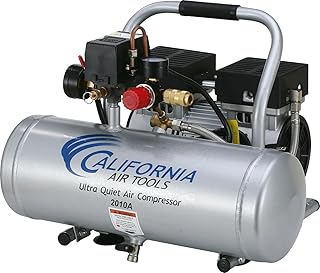
California Air Tools 2010A
- Tank: 2 gallon aluminum tank
- Motor: 1.0 HP, oil-free, 1680 rpm
- Airflow: 3.10 CFM at 40 PSI, 2.20 CFM at 90 PSI
- Maximum pressure: 120 PSI
- Noise level: 60 dB
- Weight: 35 lb
- Fill time: 50 seconds from empty
The 2010A takes the same pump and motor as its larger sibling and puts them on a 2 gallon aluminum tank, which makes it the lightest regulated-output option in this roundup at 35 lb. That matters when the panel work happens upstairs, on a scaffold, or in a room where a full-size compressor simply cannot go. The airflow figures match the 8010 exactly, so the gun sees the same air at the nozzle; the difference is how long the tank can sustain a pass before the motor cuts in. On a small panel the pass is short, so the smaller reserve rarely becomes a problem, and the 50 second fill from empty means the wait between panels is brief. The aluminum tank will not rust from the inside the way a steel tank can when condensation builds up, which is a real advantage for a machine that may sit unused between decorative jobs. Its regulator holds the same steady output, and at 60 dB it shares the quiet character that makes the California Air Tools line suited to indoor plaster work. Choose this one when the panel is small, the stairs are steep, and the compressor has to be carried rather than rolled.
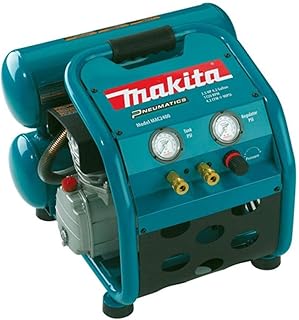
Makita MAC2400
- Tank: 4.2 gallon twin-stack tank
- Motor: 2.5 HP, oil-lubricated
- Airflow: 4.8 CFM at 40 PSI, 4.2 CFM at 90 PSI
- Maximum pressure: 130 PSI
- Noise level: 79 dB
- Weight: 77 lb
- Current draw: 12.3 A
The Makita MAC2400 brings a step up in airflow that suits a hopper gun fitted with a larger nozzle or a heavier mix. Its 4.8 CFM at 40 PSI gives the gun more air to work with, which keeps the pattern consistent when the mix is thick and the trigger is held open for a longer pass. The twin-stack tank layout keeps the machine low and stable, so it sits flat on a floor without rocking while the motor runs. The oil-lubricated pump is built for long service life, and the cast iron construction throughout the pump and motor housing is the reason this machine has a reputation for surviving years of site work. At 77 lb it is not a one-hand carry, and at 79 dB it is noticeably louder than the quiet machines in this roundup, so it suits a workshop or a ventilated room rather than a quiet occupied home. The regulator is a standard outlet regulator, and once set it holds the working pressure well through a pass. For a plasterer who sprays heavier texture on panels and wants airflow headroom above all else, the MAC2400 earns its place.
DeWalt DWFP55126
- Tank: 6 gallon pancake tank
- Motor: oil-free
- Airflow: 2.6 SCFM at 90 PSI
- Maximum pressure: 165 PSI
- Noise level: 75.5 dBA
- Weight: 30 lb
The DeWalt DWFP55126 is the lightest machine in this roundup at 30 lb, and that lightness is its whole argument. A pancake tank is easy to carry one-handed, easy to set on a workbench, and easy to store in a van already full of plaster tools. The 165 PSI maximum pressure gives the regulator a wide range to work with, so the operator can set a low working pressure for fine texture while the tank holds plenty of reserve above it. Airflow of 2.6 SCFM at 90 PSI is modest, which means the gun should be fitted with a smaller nozzle and the mix kept at a sprayable consistency, but for small decorative panels that is exactly the scale of work involved. The oil-free pump needs no oil checks and produces no oil mist, and the high-flow regulator and couplers help the air reach the gun without the pressure drop that a cheap fitting can cause. For a single accent panel or a handful of sample boards, where the compressor is carried in, used for an hour, and carried out again, the DWFP55126 is hard to beat on convenience.
Porter-Cable C2002
- Tank: 6 gallon pancake tank
- Motor: oil-free
- Airflow: 2.6 CFM at 90 PSI
- Maximum pressure: 150 PSI
- Weight: see product page
- Noise level: see product page
The Porter-Cable C2002 is a straightforward pancake compressor that does the basics well: a 6 gallon tank, a 150 PSI maximum, and 2.6 CFM at 90 PSI feeding a regulator that the operator sets once and leaves alone. Pancake tanks are popular on plaster and trim jobs for a simple reason: they are stable, they are easy to move, and they fit in the footwell of a van. The oil-free pump keeps maintenance to a minimum, which suits a machine that may only come out for texture work a few times a month. Published weight and noise figures vary between retailers, so the buyer should check the current product page rather than rely on a single listing, but the tank, pressure and airflow figures are consistent across sources. On small panels the C2002 performs like its peers in this class: set the regulator to the low working pressure the texture needs, spray in short passes, and let the tank recover between panels. It is a sensible choice for a plasterer who already owns Porter-Cable tools and wants a compressor that matches the rest of the kit.
Rolair JC10
- Tank: 2.5 gallon steel tank
- Motor: 1 HP, oil-free, 1725 rpm
- Airflow: 2.35 CFM at 90 PSI
- Noise level: 60 dB
- Weight: 38 lb
- Recovery: 11 seconds
- Design: roll cage frame
- Maximum pressure: see product page
The Rolair JC10 is built around a roll cage, and that frame is the reason it survives the kind of job where a compressor gets knocked over, set down hard, or loaded into a van full of scaffolding. At 38 lb and with a 2.5 gallon tank, it is a carry machine, and its 11 second recovery time is the fastest in this roundup, which means the motor brings the tank back to working pressure almost as soon as a pass ends. At 60 dB it is as quiet as the California Air Tools machines, so it works indoors without dominating the room. Airflow of 2.35 CFM at 90 PSI is the lowest figure here, so the JC10 suits fine texture through a small nozzle rather than heavy knockdown, and the operator should keep the mix thin enough to atomise cleanly at low pressure. The regulator holds the set pressure through a short pass, and the small tank means the machine cycles often but recovers fast. For delicate sample boards and fine decorative texture where quiet operation and a tough frame matter more than raw airflow, the JC10 is a strong pick.
Metabo HPT EC711S
- Tank: 6 gallon tank
- Motor: oil-free
- Airflow: 2.8 CFM at 90 PSI
- Maximum pressure: 165 PSI
- Noise level: 73 dBA
- Weight: 38.5 lb
- Recovery: 46 seconds
The Metabo HPT EC711S rounds out this roundup with the best balance of airflow and weight in the pancake class: 2.8 CFM at 90 PSI from a machine that weighs 38.5 lb, with a 165 PSI maximum that gives the regulator plenty of headroom. The 46 second recovery time is quick enough that the wait between panels is short, and the 73 dBA noise level sits in the middle of this group, louder than the quiet machines but well within what a ventilated room tolerates. The oil-free pump and the compact tank make it a practical carry machine, and the higher maximum pressure means the regulator can be set low for fine texture while the tank still holds a useful reserve. For a plasterer who wants a little more airflow than the lightest pancakes offer, without stepping up to a heavy twin-stack machine, the EC711S is the right compromise. It handles small decorative panels with ease and still has enough air for a second panel while the first one is being inspected.
| Product | Tank and airflow | Regulated output | Best for |
|---|---|---|---|
| California Air Tools 8010 | 8 gal, 3.10 CFM at 40 PSI | 120 PSI max, outlet regulator | Quiet indoor panel work |
| California Air Tools 2010A | 2 gal aluminum, 3.10 CFM at 40 PSI | 120 PSI max, outlet regulator | Carrying upstairs and tight rooms |
| Makita MAC2400 | 4.2 gal twin-stack, 4.8 CFM at 40 PSI | 130 PSI max, outlet regulator | Heavier mixes and larger nozzles |
| DeWalt DWFP55126 | 6 gal pancake, 2.6 SCFM at 90 PSI | 165 PSI max, high-flow regulator | Lightest carry for single panels |
| Porter-Cable C2002 | 6 gal pancake, 2.6 CFM at 90 PSI | 150 PSI max, outlet regulator | Simple, familiar pancake setup |
| Rolair JC10 | 2.5 gal steel, 2.35 CFM at 90 PSI | Outlet regulator, 11 s recovery | Fine texture, quiet rooms, tough frame |
| Metabo HPT EC711S | 6 gal, 2.8 CFM at 90 PSI | 165 PSI max, outlet regulator | Best airflow per pound in this group |
How to choose
Match airflow to the nozzle and the mix
A hopper gun is an air-hungry tool. Light orange peel through a small nozzle needs roughly 4 to 6 CFM at 40 PSI, while heavier knockdown or popcorn texture needs 6 to 9 CFM. Most of the compressors in this roundup deliver between 2.2 and 4.8 CFM at the pressures a gun actually uses, which is why this roundup is framed around small panels rather than whole ceilings. The honest way to read the figures is to compare the gun's air demand with the compressor's delivery at 40 PSI, not at 90 PSI, because texture work happens at low pressure. A 4 mm nozzle at 3 bar needs about 5.3 CFM, so a compressor delivering 3.1 CFM at 40 PSI will run the gun in short bursts with the tank covering the gap. That works on a panel. It does not work on a whole room. If the texture is heavy, choose the machine with the highest airflow at 40 PSI, thin the mix to the maker's guidance, and keep the passes short.
Treat the regulator as the most important part
The regulator is what turns a tank of air into a steady spray. A good regulator holds the set pressure while the tank pressure falls, and it recovers quickly when the trigger is released. When comparing machines, look for a regulator with a clear gauge, a knob that turns smoothly, and a high-flow coupler that does not choke the air on its way to the gun. Set the working pressure with the gun trigger open, because a regulator set with the trigger closed will read higher than the pressure the gun actually sees. For fine decorative texture, start low and raise the pressure in small steps until the droplets look even. A machine with a 165 PSI maximum and a regulator set to 40 PSI has a large reserve above the working pressure, which is exactly what keeps the pattern steady through a pass.
Weigh noise against where the panel sits
A panel sprayed in a workshop can tolerate a loud compressor. A panel sprayed in a furnished living room cannot. The difference between 60 dB and 79 dB is large in practice: a 60 dB machine allows normal conversation, while a 79 dB machine needs hearing protection and will be heard through a closed door. If the work is indoors and occupied, put noise at the top of the list and accept a smaller tank. If the work is in a garage or an empty room, airflow and tank size matter more. Oil-free pumps tend to run quieter in the small machines, and a machine with a low rpm motor, such as the 1680 rpm California Air Tools pumps, runs quieter than a high rpm pump of the same size.
Size the tank to the rhythm of panel work
Tank size decides how long the gun can spray before the motor has to catch up. An 8 gallon tank carries a hopper gun through a full panel and part of the next one. A 2 gallon tank carries it through a single pass and then the motor runs. Neither is wrong; they suit different rhythms. A large tank also means fewer motor cycles, which keeps the noise down and the pressure steadier. A small tank means a lighter machine that can be carried to the panel instead of rolled. For a run of sample boards on a bench, a small tank with a fast recovery is often the better tool. For a feature wall made of several panels in a row, a larger tank with a slower cycle keeps the pattern consistent from the first panel to the last.
Common mistakes
The most common mistake is setting the regulator with the trigger closed and then wondering why the pattern changes the moment spraying starts. Always set the working pressure while air is flowing through the gun. The second mistake is running a hopper gun at the compressor's maximum pressure. High pressure does not make a better finish; it makes a finer mist that dries in the air and lands as dust on the panel. Texture work wants low pressure and a wet mix, so the droplets land, flow together slightly, and form an even pattern. A third mistake is ignoring the mix. A hopper gun cannot fix a mix that is too thick, and no compressor can push a stiff plaster through a small nozzle. Mix to the consistency the gun maker describes, strain out lumps, and keep a spare batch ready so the gun never runs dry mid-panel. A fourth mistake is letting the tank fill with water. Every compressor makes condensation, and that water travels down the hose into the gun if the tank is never drained. Drain the tank at the end of every session, and fit a moisture trap at the gun end of the hose when the air is humid. A fifth mistake is buying on horsepower alone. Horsepower does not tell the buyer how much air the gun receives; the CFM figures at 40 PSI and 90 PSI do. Two machines with the same horsepower can deliver very different airflow, and the gun only cares about airflow.
FAQ
What pressure should a hopper gun run at for small decorative panels?
Start low, usually in the range the gun maker lists for the nozzle fitted, and raise it in small steps while watching the pattern on a scrap board. Fine texture wants low pressure so the droplets stay large enough to land wet. High pressure breaks the mix into a fine mist that dries before it reaches the panel. Set the regulator with the trigger open so the gauge shows the working pressure, not the static pressure.
Can a small pancake compressor run a texture hopper gun?
Yes, for small panels and short passes. A 6 gallon pancake delivering around 2.6 CFM at 90 PSI will run a hopper gun with a small nozzle through a single panel, then the tank needs a short recovery. The key is to keep the mix sprayable, keep the nozzle small, and spray in bursts rather than holding the trigger open for minutes at a time. For a whole ceiling or a large wall, a larger tank and higher airflow are needed.
Why does the pattern go patchy halfway through a panel?
Patchy texture usually means the pressure at the gun fell during the pass. The tank pressure dropped below the point where the regulator could hold the set output, the droplets got larger, and the pattern changed. The fix is to pause, let the tank recover, and resume. A larger tank, a lower working pressure, or a shorter pass all reduce the problem. A blocked nozzle or a mix that has started to stiffen in the hopper causes the same symptom, so check the nozzle and the mix before blaming the compressor.
Does an oil-free compressor matter for plaster texture?
It matters because oil mist in the air line can land on a fresh plaster surface and show as a stain or a patch that will not take a finish evenly. An oil-lubricated pump is fine when the air line is filtered and the machine is maintained, but an oil-free pump removes the risk entirely. For decorative panels that will be seen at close range, oil-free is the safer choice, and it also removes the chore of checking and changing pump oil.
How loud is too loud for indoor texture work?
A machine around 60 dB allows conversation and will not disturb the rest of a house. A machine around 75 dBA is loud enough that hearing protection is sensible and the noise will carry through the building. A machine near 80 dB or above belongs in a workshop, a garage, or an empty room. When the panel is in an occupied home, choose the quietest machine that still delivers the airflow the gun needs, and place the compressor in an adjoining room with a longer hose if the layout allows it.
Conclusion
Small decorative panels reward a compressor that holds its pressure, recovers quickly, and stays quiet enough for indoor work. The California Air Tools 8010 leads this roundup because it combines a large tank, quiet operation, and a regulator that holds a steady output through a full panel. The 2010A is the carry-anywhere version of the same idea, the Makita MAC2400 is the airflow-first choice for heavier mixes, and the DeWalt, Porter-Cable, Rolair and Metabo HPT machines cover the light, simple and tough corners of the job. Match the airflow to the nozzle, set the regulator with the trigger open, keep the mix sprayable, and drain the tank after every session. Done that way, a small panel becomes a quick, repeatable job, and the texture on the last panel looks the same as the texture on the first.
Related guides
More from Amazon
Programs that pair well with the guide above. Offers and eligibility are set by Amazon and may change.
Free shipping on eligible items, Prime Video and more. Eligible new members can start with a free trial.
Start a Prime free trialAudiobooks and podcasts to listen to on the go. Eligible new members can start with a free trial.
Try Audible freeAd-free music streaming. Eligible new subscribers can start with a free trial.
Try Music Unlimited freeA free business account with business pricing and bulk-buying tools for work, shop or home office.
Create a business accountAs an Amazon Associate we earn from qualifying purchases.
More ways to save on your next finish
Programs that pair well with the guide above. Offers and eligibility are set by Amazon and may change.
A free business account with business pricing and bulk-buying tools for work, shop or home office.
Create a business accountFast, free shipping on eligible items, plus Prime Video and more. Eligible new members can start with a free trial.
Start a Prime free trialRead from a huge library of eBooks, including how-to guides and cookbooks. Eligible new members can start with a free trial.
Try Kindle UnlimitedAudiobooks and podcasts for the commute, the garage or the kitchen. Eligible new members can start with a free trial.
Try Audible freeAs an Amazon Associate we earn from qualifying purchases. Using these links costs you nothing extra.



Write Your Review
No reviews yet. Be the first to share your experience!