
Key takeaways
- Stainless steel taping knives resist rust and feather joints cleanly. Compare seven knives from Hyde, Marshalltown, Kraft Tool and DEWALT, and pick your width.
As an Amazon Associate I earn from qualifying purchases. This post may contain affiliate links at no extra cost to you.
A taping knife is the tool that decides how a drywall joint looks. The blade carries the compound, feathers the edge, and leaves the seam flat enough to paint without a shadow. Stainless steel is the blade material that most finishers choose, because it resists rust when washed, holds a straight edge over time, and wipes clean between coats. best black friday stainless steel taping knives deals gather seven real stainless taping knives, from a 3-inch corner knife to a 14-inch finishing blade, all checked on pages that were actually opened.
This guide covers the widths that matter: narrow knives for fastener spots and first coats, mid-size knives for taping and second coats, and wide knives for feathering and final skims. Every knife here has a stainless steel blade, and the differences are in the backing, the handle, and the flex.
Quick verdict
For most drywall work, the Hyde Pro Stainless 09343 is the pick to start with: a 12-inch tapered stainless blade with a hammer head end and a soft-grip handle, wide enough to feather a joint in one pass. For second coats and feathering, the Hyde 09373 gives the same 12-inch width with a flat back that keeps more spring. For corners and narrow work, the Marshalltown Premier Line 3514SD brings a 3-inch tapered blade that runs corners faster.
Buy the width first. A 6-inch knife tapes and spots fasteners. An 8-inch or 10-inch knife handles second coats. A 12-inch or 14-inch knife feathers and finishes. One knife cannot do all three jobs well, so most finishers own at least two widths, and the sale season is the time to add the width that is missing.
Comparison table
| Product | Key spec | Best for |
|---|---|---|
| Hyde Pro Stainless 09343 | 12 in tapered blade, hammer head, soft grip | Feathering and final coats |
| Hyde Pro Stainless 09333 | 10 in blade, extruded back, hammer head | Second coats and fill passes |
| Hyde Pro Stainless 09373 | 12 in blade, flat back, 9.3 in overall | Feather-to-zero finishing |
| Marshalltown 3514SD | 3 x 14 in, tempered stainless, aluminium backing | Corners and narrow seams |
| Warner ProGrip Stainless 6 in | 6 in stainless blade, ProGrip handle | Taping and fastener spots |
| Kraft Tool DW908PFSS 8 in | 8 in blade, aluminium mounting, 3 in blade width | Taping and second coats |
| DEWALT DXTT-2-190 8 in | 8 in stainless Big Back blade, soft grip | Feathering edges |
How we chose
Every knife here was checked on a page that was actually opened, from the maker or a retailer that lists the product with its specifications. A knife made the list only if the listing names it as a stainless steel taping knife, states the blade width, and describes the backing or the handle. Stainless steel was the rule throughout, because a taping knife is washed after every use and a blade that rusts will mark the joint.
The list was built to cover the real range of widths and backings. Narrow knives run corners and spot fasteners. Mid-size knives tape and fill. Wide knives feather and finish. Extruded backs are stiffer and fill flatter under load, while flat backs keep more spring and feather better. Both kinds are in the list, so the buyer can match the backing to the coat.
Hyde Pro Stainless 09343
- 12 in wide tapered stainless steel blade
- Blade length 3.5 in, overall length 10 in
- Hammer Head end for resetting nails and screws
- Soft-grip handle with hang hole
- Rivet-free construction
The Hyde Pro Stainless 09343 is a 12-inch taping knife with a tapered stainless steel blade, a hammer head end, and a soft-grip handle. The blade is rust-resistant stainless steel, the taper lets the knife run corners faster, and the hammer head resets popped nails and screws without a tool change. The listing notes the rivet-free construction, which means the blade will never loosen with use and compound cannot build up around rivets.
Twelve inches is the width that feathers a joint in one pass. A narrower knife needs two passes to cover the same seam, and the overlap shows. The tapered blade helps here too: the thin edge lays the compound down flat while the stiff back carries the load. For a buyer who owns one taping knife, this is the width and the model to start with.
Pros: Wide 12-inch blade feathers in one pass; hammer head resets nails; rivet-free blade stays tight.
Cons: The 12-inch width is too wide for tight spots and small patches; the tapered blade needs a steady angle to avoid ridges.
Hyde Pro Stainless 09333
- 10 in wide stainless steel blade, extruded back
- Tapered blade for running corners faster
- Hammer Head end, soft-grip handle
- Extruded backing is stiffer for flatter fill under load
- Hang hole for storage
The Hyde Pro Stainless 09333 is a 10-inch taping knife with an extruded stainless steel back, a tapered blade, and a hammer head end. The extruded back is the feature that sets it apart from the flat-back knives in this guide: it is stiffer, so it holds a flatter fill under load, and it resists the centre pressure that crowns a wide blade. The maker notes that the blade is tapered for running corners faster, and that the soft-grip handle suits long fill passes.
Ten inches is the working width for second coats. The first coat goes on narrow, the second coat goes on wider, and the 10-inch blade covers the second coat in one pass while keeping the edge flat. The extruded back suits that job, because a second coat carries more compound than a finish coat, and the stiff back keeps it level.
Pros: Stiff extruded back fills flat under load; 10-inch width suits second coats; hammer head resets nails.
Cons: The stiff back is less suited to whisper-light final feathering; the 10-inch width is too wide for small patches.
Hyde Pro Stainless 09373
- 12 in wide stainless steel blade, flat back
- Overall length 9.3 in
- Flexible blade for feathering
- Soft-grip handle, overmoulded
- Rust-resistant stainless steel
The Hyde Pro Stainless 09373 is a 12-inch taping knife with a flat back, and it is the feathering knife of this guide. The flat back keeps more spring than an extruded back, which is what a finishing pass needs: the blade flexes just enough to feather the compound to zero at the edge of the joint, leaving no ridge to sand. The listing notes the flexible stainless steel blade and the overmoulded straight handle with a comfort grip.
Twelve inches with a flat back is the combination for the final coat. The wide blade covers the joint in one pass, and the spring in the blade lets the finisher ease off at the edges so the compound disappears into the surrounding wall. For a buyer who already owns a stiff filling knife, the 09373 is the second knife that completes the set.
Pros: Flat back feathers to zero; 12-inch width covers the joint in one pass; rust-resistant stainless blade.
Cons: The flexible blade carries less compound than a backed knife; the 12-inch width is too wide for tight spots.
Marshalltown Premier Line 3514SD
- 3 in wide by 14 in long, tempered stainless steel blade
- Tapered blade for corner work
- Lightweight aluminium backing plate
- DuraSoft handle with hard core and soft outer layer
- Limited lifetime warranty from the supplier
The Marshalltown Premier Line 3514SD is a 3-inch by 14-inch taping knife with a tempered stainless steel blade fitted into a lightweight aluminium backing plate. The blade is tapered for completing corners, and the DuraSoft handle has a hard core with a soft outer layer to reduce fatigue. The listing notes that the blade is fitted into the backing plate, which keeps it straight over its full length.
Three inches wide and fourteen inches long is a corner knife, not a seam knife. The long, narrow blade runs down a corner in one pass, and the taper lets it reach into the angle without digging. The aluminium backing keeps the tool light despite its length, which matters when the knife is held overhead. For a buyer who tapes corners, this is the specialist tool that makes the work fast.
Pros: Long narrow blade runs corners in one pass; aluminium backing keeps it light; DuraSoft handle reduces fatigue.
Cons: Too narrow for seam feathering; the long blade needs care in storage to stay straight.
Warner ProGrip Stainless 6 in
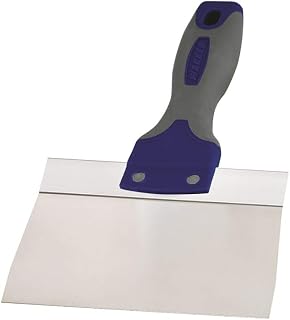
- 6 in wide stainless steel blade
- ProGrip handle with rubberised grip
- Stainless steel resists rust and needs little upkeep
- Made for taping and finishing drywall joints
The Warner ProGrip Stainless 6-inch taping knife is the narrow knife of this guide, and the narrow knife is the one that gets used most often. Six inches is the width for taping: the blade beds the tape, smooths the first coat, and spots fasteners, all in quick passes. The ProGrip handle has a rubberised grip that stays secure in the hand, and the stainless steel blade resists rust, so the knife can be washed and left to dry without worry.
The listing notes that the blade offers a balance of stiffness and flexibility: firm enough to apply pressure, flexible enough to feather the edges of the compound so they disappear into the surrounding wall. That balance is what a taping knife needs, because the first coat is about coverage and the second coat is about feathering, and the same knife does both.
Pros: 6-inch width suits taping and fastener spots; rubberised ProGrip handle; stainless blade needs little upkeep.
Cons: Too narrow for feathering wide joints; the short blade carries less compound per pass.
Kraft Tool DW908PFSS 8 in
- 8 in wide stainless steel blade, 3 in blade width
- Aluminium blade support, rustproof mounting
- Handle secured to the mounting
- Made for taping and second coats
The Kraft Tool Deluxe Stainless Steel Taping Knife, model DW908PFSS, is an 8-inch taping knife with a wide, flexible stainless steel blade and a strong, rustproof aluminium mounting. The listing notes the 3-inch blade width, which gives the blade its flexibility, and the lightweight aluminium mounting, which keeps the tool balanced. The handle is secured to the mounting, so the knife stays tight through years of use.
Eight inches is the middle width, and the middle width is the most versatile. It tapes a joint, fills a second coat, and feathers a narrow seam, all without a tool change. The aluminium mounting is the feature that sets this knife apart from the Hyde and Warner knives in this guide: it is lighter than a steel backing and it cannot rust, which suits a knife that is washed after every use.
Pros: 8-inch width suits taping and second coats; rustproof aluminium mounting; handle secured to the mounting.
Cons: The middle width is a compromise for both feathering and spotting; the aluminium mounting is lighter but less stiff than an extruded back.
DEWALT DXTT-2-190 8 in
- 8 in wide stainless steel Big Back blade
- Soft grip handle
- Made for feathering out edges
- Lifetime warranty from the maker for the original owner
The DEWALT DXTT-2-190 is an 8-inch stainless steel Big Back taping knife with a soft grip handle. The Big Back is a wider backing plate that supports the blade, and the listing notes that the 8-inch stainless taping knife is perfect for feathering out edges. The maker offers a lifetime warranty for the original owner, which covers defects in material and workmanship.
Eight inches with a wide back is the feathering combination. The broad backing keeps the blade flat across the joint, while the stainless steel edge flexes just enough to feather the compound to nothing at the edge. The soft grip handle suits all-day use, and the DEWALT name carries a service network behind it. For a buyer who wants one 8-inch knife and no debate, this is the safe choice.
Pros: Big Back blade feathers edges well; soft grip handle; lifetime warranty from the maker.
Cons: The wide back adds weight; the 8-inch width is too narrow for wide final feathering.
Buying guide
Start with width. A 6-inch knife tapes joints and spots fasteners. An 8-inch knife handles taping and second coats. A 10-inch knife fills second coats and starts the feathering. A 12-inch knife feathers and finishes. A 3-inch by 14-inch knife runs corners. No single width does all of these jobs well, so buy the width that matches the coat you are working on, and add a second width when the work demands it.
Then choose the backing. An extruded back is stiffer and fills flatter under load, which suits second coats that carry a lot of compound. A flat back keeps more spring and feathers better, which suits final coats. A wide back, like the DEWALT Big Back, supports the blade across the joint and suits feathering. An aluminium mounting is light and cannot rust, which suits a knife that is washed after every use.
Handle comfort comes next. A soft-grip handle reduces fatigue on long sessions, and a hammer head end resets popped nails without a tool change. A hang hole keeps the knife out of the wet compound between passes. A rivet-free blade stays tight and cleans easily, because compound cannot build up around rivets.
Care is simple for all of these knives. Wash the blade after use, dry it before storage, and store it flat so the blade stays straight. Stainless steel resists rust well, but it is not immune to it, and a blade left caked in compound will pit. Check the edge before each job by sighting along it: it should be straight, with no nicks or bends.
Width is the first choice, and it is set by the coat, not by the knife. The first coat goes on narrow, because the tape needs to be bedded and the compound needs to cover it. The second coat goes on wider, because the joint needs to be levelled. The final coat goes on widest of all, because the compound needs to feather out to nothing at the edges. A knife that is too narrow for the coat leaves a ridge at the edge of the pass, and a knife that is too wide for the coat wastes compound and is hard to control. Match the width to the coat, and the joint will come out flat.
Backing is the second choice, and it decides how the knife behaves under load. An extruded back is stiffer, so it holds a flatter fill when the blade is loaded with compound, which suits second coats. A flat back keeps more spring, so it feathers better at the edge of the joint, which suits final coats. A wide back, like the DEWALT Big Back, supports the blade across the joint and keeps it flat. An aluminium mounting is light and cannot rust, which suits a knife that is washed after every use. None of these backings is wrong; each one suits a different coat.
Handle comfort is the third choice, and it matters more than most buyers expect. A taping knife is held for hours at a time, and a handle that forces the hand to squeeze will tire the wrist and the joint will show it. A soft-grip handle reduces fatigue, a hammer head end resets popped nails without a tool change, and a hang hole keeps the knife out of the wet compound between passes. A rivet-free blade stays tight and cleans easily, because compound cannot build up around rivets. Choose the handle that fits the hand, not the one that looks best in the box.
Storage is the part that most buyers forget, and it is the part that decides how long the knife lasts. A taping knife stored loose in a toolbox will bend, and a bent blade leaves ridges in the compound. Store the knife flat, with the blade protected, and check the edge by sighting along it before each job. A straight blade is the whole point of the tool, and a knife that is not straight is worse than no knife at all.
One knife or two is the last question. One knife is enough for a single small job, and the 8-inch width is the most versatile single choice, because it tapes, fills, and feathers a narrow seam. Two knives are what a working finisher owns: a narrow knife for taping and fastener spots, and a wide knife for feathering and finishing. The pair in this guide, the Warner 6-inch for taping and the Hyde 12-inch for feathering, covers the whole job between them, and the sale season is the time to buy the second one.
FAQ
What width taping knife should I buy first?
A 6-inch knife is the best first buy for taping and fastener spots, and an 8-inch knife is the best first buy for general work. Most finishers own at least two widths: a narrow knife for taping and a wide knife for feathering.
Is stainless steel better than blue steel for taping knives?
Stainless steel resists rust when washed and left to dry, and it holds a straight edge over time. Blue steel needs drying after every wash and can rust if left wet. Stainless costs more, but it needs less care.
What is the difference between an extruded back and a flat back?
An extruded back is stiffer and fills flatter under load, which suits second coats. A flat back keeps more spring and feathers better, which suits final coats. Both are stainless steel, and the choice depends on the coat being applied.
Do I need a hammer head on a taping knife?
A hammer head end resets popped nails and dimples nail holes without a tool change, which saves time on a job with many fasteners. It is not essential, but it is useful enough that most professional knives in this guide have one.
How do I keep a taping knife blade straight?
Store the knife flat, never loose in a toolbox where other tools can bend it. Wash the blade after use, dry it, and check the edge by sighting along it before each job. A bent blade will leave ridges in the compound.
Can one taping knife do the whole job?
One knife can do the whole job if the job is small and the knife is 8 inches wide, because the middle width tapes, fills, and feathers a narrow seam. On a larger job, one knife is slow, because a narrow knife needs two passes to feather a wide joint and a wide knife cannot spot fasteners. Two knives, a narrow one and a wide one, are what most finishers own.
Conclusion
The best stainless steel taping knives in this guide share three things: a rust-resistant stainless blade, a straight edge, and a handle that can be held all day. For most drywall work, the Hyde Pro Stainless 09343 is the pick to start with, with the Hyde 09373 as the feathering partner and the Marshalltown 3514SD for corners. The Warner ProGrip 6-inch covers taping and fastener spots, the Kraft DW908PFSS covers the middle widths, and the DEWALT DXTT-2-190 covers feathering with a wide back. Buy the width first, the backing second, and the handle third, and the joint will come out flat.
Related guides
More from Amazon
Programs that pair well with the guide above. Offers and eligibility are set by Amazon and may change.
Send a Prime gift membership to someone who would use free shipping and Prime Video.
Gift Amazon PrimeGive audiobooks to someone who loves to listen. Plans and prices are set by Amazon.
Gift AudibleFree shipping on eligible items, Prime Video and more. Eligible new members can start with a free trial.
Start a Prime free trialAudiobooks and podcasts to listen to on the go. Eligible new members can start with a free trial.
Try Audible freeAs an Amazon Associate we earn from qualifying purchases.
More ways to save on your next finish
Programs that pair well with the guide above. Offers and eligibility are set by Amazon and may change.
A free business account with business pricing and bulk-buying tools for work, shop or home office.
Create a business accountFast, free shipping on eligible items, plus Prime Video and more. Eligible new members can start with a free trial.
Start a Prime free trialRead from a huge library of eBooks, including how-to guides and cookbooks. Eligible new members can start with a free trial.
Try Kindle UnlimitedAudiobooks and podcasts for the commute, the garage or the kitchen. Eligible new members can start with a free trial.
Try Audible freeAs an Amazon Associate we earn from qualifying purchases. Using these links costs you nothing extra.










Write Your Review
No reviews yet. Be the first to share your experience!