
Key takeaways
- Seven notched trowels with consistent notch spacing for plaster bonding compared on ridge height, notch depth, blade size, handle comfort and backing texture.
What's inside
As an Amazon Associate I earn from qualifying purchases. This post may contain affiliate links at no extra cost to you.
Our top picks at a glance
3 products from this guide, in the order reviewed below.


As an Amazon Associate we earn from qualifying purchases. Prices and availability can change.
A textured backing for decorative plaster is only as good as the ridges that form it. The bonding coat needs grooves of the same height and the same distance apart across the whole surface, because the decorative coat that follows keys into those grooves, and any ridge that stands taller or shorter than its neighbours leaves a weak line in the finished plaster. Choosing among the best notched trowels for plaster bonding with consistent notch spacing for preparing textured backing for decorative plaster is therefore a question of measurement: the notch width, depth and spacing have to be stated, even and repeatable, pass after pass.
Inconsistent spacing shows up in the finished surface. When ridges vary, the decorative plaster keys deeply in one place and shallowly in the next, and the bond between the backing and the finish becomes uneven. Over a whole wall that unevenness reads as patchy adhesion and, in the worst places, as hollow spots that sound different under the knuckle and fail first when the wall moves. A trowel whose notches are cut to equal width, depth and spacing removes that variable entirely, and the applicator can trust that every ridge in the bed is the same as the one beside it.
This guide compares seven notched trowels chosen for the consistency of their notch spacing, all listed by their makers or retailers for spreading bonding mortar and preparing textured backing. Each entry records the notch dimensions, the blade, the handle and the shank from the product page, and the buying guide at the end explains how spacing controls ridge height, how notch shapes differ, and how to check the backing before the decorative coat goes on.
Quick verdict
For most textured backing work, the MARSHALLTOWN QLT NT696 is the natural lead pick: its notches are stated as 1/2 inch wide, 1/2 inch deep and 1/2 inch apart, so every ridge in the bed is identical, and its 16 inch blade combs long, even passes across a wide base coat. If the work needs a different pattern, the MARSHALLTOWN SAW11SD answers with a sawtooth profile for even coverage, the Tile Tools three-piece set offers three exact square-notch depths, the M-D economy trowel gives an even 1/4 inch notch in a compact size, the QEP economy V-notch trowel gives fine shallow ridges, the MARSHALLTOWN MT79 handles tight spots with a 1/4 inch V-notch, and the Roberts dual-edge spreader puts two even notch sizes on one tool.
At a glance
| Product | Key spec | Best for |
|---|---|---|
| MARSHALLTOWN QLT NT696 Notched Trowel | Tempered steel blade 16 x 4 in, 1/2 in square notch | Deep 1/2 in grooves on long bonding runs |
| MARSHALLTOWN SAW11SD Sawtooth Notched Trowel | Tempered steel blade 11 x 4.5 in, sawtooth notch | Even sawtooth coverage with a DuraSoft grip |
| MARSHALLTOWN QLT MT79 V-Notched Margin Trowel | Metal blade 5 x 2 in, 1/4 in V-notch | Precise V-notch work in confined spaces |
| Tile Tools Stainless Steel Square Notched Trowel Set 3 PC | Stainless blades 11 x 4 in, notches 4, 8 and 12 mm | Three notch depths for changing bonding beds |
| QEP 3/16 x 5/32 V-Notch Economy Flooring Trowel | Alloy steel blade 9 x 4 in, 3/16 x 5/32 in V-notch | Fine V-notch ridges for small tile and wall base |
| M-D Building Products Economy Square Notch Trowel 1/4 in | Stainless blade 9 x 4 in, 1/4 in square notch | Compact rust-proof notching for standard beds |
| Roberts 10-136 Dual Edge Adhesive Spreader | Plastic spreader, 1/4 in and 3/16 in notches | Two notch sizes in one lightweight spreader |
How we chose
The shortlist started from the notch dimensions. Every trowel here has its notch width, depth and spacing stated on the product page, because consistent spacing cannot be judged from a photograph. The NT696 states equal 1/2 inch width, depth and spacing, the M-D economy trowel states an even 1/4 inch square notch, the Tile Tools set states 4, 8 and 12 millimetre square notches, the QEP economy trowel states its 3/16 by 5/32 inch V-notch, and the V-notch and sawtooth models state their patterns plainly. A trowel whose listing gave no notch dimensions at all was left out.
Notch shape was the second filter, because spacing only matters if the shape suits the coat. Square notches lay ridges with flat tops that collapse evenly under pressure, which suits most bonding beds. V-notches lay finer ridges that suit thin beds and small tile, and the sawtooth pattern of the SAW11SD spreads adhesive in a profile designed for even coverage under large-format units. The list holds all three shapes so the applicator can match the pattern to the decorative plaster system being backed.
Blade length and handle were recorded alongside the notches, because a consistent notch still needs a steady hand. Blade lengths run from the compact 5 by 2 inch MT79 margin trowel to the 16 inch NT696 and the 24 inch class of wide trowels, and the handles range from DuraSoft cushioned grips to soft grip and rubber handles. A blade that is too long for the wall cannot be held steady, and a handle that tires the hand will change the angle, so both were weighed when the shortlist was built.
The trowels in detail
MARSHALLTOWN QLT NT696 Notched Trowel
- Blade: hard tempered steel, 16 x 4 in
- Notch: 1/2 x 1/2 x 1/2 in square notch
- Handle: DuraSoft soft grip handle
- Mounting: aluminum alloy mounting, riveted to the blade
- Weight: 14.4 oz
The NT696 is built for heavy bonding beds. Its 16 inch blade and 1/2 inch square notches lay deep ridges that carry the volume of adhesive a thick base coat or a large-format bed demands, and the notch dimensions are stated as equal width, depth and spacing, so every ridge in the bed is the same height and the same distance from its neighbour. That regularity is the whole point of a notched trowel: when the tile or the next coat presses the ridges flat, the adhesive spreads into a layer of even thickness with no thin spots and no excess.
The DuraSoft handle softens the grip through long sessions, which matters on a 16 inch tool that is worked hard across wide walls. The aluminum alloy mounting is riveted to the blade, and the maker manual stresses the working habits that keep the tool accurate: hold a consistent angle, usually 45 to 60 degrees, keep the pressure even, and clean the blade immediately after use so dried adhesive cannot damage the notches. At 14.4 ounces it is a substantial tool, and it suits applicators who want deep grooves and long passes rather than fine detail.
Pros:
- Deep 1/2 inch notches with equal width, depth and spacing
- Long 16 inch blade covers wide beds quickly
- DuraSoft handle cushions long sessions
Cons:
- The 16 inch length is awkward in tight areas
- Tempered steel blade needs drying to avoid rust
MARSHALLTOWN SAW11SD Sawtooth Notched Trowel
- Blade: hard tempered steel, 11 x 4.5 in
- Notch: sawtooth notch pattern
- Mounting: aluminum alloy Xtralite mounting
- Handle: ergonomic DuraSoft handle
- Weight: 12.3 oz
- Coverage: the listing describes at least 95 percent adhesive coverage
The SAW11SD trades the familiar square notch for a sawtooth pattern, and the change has a clear purpose. The teeth spread adhesive in an even sawtooth profile that collapses uniformly when the tile is pressed down, and the listing describes at least 95 percent adhesive coverage, which is the figure that matters most for a bonding bed that has to hold large-format units without hollow spots. The hard tempered steel blade and the aluminum alloy Xtralite mounting give the tool the stiffness to hold that profile across the full 11 inch width.
Comfort comes from the ergonomic DuraSoft handle, which reduces hand fatigue during the long, repetitive passes that large bonding beds demand. The blade is easy to clean after use, and keeping the sawtooth edges free of dried mortar is what preserves the even spread from one job to the next. The sawtooth pattern is a specialist choice rather than a general square notch, so it suits applicators who have chosen the pattern deliberately for coverage, and who value the even collapse it gives under large tiles.
Pros:
- Sawtooth pattern spreads adhesive evenly
- DuraSoft handle reduces fatigue on long passes
- Sturdy tempered blade with lightweight mounting
Cons:
- Sawtooth pattern is not a standard square notch
- Tempered steel blade needs care after wet use
MARSHALLTOWN QLT MT79 V-Notched Margin Trowel
- Blade: metal, 5 x 2 in
- Notch: 1/4 in V-shaped notch
- Handle: soft synthetic and rubber handle
- Weight: 5.9 oz
The MT79 is a margin trowel first and a notched trowel second, and that order suits the tight spots in bonding work. Its compact 5 by 2 inch blade slips into corners and narrow reveals where a full-size trowel cannot reach, and the 1/4 inch V-shaped notch combs a fine, even ridge of thinset exactly where it is needed. The V profile collapses readily under pressure, which helps the adhesive spread into full contact in confined areas that cannot be reached again once the board or tile is set.
At 5.9 ounces it is light enough to manoeuvre precisely, and the soft synthetic and rubber handle keeps the grip comfortable through detailed work. The small blade is the limit as well as the strength: it covers ground slowly and it is not the tool for a wide bonding bed. But for the edges of a base coat, the reveals around openings and the narrow strips beside fittings, it puts even adhesive exactly where the job needs it.
Pros:
- Compact blade reaches confined spaces
- Lightweight at 5.9 ounces for precise control
- Soft synthetic and rubber handle reduces fatigue
Cons:
- Small blade covers ground slowly
- A single fixed V-notch pattern cannot vary bed depth
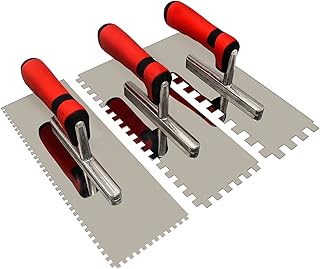
Tile Tools Stainless Steel Square Notched Trowel Set 3 PC
- Blades: polished stainless steel, 11 x 4 in each
- Notches: square notches of 4 mm, 8 mm and 12 mm across the set
- Shanks: welded aluminum shanks, no rivets
- Handles: ergonomic plastic and rubber handles
- Set: three trowels covering three mortar depths
This three-piece set answers the most common problem in bonding work, which is that one notch depth rarely suits every coat. A base coat that needs a shallow key takes the 4 millimetre trowel, a standard bonding bed takes the 8 millimetre, and a heavy bed on uneven masonry takes the 12 millimetre, and because all three share the same 11 by 4 inch polished stainless blade, the hand feel stays constant while the adhesive depth changes. The stainless blades resist rust through repeated wet work, and the welded aluminum shanks have no rivets to catch mortar or to work loose over time.
The ergonomic plastic and rubber handles keep the set comfortable through a full day of combing, and the three sizes let the applicator match the notch to the coat instead of forcing one trowel to do work it was not cut for. The trade is storage and discipline: three trowels take more room in the bucket than one, and the applicator has to pick the right one for each coat rather than reaching for the nearest. Used with that discipline, the set covers more bonding situations than any single trowel in this list.
Pros:
- Three notch depths cover shallow keys and heavy beds
- Polished stainless blades resist rust
- Welded shanks have no rivets to loosen
Cons:
- Three trowels take more storage space than one
- Plastic and rubber handles may wear faster than metal ones under daily use
QEP 3/16 x 5/32 V-Notch Economy Flooring Trowel
- Blade: alloy steel, 9 x 4 in
- Notch: 3/16 x 5/32 in V-notch
- Handle: high-impact black plastic handle
- Weight: 6.3 oz
- Listed use: tile up to 6 x 6 in and wall base applications
The QEP economy V-notch trowel is the fine tool of this list. Its 3/16 by 5/32 inch V-notch combs shallow ridges that suit small tile up to 6 by 6 inches and wall base work, where a deep square notch would lay down more adhesive than the tile can take. The 9 by 4 inch alloy steel blade resists wear and holds its shape through repeated use, and at 6.3 ounces the whole tool is light enough to handle precisely for long stretches without tiring the wrist.
The high-impact black plastic handle is shaped for comfort and control, and the economy design keeps the tool simple: no rivets to check, no heavy shank to balance, just a straight working edge and a fine notch. It is not a heavy-duty tool, and the alloy steel blade is not stainless, so it needs rinsing and drying after wet work. For thin beds and small tile, though, its fine notch spacing gives the even, shallow ridges that a bonding bed for decorative plaster backing needs.
Pros:
- Fine V-notch suits small tile and thin beds
- Lightweight at 6.3 ounces for precise handling
- Simple economy design is easy to clean
Cons:
- Alloy steel blade is not stainless
- Fine notch cannot carry deep bonding beds
M-D Building Products Economy Square Notch Trowel 1/4 in
- Blade: stainless steel, 9 x 4 in
- Notch: 1/4 in square notch
- Handle: black ABS slip-resistant handle
- Listed use: backsplash and general mortar applications
The M-D Building Products economy trowel proves that a rust-resistant blade does not need a large frame. Its 9 by 4 inch stainless steel blade resists bending and rusting through repeated wet work, and the 1/4 inch square notch combs even ridges for standard bonding beds. The compact size suits applicators who work in smaller areas or who want a lighter tool for overhead and vertical passes, where a full 11 inch blade can feel unwieldy.
The black ABS handle is shaped for a slip-resistant grip, which helps the applicator hold a steady angle through long combing sessions. The listing notes that the handle can feel slippery when wet, so drying the grip during use is worth the habit. Rinsing the blade after use keeps mortar out of the notches and the stainless face clean, and the simple square-notch pattern does exactly what it promises: even ridges, repeated pass after pass, without fuss.
Pros:
- Stainless blade resists rust in a compact size
- Even 1/4 inch square notch for standard beds
- Slip-resistant ABS handle aids control
Cons:
- The ABS handle can feel slippery when wet
- A single basic notch pattern cannot cover deep beds
Roberts 10-136 Dual Edge Adhesive Spreader
- Notches: dual edge with 1/4 in and 3/16 in notch sizes
- Construction: plastic
- Size: fits inside five-gallon buckets
- Listed use: mastic and pre-mixed adhesives on vertical surfaces
The Roberts 10-136 takes a different approach to notch spacing: two notch sizes on one lightweight plastic tool. One edge combs 1/4 inch ridges and the other combs 3/16 inch ridges, so the applicator can switch bed depth with a flip of the wrist instead of a trip back to the toolbox. The plastic construction makes dried adhesive easy to remove, since the blade can be flexed to pop residue off, and the small size fits inside a five-gallon bucket and turns easily in tight kitchen spaces.
It is an entry-level tool by design, and the plastic blade lacks the rigidity of steel, so it suits thinner adhesives and wall applications rather than heavy mortar beds. Within that range it is genuinely useful: the two notch sizes cover the common depths for mosaic and backsplash work, the tool is easy to manoeuvre, and the even spacing of both edges keeps ridges uniform. For a bonding bed that needs a light, controlled application on a vertical surface, it earns its place.
Pros:
- Two notch sizes in a single tool
- Light plastic blade is easy to clean
- Small size manoeuvres well in tight spaces
Cons:
- Plastic lacks the rigidity of steel
- Suited to thinner adhesives, not heavy mortar beds
Buying guide
Start with the numbers, and read them as a set. A notch described as 1/2 by 1/2 by 1/2 inch gives width, depth and spacing in one figure, and that equality is what makes the ridges repeatable: each ridge is the same height as the last, and each gap is the same width. When a listing gives only one figure, ask for the rest before buying, because a notch with the right depth but uneven spacing still lays an uneven bed.
Match the notch shape to the coat. Square notches are the default for bonding beds, because their flat-topped ridges collapse evenly and leave a uniform layer when the next coat is pressed on. V-notches suit thin beds and small tile, where a shallow ridge is enough and a deep one would waste adhesive. The sawtooth pattern suits large-format work, where even coverage across a wide bed matters more than the shape of any single ridge. The wrong shape does not ruin a wall on its own, but it makes even spacing harder to hold.
Hold the angle steady, because the angle is what turns notch spacing into ridge height. The maker guidance for the NT696 suggests 45 to 60 degrees, and that range holds for most notched trowels: too flat and the ridges come out thin, too upright and they stand too tall. Keep the pressure even across the full width of the blade, and comb in straight, parallel lines rather than arcs, so the spacing stays true from one edge of the wall to the other.
Match the blade length to the wall. A 16 inch blade combs a wide backing in long passes, which keeps the spacing consistent across the field, but it cannot turn around fittings or into corners. A 9 or 11 inch blade is the everyday compromise, and a 5 or 6 inch margin trowel finishes the edges where the field trowel cannot reach. The backing has to be even everywhere, including the edges, so the small trowel is not optional.
Check the ridges before the decorative coat goes on. Run a straightedge lightly across the combed bed and look at the ridge tops in raking light: they should stand at the same height and the same spacing across the whole surface. Any ridge that stands proud or any gap that runs wide is a sign to re-comb that section while the mortar is still workable. Once the backing has set, an uneven section can only be corrected by cutting it back and starting again.
Care for the notches as measuring tools. Rinse the blade before mortar hardens in the cuts, dry it before storage, and check the notch edges against a straightedge from time to time. A nicked or worn notch lays a shallower ridge, and a shallower ridge changes the spacing pattern the decorative coat keys into. Follow the decorative plaster maker guidance on backing texture and open time, and prove the trowel and mortar combination on a sample board before the real wall is started.
FAQ
Why does notch spacing matter for decorative plaster backing?
The decorative coat keys into the ridges of the backing, and ridges of even height and spacing give it a uniform grip across the whole wall. When spacing varies, the finish keys deeply in one place and shallowly in the next, and the bond becomes patchy. Even spacing removes that variable, so the finished plaster holds evenly and sounds solid across the surface.
What is the difference between square, V and sawtooth notches?
Square notches lay flat-topped ridges that collapse evenly under pressure, which suits most bonding beds. V-notches lay finer, pointed ridges that suit thin beds and small tile. Sawtooth notches spread adhesive in a toothed profile designed for even coverage under large-format units. The choice depends on the bed depth and the tile or coat being backed, not on which shape looks more precise.
How do I check that my ridges are even?
Comb the bed in straight, parallel lines at a steady angle, then look across the ridges in raking light and run a straightedge lightly over the tops. Even ridges stand at the same height with the same gaps between them. Any ridge that stands proud or any gap that runs wide should be re-combed while the mortar is still workable.
Can one trowel prepare backing for every decorative plaster system?
One trowel can cover most backing work if its notch size matches the bed depth the plaster maker calls for, but different systems call for different depths. The Tile Tools three-piece set covers shallow, standard and deep beds in one buy, and the Roberts spreader puts two sizes on one tool. If the budget allows only one trowel, choose the notch size that matches the most common system in the work at hand.
What happens if the backing ridges are uneven when the finish goes on?
The finish coat keys unevenly, which can leave hollow spots and patchy adhesion that show up later as weak areas in the plaster. The only reliable fix is to correct the backing while it is still workable, or to cut back and re-comb a set section. Checking the ridges before the finish coat goes on is far cheaper than repairing a finished wall.
Conclusion
Consistent notch spacing is what turns a bonding coat into a reliable textured backing, and the MARSHALLTOWN QLT NT696 leads this list because its notches are stated as equal 1/2 inch width, depth and spacing on a long 16 inch blade. The SAW11SD adds even sawtooth coverage, the Tile Tools set offers three exact square-notch depths, the M-D economy trowel gives an even 1/4 inch notch in a compact size, the QEP economy V-notch trowel lays fine shallow ridges, the MT79 reaches tight spots, and the Roberts spreader puts two even notch sizes on one tool. Pick the notch size that matches the coat, hold a steady angle, check the ridges in raking light, and the decorative plaster will have a backing it can trust.
Related guides
More from Amazon
Programs that pair well with the guide above. Offers and eligibility are set by Amazon and may change.
Free shipping on eligible items, Prime Video and more. Eligible new members can start with a free trial.
Start a Prime free trialAudiobooks and podcasts to listen to on the go. Eligible new members can start with a free trial.
Try Audible freeAd-free music streaming. Eligible new subscribers can start with a free trial.
Try Music Unlimited freeA free business account with business pricing and bulk-buying tools for work, shop or home office.
Create a business accountAs an Amazon Associate we earn from qualifying purchases.
More ways to save on your next finish
Programs that pair well with the guide above. Offers and eligibility are set by Amazon and may change.
A free business account with business pricing and bulk-buying tools for work, shop or home office.
Create a business accountFast, free shipping on eligible items, plus Prime Video and more. Eligible new members can start with a free trial.
Start a Prime free trialRead from a huge library of eBooks, including how-to guides and cookbooks. Eligible new members can start with a free trial.
Try Kindle UnlimitedAudiobooks and podcasts for the commute, the garage or the kitchen. Eligible new members can start with a free trial.
Try Audible freeAs an Amazon Associate we earn from qualifying purchases. Using these links costs you nothing extra.










Write Your Review
No reviews yet. Be the first to share your experience!