
Key takeaways
- Compare portable paint sprayers with pressure control for old masonry, with pressure ranges, flow rates and tip sizes from the makers, for steady mineral coats.
As an Amazon Associate I earn from qualifying purchases. This post may contain affiliate links at no extra cost to you.
Our top picks at a glance
4 products from this guide, in the order reviewed below.


As an Amazon Associate we earn from qualifying purchases. Prices and availability can change.
Old masonry is the surface that tests a sprayer hardest. The brick is rough, the mortar joints sit deep, the stone is uneven, and the wall changes from one course to the next: a smooth brick face, a crumbling joint, a patched section of render, a stone lintel. A mineral coating makes the job harder still: it is thin, it dries fast, and it shows every change in pressure as a change in the coat, because a fan that runs too hard floods the brick and a fan that runs too soft leaves the hollows bare. Pressure control is the feature that holds the coat steady across a wall that never stays the same, because the painter can turn the pressure down for a thin limewash on smooth brick and turn it up for a heavier silicate paint on rough stone, without changing the tip or the pump. The best portable paint sprayers for mineral coatings with pressure control for painting old masonry with compatible coatings are the ones whose pressure dials are fully adjustable, whose pumps hold the pressure steady from the first pass to the last, and whose makers publish the pressure range the machine can reach.
A compatible coating is the thread that runs through this roundup. A mineral coating maker states which application methods its product suits, and a sprayer maker states which materials its machine handles, and the job is only sound where the two statements meet. The sprayers below all list water-based paints and primers among the materials they handle, and they all offer a pressure control that sets how hard the coating is driven. A mineral coating on old masonry should be strained before it goes into the machine, kept stirred while the work goes on, and sprayed at the pressure the coating data sheet allows. A pressure dial that moves in small steps is worth more than a high pressure ceiling, because the painter sets the pressure once for each section of wall and holds it there.
The seven sprayers below were picked for pressure control first. Every model here offers a fully adjustable pressure control, so the painter can set the pressure the coating needs rather than the pressure the pump happens to give, and every model has maker-stated figures for pressure, flow rate and tip size, so the comparison rests on numbers the makers publish rather than on guesswork. The roundup mixes High Efficiency Airless machines, which run at 1500 to 1600 psi with a soft fan, with conventional airless machines, which run to 2800 or 3000 psi with a harder fan, and with turbine machines, which set the pressure with a dial on the gun.
Best products
Titan ControlMax 1900 Pro
- High Efficiency Airless (HEA) system
- 0.7 HP motor
- Maximum flow rate: 0.40 gallons per minute
- Maximum working pressure: 1600 psi, fully adjustable
- Maximum tip size: 0.019 in
- Hose supplied: 50 ft, all-metal spray gun
- Cart frame, weight 39.7 lb
- Recommended annual use: up to 500 gallons
- HEA tip 515 included, repairable fluid section
The Titan ControlMax 1900 Pro leads this roundup because its pressure control is the most useful here: a fully adjustable dial that sets the delivery from a gentle mist for a thin limewash to a full 1600 psi for a heavier silicate paint, and a pump that holds the setting steady across a whole wall. The 0.7 HP motor is the strongest in the Titan ControlMax line, and the flow rate of 0.40 gallons per minute is the highest in this roundup, so the machine covers a long brick wall fast enough to keep a wet edge from one end to the other. The High Efficiency Airless system sprays through a tip with a pre-orifice that softens the stream, which gives a softer fan with less overspray than a conventional airless machine, and that matters on old masonry in the open air, where a hard fan bounces off the high spots.
The flow adjustment control on the pump lets the painter set the delivery rate for a thin mineral coating without touching the pressure dial, so the two controls work together: the pressure sets how hard the coating is driven, and the flow sets how much leaves the gun. The cart frame carries the pump on wheels, the 50 ft hose reaches along a long wall or up to the upper courses from the ground, and the all-metal gun takes the 515 HEA tip that ships in the box, with other HEA tip sizes available for thinner or thicker coatings. The fluid section is repairable, so the pump can be kept running for years instead of being replaced when the seals wear. For old masonry where the pressure must be set and held, the 1900 Pro is the pick.
Titan ControlMax 1700 Pro
- High Efficiency Airless (HEA) system
- 0.6 HP motor
- Maximum flow rate: 0.33 gallons per minute
- Maximum working pressure: 1500 psi, fully adjustable
- Maximum tip size: 0.017 in
- Hose supplied: 50 ft, all-metal spray gun
- Cart frame, weight 37 lb
- Recommended annual use: up to 300 gallons
- ControlMax 515 HEA tip included
The Titan ControlMax 1700 Pro pairs the same pump as the ControlMax 1700 with a cart frame and a 50 ft hose, and its pressure control works the same way as the 1900 Pro: a fully adjustable dial that sets the delivery from a gentle mist to a full 1500 psi, and a flow adjustment control that sets how much coating leaves the gun without touching the pressure dial. The 0.33 gallons per minute flow and the 0.017 in maximum tip suit a mineral coating on old masonry, where a smaller tip keeps the flow low and the mist fine on a thin limewash, and a larger tip feeds a silicate paint with more body.
The cart carries the pump on wheels, so the painter moves the rig along the wall instead of lifting it, and the 50 ft hose reaches the far end of a long wall or the upper courses from the ground without moving the pump. The all-metal gun takes the 515 HEA tip that ships in the box, and the HEA tips spray unthinned coatings with a softer fan than a conventional airless machine, which keeps the overspray down on a windy day outside a brick wall. The 300 gallon annual rating marks the 1700 Pro as the machine for regular work on old masonry. For a wall where the pressure must be set in small steps and held steady, the 1700 Pro is the pick.
Wagner Control Pro 190
- High Efficiency Airless (HEA) system
- Maximum flow rate: 0.40 gallons per minute
- Maximum working pressure: 1600 psi, fully adjustable
- Maximum tip size: 0.019 in
- Hose supplied: 50 ft, all-metal spray gun
- High-boy cart frame, suction from 1 or 5 gallon containers
- Recommended annual use: up to 500 gallons
- SureFlow priming system, 515 HEA tip
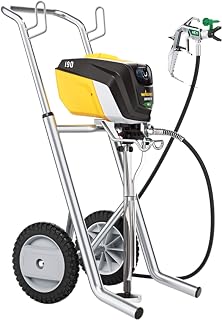
The Wagner Control Pro 190 is the largest machine in the Control Pro line, and its pressure control suits old masonry because it is fully adjustable across the whole range to 1600 psi. The painter sets the pressure low for a thin limewash on smooth brick and raises it for a heavier silicate paint on rough stone, and the pump holds the setting steady across a whole wall. The flow rate of 0.40 gallons per minute is the highest in this roundup, so the machine covers a long wall fast enough to keep a wet edge, and the 0.019 in maximum tip takes the thickest mineral coating the line can spray.
The high-boy cart carries the pump and the paint together, and the 50 ft hose lets the painter work along a long wall or up a ladder without moving the rig. The all-metal gun feels solid in the hand, and the SureFlow priming system makes the start of the day simple: prime, set the pressure, and spray. The HEA tips are made to spray unthinned coatings, which suits a mineral paint that should not be thinned past the maker's guidance, and the 500 gallon annual rating marks the 190 as the machine for frequent large work rather than occasional use. For old masonry where a high flow and a fully adjustable pressure dial matter most, the Control Pro 190 is the pick.
Titan ControlMax 1700
- High Efficiency Airless (HEA) system
- 0.6 HP motor
- Maximum flow rate: 0.33 gallons per minute
- Maximum working pressure: 1500 psi, fully adjustable
- Maximum tip size: 0.017 in
- Hose supplied: 30 ft, hybrid spray gun
- Stand frame, suction from 1 or 5 gallon containers
- Recommended annual use: up to 300 gallons
The Titan ControlMax 1700 is the stand version of the 1700 Pro, and it suits old masonry where a cart is more machine than the job needs. Its pump is the same as the Pro: a 0.6 HP motor, a flow rate of 0.33 gallons per minute, a fully adjustable pressure dial to 1500 psi, and a flow adjustment control that sets the delivery rate without touching the pressure dial. The differences sit in the frame and the hose: the stand frame is lighter and simpler, the hose in the box is 30 ft instead of 50 ft, and the hybrid gun mixes a plastic handle with metal parts, which keeps the weight down in the hand.
The 1700 sprays unthinned paints, stains and paint-and-primer coatings, which covers the mineral coatings this roundup is built around, and its HEA tips give a softer spray with less overspray than a conventional airless machine. The stand frame suits a wall where the painter works from one position and moves the pump by hand between sections, and the 30 ft hose reaches across a room or along a section of wall. The 300 gallon annual rating marks the 1700 as the machine for regular work. For old masonry where a light stand machine and a fully adjustable pressure dial matter most, the 1700 is the pick.
Graco Project Painter Plus
- 0.375 HP motor, 9 amps, 120 V
- Maximum flow rate: 0.24 gallons per minute
- Maximum working pressure: 2800 psi, fully adjustable
- Maximum tip size: 0.015 in
- Hose supplied: 1/4 in x 25 ft DuraFlex, supports up to 50 ft
- Stand frame, weight 13 lb
- Recommended annual use: up to 50 gallons
- SG2 metal spray gun with TrueAirless 515 tip and tip guard
The Graco Project Painter Plus is the lightest floor-standing airless machine in this roundup at 13 lb, and its pressure control suits old masonry because it is fully adjustable across the whole range to 2800 psi. The painter sets the pressure low for a thin limewash on smooth brick and raises it for a heavier silicate paint on rough stone, and the pump holds the setting steady. The flow rate of 0.24 gallons per minute and the 0.015 in maximum tip are modest, but they are enough for a mineral coating on a section of old masonry, and the stand frame is simple and light, so the painter lifts it over a threshold and sets it down beside the next section without help.
The Project Painter Plus shares the SG2 gun and the reversible TrueAirless 515 tip with its bigger Magnum siblings, so a clog clears by turning the tip around instead of taking the gun apart. The 25 ft hose reaches across a room, and the pump supports up to 50 ft when the wall is long. The suction tube draws straight from a one-gallon or five-gallon container, so a long run of wall needs no refilling. The 50 gallon annual rating marks it as the machine for occasional work on old masonry rather than daily spraying, and for a homeowner who coats a wall or two each year, that is the right scale.
Wagner FLEXiO 3000
- X-Boost turbine, handheld unit
- Cup volume: 1.5 quarts
- Spray patterns: horizontal, vertical and round
- Nozzles included: iSpray nozzle, Detail Finish nozzle and extra finishing nozzle
- Power dial on the gun handle
- Lock-N-Go system with cup liners
- Can spray unthinned interior and exterior latex paint, primers, polyurethane and sealers
The Wagner FLEXiO 3000 brings a different kind of pressure control to this roundup: a power dial on the gun handle that sets the turbine air pressure, rather than a dial on the pump. The painter holds the gun in one hand and turns the dial with the other, so the pressure changes in the middle of a pass without walking back to the base. The 1.5 quart cup holds enough mineral paint for a section of old masonry, and the three nozzles split the work between them: the iSpray nozzle for a flat brick face, the Detail Finish nozzle for fine work, and an extra finishing nozzle for a smooth coat on a stone feature.
The turbine is built into the gun, so there is no base on the floor and no hose to drag, and the machine sprays unthinned interior and exterior latex paint, primers, polyurethane and sealers, which covers the mineral paints this roundup is built around. The Lock-N-Go liners let the painter change colour or clean out in minutes by swapping the liner instead of scrubbing the cup. For old masonry where the pressure must change in the middle of a pass, the FLEXiO 3000 is the pick.
Fuji Spray Semi-Pro 2
- Two-stage turbine, 1400 watt motor
- Maximum air pressure: 5 psi
- Bottom-feed cup: 1 quart
- Gun: M-Model gun, non-bleed, 1.3 mm air cap set
- Hose: 25 ft with air control valve
- Adjustable pattern fan control, 1 to 12 in spray width
- Metal turbine case with gun holder
- Two-year parts and labour warranty from the maker
The Fuji Spray Semi-Pro 2 is the finest atomising machine in this roundup, and its pressure control works through the air control valve on the 25 ft hose: the painter turns the valve at the gun to set the air pressure, and the two-stage 1400 watt turbine holds it steady. The maximum air pressure of 5 psi is low, and that is the point: a turbine HVLP machine moves a large volume of air at low pressure, so the fan is soft and the coating settles into the texture of old masonry instead of bouncing off it. The bottom-feed 1 quart cup holds enough mineral paint for a section of wall, and the M-Model gun is non-bleed, so the air stops the moment the trigger is released.
The adjustable pattern fan control sets the spray width from 1 in to 12 in, so the painter can lay a narrow line along a mortar joint and a wide fan across a flat brick face with the same gun, and the 1.3 mm air cap set gives a fine atomisation for a smooth finish. The metal turbine case has a holder for the gun, so the whole system packs away as one unit. For old masonry where the finish will be seen close up and the pressure must stay low and steady, the Semi-Pro 2 is the pick.
| Sprayer | Type and pressure control | Best for |
|---|---|---|
| Titan ControlMax 1900 Pro | HEA airless, 1600 psi dial, 0.40 gpm, 0.019 in tip | Set-and-hold pressure on long walls |
| Titan ControlMax 1700 Pro | HEA airless, 1500 psi dial, 0.33 gpm, 0.017 in tip | Pressure steps on a cart with 50 ft hose |
| Wagner Control Pro 190 | HEA airless, 1600 psi dial, 0.40 gpm, 0.019 in tip | High flow with a fully adjustable dial |
| Titan ControlMax 1700 | HEA airless, 1500 psi dial, 0.33 gpm, 0.017 in tip | Light stand machine with a pressure dial |
| Graco Project Painter Plus | Airless, 2800 psi dial, 0.24 gpm, 0.015 in tip | Light pump for occasional masonry work |
| Wagner FLEXiO 3000 | HVLP turbine, power dial on gun, 3 nozzles | Pressure changes mid-pass |
| Fuji Spray Semi-Pro 2 | HVLP turbine, 5 psi, air control valve on hose | Low steady pressure for fine finishes |
How to choose
Set the pressure for the coating, not the pump
Pressure is a setting, not a score. A thin limewash atomises well at low pressure, and a high pressure only drives the mist past the wall and into the air, where it dries before it lands. A heavier silicate paint needs more pressure to break into a fine mist, and a low pressure leaves it in coarse drops that dry as orange peel. The High Efficiency Airless machines in this roundup run at 1500 to 1600 psi, and the conventional airless machines run to 2800 psi, so the choice is between a soft fan and a hard fan rather than between more and less power. Set the pressure at the lowest point where the fan looks even edge to edge, and raise it only until the tails at the fan edges disappear.
Check that the pump holds the setting
A pressure dial is only useful if the pump holds the setting steady. A pump that sags under load gives a fan that weakens in the middle of a pass, and a fan that weakens leaves a stripe of thin coating that shows after the coat dries. The machines in this roundup hold their pressure with a piston pump or a turbine that feeds a steady volume of air, and the painter can hear and see the difference: the fan stays even from the first pass to the last, and the sound of the pump stays steady. Before buying, the painter should spray a sheet of cardboard and watch the fan for a full minute: it should stay even edge to edge, with no heavy centre and no weak tails.
Match the tip to the pressure
The tip hole and the pressure work together. A small tip at high pressure gives a fine mist and a low flow, which suits a thin limewash on smooth brick. A large tip at low pressure gives a coarse mist and a high flow, which suits a heavy silicate paint on rough stone. The coating maker states the tip size its product needs, and the sprayer maker states the pressure range its machine can reach, so the choice sits where the two figures meet. A tip that is too large for the pressure gives a fan with weak edges, and a tip that is too small for the coating gives a fan that clogs. Buy a spare tip in the same size, because a worn tip sprays a wider fan with a heavier centre, and a mineral coating shows that change at once.
Weigh the pump against the size of the job
A floor pump with a hose suits a wall; a handheld gun suits a feature. The cart machines in this roundup carry the pump and the paint together and cover a whole house without stopping, but they need floor space and a clear path along the wall. The stand machines are lighter and simpler, and they suit a single wall or a room. The turbine machines suit detailed stonework where the finish will be seen close up. Before buying, walk the job and count the walls, the features, and the tight corners: the machine that fits the largest part of the job is the one to buy, and the machine that fits only the smallest part is the one to hire or borrow.
Common mistakes
The most common mistake on old masonry is setting the pressure too high. A high pressure drives the mist past the wall and into the air, where it dries before it lands, and the coating that does reach the wall bounces off the high spots and leaves the hollows bare. The fix is to set the pressure at the lowest point where the fan looks even edge to edge, and to raise it only until the tails at the fan edges disappear. A thin limewash needs a low pressure, and a heavier silicate paint needs a higher pressure, but neither needs the maximum the pump can give.
A second mistake is spraying the coating too thick. A mineral coating bonds by soaking into the surface, and a thick coat sits on top instead of soaking in, then peels away in sheets when the weather turns. The fix is to lay two thin coats rather than one thick one, and to let the first coat dry fully before the second goes on. A third mistake is skipping the strain. Mineral coatings carry fine particles, and a single lump blocks a tip in the middle of a wall, which leaves a stripe of uncoated brick that shows after the coat dries. Strain the coating through a fine mesh strainer into a clean container before it goes into the sprayer, and keep the container covered while the work goes on.
A fourth mistake is holding the gun too close or too far from the wall. Too close, and the coating floods and runs; too far, and the mist dries in the air and lands as dust. The gun should sit about a foot from the wall, moving in steady, overlapping passes, with the trigger pulled before the pass starts and released after it ends. A fifth mistake is leaving the sprayer full overnight. A mineral coating left in a pump sets hard by morning, and the pump, the hose and the gun all need taking apart. Flush the machine with clean water at the end of every day, run the water through until it comes out clear, and store the pump with the storage fluid the maker supplies.
FAQ
What pressure suits a mineral coating on old masonry?
A thin limewash atomises well at low pressure, and a heavier silicate paint needs more pressure to break into a fine mist. The High Efficiency Airless machines in this roundup run at 1500 to 1600 psi, and the conventional airless machines run to 2800 psi, so the painter can set the pressure the coating needs rather than the maximum the pump can give. Set the pressure at the lowest point where the fan looks even edge to edge, and raise it only until the tails at the fan edges disappear. A turbine machine runs at single-digit psi with a large volume of air, which suits a fine finish on stonework that will be seen close up.
Can I change the pressure in the middle of a wall?
Yes, and the pressure dial is made for it. On a floor machine, turn the dial on the pump to set the pressure for the next section, and spray a sheet of cardboard first to check the fan. On a turbine machine with a dial on the gun, turn the dial in the middle of a pass without walking back to the base. Change the pressure when the surface changes: a smooth brick face needs a lower pressure than a rough stone section, and a thin limewash needs a lower pressure than a heavy silicate paint.
What tip size suits a mineral coating on old masonry?
A tip in the 0.013 in to 0.019 in range suits most mineral coatings on old masonry, with the smaller end for a thin limewash and the larger end for a silicate paint with more body. The fan width comes from the first digit of the tip number: a 515 tip sprays a fan about 10 in wide through a 0.015 in hole, and a 519 tip sprays a fan about 10 in wide through a 0.019 in hole. On rough brick, a wider fan covers the mortar joints and the brick faces in one pass, while a narrow fan suits a pier or a narrow stone feature.
Should a mineral coating be thinned before spraying?
Only as far as the coating maker allows. Some mineral coatings spray as they come from the container, and some allow a small addition of water, but thinning past the maker's guidance weakens the bond and washes the colour out. The sprayers in this roundup are made to spray unthinned coatings through the right tip, so the first step is to pick the tip size the coating maker states, and the second step is to set the pressure low and raise it until the fan looks even. If the coating still will not atomise, the tip is too small, not the coating too thick.
How do I clean a sprayer after a mineral coating?
Flush with clean water as soon as the work stops. Run water from the suction tube through the pump and the gun until it comes out clear, then take the tip and the tip guard off and rinse them separately. On a turbine machine, wash the gun and the cup and wipe the hose ends, while the turbine itself stays dry. On a handheld machine, change the FlexLiner bag and flush the pump. Never leave a mineral coating in the machine overnight, and store the pump with the storage fluid the maker supplies so the seals stay wet.
Conclusion
Old masonry rewards a sprayer whose pressure can be set and held, because the wall changes from one course to the next and the coating must stay steady across them all. The Titan ControlMax 1900 Pro leads this roundup with a fully adjustable dial, the highest flow, and a repairable pump built to last for years, and the Titan ControlMax 1700 Pro gives the same control on a cart with a 50 ft hose. The Wagner Control Pro 190 matches the flow and the pressure on a high-boy cart, the Titan ControlMax 1700 gives the same pump on a lighter stand, the Graco Project Painter Plus gives a fully adjustable dial in the lightest floor pump here, the Wagner FLEXiO 3000 lets the painter change the pressure mid-pass from a dial on the gun, and the Fuji Spray Semi-Pro 2 holds a low steady pressure for the finest finish on stonework. Pick the pressure the coating maker states, set the dial at the lowest point where the fan looks even, strain the coating before it goes into the machine, and flush the machine with clean water at the end of every day. That is all the care old masonry needs, and a sprayer that holds its pressure will give it every time.
Related guides
More from Amazon
Programs that pair well with the guide above. Offers and eligibility are set by Amazon and may change.
Free shipping on eligible items, Prime Video and more. Eligible new members can start with a free trial.
Start a Prime free trialAudiobooks and podcasts to listen to on the go. Eligible new members can start with a free trial.
Try Audible freeAd-free music streaming. Eligible new subscribers can start with a free trial.
Try Music Unlimited freeA free business account with business pricing and bulk-buying tools for work, shop or home office.
Create a business accountAs an Amazon Associate we earn from qualifying purchases.
More ways to save on your next finish
Programs that pair well with the guide above. Offers and eligibility are set by Amazon and may change.
A free business account with business pricing and bulk-buying tools for work, shop or home office.
Create a business accountFast, free shipping on eligible items, plus Prime Video and more. Eligible new members can start with a free trial.
Start a Prime free trialRead from a huge library of eBooks, including how-to guides and cookbooks. Eligible new members can start with a free trial.
Try Kindle UnlimitedAudiobooks and podcasts for the commute, the garage or the kitchen. Eligible new members can start with a free trial.
Try Audible freeAs an Amazon Associate we earn from qualifying purchases. Using these links costs you nothing extra.



Write Your Review
No reviews yet. Be the first to share your experience!