
Key takeaways
- Seven compact wet dry vacuums for small plaster workshops, compared on footprint, cord and hose reach, noise and storage, so a tight room still stays workable.
As an Amazon Associate I earn from qualifying purchases. This post may contain affiliate links at no extra cost to you.
Our top picks at a glance
3 products from this guide, in the order reviewed below.


As an Amazon Associate we earn from qualifying purchases. Prices and availability can change.
A compact plaster workshop is a room where every square foot is already spoken for. The mixing bench stands against one wall, the plaster boards lean against another, the trowels and floats hang above the bench, and the floor space in the middle is the only place to stand and work. In a room like that, a sixteen gallon vacuum is not a tool, it is an obstacle. What the room needs is a machine that tucks under the bench, rolls into a corner, or hangs on a hook, and still clears the dust and splashes that plaster work produces every day. This roundup covers the best wet dry vacuums for plaster job sites for maintaining compact workshop spaces, seven machines chosen for small footprints, short hoses that do not tangle, quiet running, and storage that keeps the machine out of the way when the work starts.
Compact does not mean weak. A small workshop still produces the same mix of fine dust, dried lumps, and wet splashes as a large site, just in a smaller area. The difference is that the vacuum must fit the room, not the other way round. A five gallon drum that empties twice a day is better than a sixteen gallon drum that blocks the doorway. A cordless machine that lives on a shelf is better than a corded machine whose cord crosses the only walkway. The seven models below were picked from a pool of twenty four verified wet dry vacuums, and each one brings a different answer to the same question: how much cleaning power fits in how little space.
Best products
Vacmaster Beast VFB511H 0201
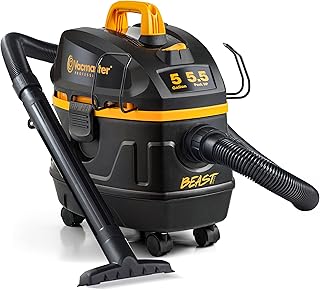
The Vacmaster Beast VFB511H 0201 leads this roundup because it packs the strongest suction figures of any small machine here into a five gallon body. Its five and one half peak horsepower motor delivers one hundred and two cubic feet per minute and eighty two inches of water lift, with three hundred and twenty air watts, all measured at the end of the included hose to the ASTM standard. On a compact workshop bench, that means it clears sanding dust and small lumps without needing a large drum behind it. Its eighteen foot cord is the longest in this group, so the machine can sit in its corner while the hose reaches the bench, the floor, and the doorway.
- Tank size: 5 gallons
- Motor: 5.5 peak horsepower, 11 amps
- Airflow: 102 cubic feet per minute
- Water lift: 82 inches
- Air watts: 320
- Hose: 1-7/8 inch diameter, 7 feet long
- Power cord: 18 feet
- Weight: 15.63 pounds
- Filter: HEPA cartridge filter plus foam wet filter, captures dust down to 1 micron
- Extras: on board hose, cord and accessory storage, 5-year limited warranty
The VFB511H suits the small workshop that needs real suction in a small body. Its five gallon drum fills fast on a strip out day, so it is a daily maintenance machine rather than a strip out machine, and its one and seven eighths inch hose passes sand and small lumps but will jam on a large chunk of render. Pick up the big pieces by hand. Its HEPA cartridge and dust bag capture fine dust down to one micron, which matters in a small room where the air has nowhere to go. Keep a spare cartridge on the shelf, since fine dust loads it fast, and use the on board storage so the hose and tools stay with the machine instead of spreading across the bench.
DeWalt DCV581H
The DeWalt DCV581H is the cordless or corded machine in this roundup, and it earns its place in a compact workshop because it works with or without a power outlet. It runs on an eighteen or twenty volt MAX battery, or it plugs into a standard outlet, so a flat battery never stops the cleanup. Its two gallon tank and five foot hose suit a bench and a small floor, and its HEPA filter traps dust with 99.97 percent efficiency at 0.3 microns. In a room where the cord is a trip hazard across the only walkway, the cordless option is worth more than extra capacity.
- Tank size: 2 gallons
- Power: 20 volt MAX battery or 120 volt AC outlet, 8 amps
- Airflow: 31 cubic feet per minute
- Water lift: 52 inches
- Hose: 1-1/4 inch diameter, 5 feet long, heavy duty
- Weight: 11.06 pounds
- Filter: HEPA, 99.97 percent at 0.3 microns, washable and reusable
- Extras: on board hose, cord and accessory storage, wide nozzle tool, crevice tool, battery and charger sold separately
The DCV581H suits the small workshop where the vacuum lives on a shelf and comes down for spot cleaning, bench cleanup, and small spills. Its thirty one cubic feet per minute of airflow is modest, so it works best on dust and fresh splashes rather than on heavy debris, and its two gallon tank needs emptying often. The battery and charger are sold separately, so the real cost includes them unless the crew already runs DeWalt twenty volt MAX tools. Its strength is freedom from the cord: it cleans the bench, the floor by the door, and the inside of the van without an outlet in reach. Keep the HEPA filter washed and dry, since a damp filter drops airflow fast.
RIDGID HD0600
The RIDGID HD0600 is the six gallon NXT machine in this roundup, and it fits a compact workshop because it is small enough to roll into a corner and strong enough to handle the daily dust and debris of plaster work. Its three and one half peak horsepower motor delivers sixty four cubic feet per minute and sixty seven inches of lift, with one hundred and eighty six air watts measured to the ASTM standard. The four swivel casters roll easily across a workshop floor, and the locking hose stays connected when the machine is pulled out from its corner and pushed back again.
- Tank size: 6 gallons
- Motor: 3.5 peak horsepower, 7.5 amps
- Airflow: 64 cubic feet per minute
- Water lift: 67 inches
- Air watts: 186
- Hose: 1-7/8 inch diameter, 7 feet long, Tug-A-Long locking hose
- Power cord: 10 feet
- Noise: 82 decibels
- Extras: blower port, on board accessory storage, full lifetime warranty on the drum
The HD0600 suits the workshop that needs one machine for daily maintenance, kept in a corner and pulled out as needed. Its six gallon drum holds a day of dust and small debris, and its ten foot cord is short for a large room, so keep the outlet near the machine's corner. Its airflow is modest beside the larger machines here, so it works best when the floor is cleared daily rather than left for a weekly deep clean. Empty the drum at the end of each day, since a small drum of damp plaster waste sets hard overnight, and keep the hose coiled loosely so it does not kink in storage.
Stanley SL18184
The Stanley SL18184 is the stainless steel machine in this roundup, and it fits a compact workshop because its six gallon steel tank resists rust and dents, and its swivel casters and sturdy handle make it easy to move with one hand. Its four peak horsepower motor handles daily dust and small debris, and its waterproof switch is a practical detail on a plaster site, where wet hands and splashes are part of the day. The large lid latches hold the tank shut when the machine is carried, and the accessory holder keeps the tools on the machine instead of on the bench.
- Tank size: 6 gallons
- Motor: 4.0 peak horsepower
- Tank material: stainless steel
- Extras: swivel casters, waterproof switch, sturdy handle, large lid latches, accessory holder, 9 piece accessory kit
The SL18184 suits the workshop where the vacuum is moved often and stored in a damp corner, since the stainless tank will not rust the way a painted steel drum can. Its airflow figure is not published on the pages checked, so treat its suction as adequate for daily dust and small debris rather than for heavy loads, and see the product page for the latest figures. It is a maintenance machine rather than a strip out machine: it keeps the bench and floor clear day by day, and a larger machine handles the big strip out when it comes. Keep the casters clean, since plaster dust in a caster wheel stops it rolling and turns a mobile machine into a fixed one.
Milwaukee M18 FUEL 0910-20
The Milwaukee M18 FUEL 0910-20 is the six gallon cordless machine in this roundup, and it earns its place because it brings cordless freedom to a drum large enough for a real session of workshop cleanup. It runs on the eighteen volt M18 battery platform, and it delivers eighty seven cubic feet per minute with sixty inches of suction. In a compact workshop it lives under the bench, it starts without a cord, and it clears the floor and the bench at the end of the day without the cord crossing the walkway.
- Tank size: 6 gallons
- Power: 18 volt M18 battery platform
- Airflow: 87 cubic feet per minute
- Suction: 60 inches
- Extras: HEPA filter available, on board accessory storage
The 0910-20 suits a crew that already runs Milwaukee M18 tools, since the batteries are shared and the vacuum is always ready. Its six gallon drum holds a useful load, and its eighty seven cubic feet per minute is strong for a cordless machine. The battery is sold separately, so the cost includes a battery and charger for a crew that does not already own them. Its run time depends on the battery, so keep a spare charged for the end of day cleanup. It is a maintenance machine for a small room, not a strip out machine for a full renovation, and it works best when the floor is cleared daily.
DeWalt DXV04T
The DeWalt DXV04T is the four gallon machine in this roundup, and it fits a compact workshop because it is small enough to sit on a shelf or under a bench, yet its five peak horsepower motor delivers ninety cubic feet per minute, which is strong for its size. Its twenty foot cord is the longest cord among the small machines here, so it can sit in its storage spot while the hose reaches across the room. Its eighty decibel noise figure is moderate, which matters in a small room where the machine is close to the person using it.
- Tank size: 4 gallons
- Motor: 5.0 peak horsepower
- Airflow: 90 cubic feet per minute
- Air watts: 140
- Hose: 1-7/8 inch diameter, 7 feet long
- Power cord: 20 feet
- Noise: 80 decibels
- Extras: blower port, on board accessory storage
The DXV04T suits the workshop that wants a small machine with real airflow, kept under the bench and pulled out for the daily clean. Its four gallon drum fills fast, so it needs emptying often on a busy day, and its one and seven eighths inch hose passes sand and small lumps but not large chunks. Pick up the big pieces by hand. Its twenty foot cord is a genuine advantage in a small room, since the machine can stay in its corner while the hose and cord reach the bench and the door. Keep the filter clean, since a small machine with a loaded filter loses airflow faster than a large one.
Fein Turbo II
The Fein Turbo II is the dust extractor in this roundup, and it earns its place in a compact workshop because it is quiet, it connects to power tools, and it carries a long hose and cord that reach across the room from a single spot. Its eleven hundred watt turbine delivers one hundred and fifty one cubic feet per minute and ninety eight point four inches of water lift, and it runs at sixty six decibels, which is the quietest figure in this roundup. The autostart outlet switches the vacuum on with the power tool, so dust is captured at the source instead of settling on the bench.
- Tank size: 8.5 gallons
- Motor: 1,100 watts
- Airflow: 151 cubic feet per minute
- Water lift: 98.4 inches
- Hose: 1-3/8 inch diameter, 13 feet long
- Power cord: 19.7 feet
- Weight: 20.06 pounds
- Noise: 66 decibels
- Dust class: L
- Extras: autostart outlet with power on delay, tool coupling with suction control, anti static function, 3-year limited warranty
The Turbo II suits the workshop where sanding and power tool work produce most of the dust, since it captures dust at the tool instead of letting it settle. Its thirteen foot hose and nineteen point seven foot cord give it the longest reach in this roundup, so it can sit in a corner while the hose reaches the bench and the far wall. Its one and three eighths inch hose is narrow for large lumps, so pick up the big pieces by hand and let the machine handle dust and small debris. Its sixty six decibel running noise is a real advantage in a small room, where a loud machine makes conversation and concentration hard. Keep the flat fold filter clean and the fleece bag changed, since a loaded filter drops airflow even on a machine this strong.
| Model | Tank and motor | Airflow and lift | Fit for this job |
|---|---|---|---|
| Vacmaster Beast VFB511H 0201 | 5 gal, 5.5 peak HP | 102 CFM, 82 in lift | Small body, strong suction |
| DeWalt DCV581H | 2 gal, 20V cordless or corded | 31 CFM, 52 in lift | No cord across the walkway |
| RIDGID HD0600 | 6 gal, 3.5 peak HP | 64 CFM, 67 in lift | Daily corner machine |
| Stanley SL18184 | 6 gal, 4.0 peak HP | See product page | Steel tank, damp storage |
| Milwaukee M18 FUEL 0910-20 | 6 gal, 18V cordless | 87 CFM, 60 in suction | Cordless, shared batteries |
| DeWalt DXV04T | 4 gal, 5.0 peak HP | 90 CFM, see product page | Under bench, long cord |
| Fein Turbo II | 8.5 gal, 1,100 W | 151 CFM, 98.4 in lift | Tool extraction, quiet |
How to choose
Measure the storage spot before the machine
A compact workshop has no spare floor, so the first check is where the vacuum will live when it is not working. Measure the space under the bench, in the corner, or on the shelf, and compare it with the machine's height, width, and depth. A machine that does not fit its spot will live in the walkway, where it gets kicked, splashed, and tripped over. Check the hose and cord storage too: a machine with on board storage keeps its hose and tools with it, while a machine without storage spreads its parts across the bench. A wall mount option is worth looking for when floor space is truly tight.
Balance drum size against emptying effort
A small drum empties often and a large drum empties rarely, but in a compact workshop the large drum also blocks the room. A five to six gallon drum holds a day of dust and small debris in a small workshop, and it is light enough to carry to the bin when full. A two gallon drum needs emptying twice a day but fits on a shelf. A fourteen gallon drum holds a week of dust but takes up floor that the work needs. Pick the smallest drum that holds a full day of the workshop's normal waste, and empty it at the end of every day so wet waste never sets inside it.
Check noise, cord, and hose reach together
In a small room the machine is always close to the person using it, so noise matters more than it does on an open site. A machine rated at sixty six decibels is far easier to live with than one rated at eighty seven decibels, and the difference shows over a full day. Cord length decides where the machine can sit: a twenty foot cord lets the machine stay in its corner while the hose reaches the bench, while a ten foot cord forces the machine into the middle of the room. Hose length decides how far the nozzle reaches from the machine, and a locking hose stays connected when the machine is pulled out and pushed back. Check all three together, since a quiet machine with a short cord is no better than a loud machine with a long one.
Plan the filter routine for a small room
A small room has less air to dilute dust, so the filter matters more here than on an open site. A fine dust filter or a HEPA cartridge holds the plaster dust that otherwise hangs in the air and settles on fresh work. Check the filter at least once a day, tap it clean outside, and carry a spare so a loaded filter can be swapped instead of cleaned on the spot. A dust collection bag inside the drum catches much of the fine material before it reaches the filter, and it makes emptying cleaner in a room where there is nowhere to make a mess. Never vacuum wet material with a dry filter fitted, and rinse the foam wet filter at the end of the day.
Common mistakes
The most common mistake in a compact workshop is buying a vacuum that is too large for the room. It blocks the walkway, it gets splashed because it cannot be moved out of the way, and it ends up stored outside, where it is never in hand when needed. Measure the storage spot first and buy the machine that fits it. A second mistake is leaving the drum closed with damp waste inside. In a small room the smell spreads fast, and the waste sets hard overnight. Empty the drum at the end of every day, rinse it, and leave it open. A third mistake is coiling the hose tight around the machine. A tight coil sets a permanent kink, and a kinked hose drops airflow and catches debris. Coil the hose loosely or hang it on a hook. A fourth mistake is ignoring the filter because the machine still runs. A loaded filter drops airflow gradually, and the workshop slowly fills with dust that settles on fresh plaster. Check the filter daily. A fifth mistake is running the cord across the walkway. In a small room there is only one walkway, and a cord across it is a trip hazard every time someone crosses the room. Run the cord along the wall, or use a cordless machine. A sixth mistake is storing accessories on the bench instead of on the machine. The bench is for plaster work, and every nozzle left on it is a tool that gets splashed, lost, or knocked to the floor. Use the on board storage, or fit a hook beside the machine.
FAQ
What size vacuum fits under a workbench?
Measure the space first, since bench heights vary. A four to six gallon machine with a height under twenty inches usually fits under a standard bench, while a fourteen gallon drum rarely does. Check the machine's published height, width, and depth before buying, and remember the hose and cord add bulk. A wall mount machine or a cordless model that lives on a shelf is often the better answer when under bench space is tight.
Is a cordless vacuum enough for a small plaster workshop?
For daily maintenance, yes. A cordless machine clears dust from the bench, picks up fresh splashes, and cleans the floor at the end of the day, all without a cord across the walkway. For a strip out or a heavy sanding session, a corded machine with higher airflow is still the better choice. Many small workshops keep both: a cordless machine for the quick jobs and a corded machine for the heavy days.
How do I keep dust down in a small room?
Vacuum little and often, instead of letting dust build up for a weekly clean. Fit a fine dust filter or a HEPA cartridge, use a dust collection bag inside the drum, and capture dust at the source with a tool extraction vacuum when sanding. Keep the door closed while sanding so dust does not drift into the rest of the house, and wipe the bench down at the end of the day so dust does not settle on fresh work overnight.
Can I store a wet dry vacuum outside the workshop?
It is better to store it inside, dry, with the drum open. A machine stored outside picks up damp, and a damp machine grows mould inside the drum and the hose. If outside storage is the only option, empty and rinse the drum, dry the hose, and cover the machine. Bring it inside to dry fully at least once a week, and check the filter before each use.
How often should I empty a small drum?
At the end of every working day, without exception. A small drum fills fast, and wet plaster waste sets hard overnight. Emptying daily keeps the machine light, the filter clean, and the drum free of set material that has to be chipped out. On a busy day, empty it at lunch as well, so the afternoon session starts with a clean drum and full airflow.
Conclusion
A compact workshop needs a vacuum that fits the room, not one that fights it. The Vacmaster Beast VFB511H 0201 leads this roundup because it packs strong suction and a HEPA cartridge into a five gallon body that tucks into a corner. The DeWalt DCV581H works with or without a cord, the RIDGID HD0600 rolls into its corner every day, the Stanley SL18184 survives damp storage in a steel tank, the Milwaukee M18 FUEL 0910-20 shares batteries with the rest of the kit, the DeWalt DXV04T hides under the bench with a twenty foot cord, and the Fein Turbo II captures dust at the tool in near silence. Measure the storage spot first, pick the smallest drum that holds a day of waste, and keep the filter clean. Do that, and the small room stays workable, the dust stays out of the fresh plaster, and the vacuum is in hand whenever the mess appears instead of buried behind the boards.
Related guides
More from Amazon
Programs that pair well with the guide above. Offers and eligibility are set by Amazon and may change.
Free shipping on eligible items, Prime Video and more. Eligible new members can start with a free trial.
Start a Prime free trialAudiobooks and podcasts to listen to on the go. Eligible new members can start with a free trial.
Try Audible freeAd-free music streaming. Eligible new subscribers can start with a free trial.
Try Music Unlimited freeA free business account with business pricing and bulk-buying tools for work, shop or home office.
Create a business accountAs an Amazon Associate we earn from qualifying purchases.



Write Your Review
No reviews yet. Be the first to share your experience!