
Key takeaways
- Bonding primers decide whether Venetian plaster grips or peels. Compare seven real primers by coverage, dry time and fit, and pick the right one for your wall.
What's inside
As an Amazon Associate I earn from qualifying purchases. This post may contain affiliate links at no extra cost to you.
Venetian plaster is only as strong as the bond beneath it. The polished layers that give a wall its depth and shine are thin, and they rely entirely on the primer coat to grip the surface below. Get the primer wrong and the plaster can peel, blister or lift at the edges, sometimes months after the work looked finished. Get it right and the finish will hold for years. That is why the choice of a bonding primer deserves the same care as the choice of the plaster itself, and why the best black friday bonding primers for venetian plaster deals are worth a careful look before the sale weekend ends.
A bonding primer for Venetian plaster has a specific job. It must even out the suction of the wall, so that the plaster dries at the same rate across the whole surface. It must give a smooth or lightly textured key for the plaster to hold. And it must be compatible with lime, which is alkaline and will attack a primer that was never made for masonry. A general purpose wall primer may do none of these things well, which is why this guide only includes primers with a published masonry or bonding role.
The seven primers below cover the main approaches a plasterer will meet: an acrylic masonry primer-sealer, a water based multi-surface primer, a PVA bonding agent, a concrete bonding adhesive, a system primer from a stucco maker, and a mineral micro primer with fine aggregate. Each one is a real product with published coverage and drying figures, so the comparison rests on numbers rather than on habit.
Quick verdict
For most Venetian plaster work over sound masonry, plasterboard or a cured render, the Sherwin-Williams Loxon Concrete and Masonry Primer-Sealer is the strongest single pick. It is made for masonry, it lists a coverage range that accounts for porous stucco, and it states a clear recoat window and a pH range that covers lime. If the wall is glossy, painted or otherwise hard to grip, the Larsen Weld-Crete bonding agent is the better choice, with a published bond strength figure that few rivals match.
For a buyer stocking up during the sale period, the practical move is to match the primer to the wall rather than to buy one product for every surface. A porous render needs a sealer that controls suction. A smooth painted wall needs a bonding agent that grips. A Venetian finish over a fresh lime coat needs a mineral primer that tolerates alkalinity. Buy the primer the wall needs, in the quantity the area needs, and the plaster will have the foundation it deserves.
| Product | Key spec | Best for |
|---|---|---|
| Sherwin-Williams Loxon Concrete and Masonry Primer-Sealer | 200 to 320 sq ft per gal; pH 6 to 13 | General masonry and stucco |
| Zinsser Bulls Eye 1-2-3 | 400 to 450 sq ft per gal; topcoat in 1 hour | Fast work over varied surfaces |
| Larsen Weld-Crete | 200 to 300 sq ft per gal; bond 615 psi | Smooth and glossy walls |
| QUIKRETE Concrete Bonding Adhesive No. 9902 | Primer 600 to 1,200 sq ft per gal; ASTM C1059 | Concrete and render bonding |
| Parex 310 Primer | Prime coat in the Parex acrylic finish system | Parex system finishes |
| SikaWall-10 Stucco Prime | 150 to 250 sq ft per gal; dry within 24 hours | Stucco and SikaWall bases |
| Romabio BioGrip Micro Primer | 1 L covers 65 to 85 sq ft; 2 coats | Mineral finishes and limewash |
How we chose
Every primer in this roundup had to meet four conditions. First, it had to be a real, named product with a published role in bonding or priming masonry, plaster or stucco. A product described only as a general paint primer was left out. Second, the maker had to publish coverage and drying figures, because those numbers decide how much to buy and how long to wait before plastering. Third, the primer had to be compatible with at least one of the surfaces Venetian plaster is commonly applied over: cured render, plasterboard, concrete, masonry or a sound painted wall. Fourth, the product had to be currently sold in a pack size a plasterer can buy.
Coverage was weighted heavily, because it decides the true quantity needed for a wall. A primer that covers 400 square feet per gallon needs half as much product as one that covers 200, and that difference matters more than any small difference in the shelf tag. Drying time mattered too: a primer that is ready for a topcoat in one hour suits a tight schedule, while one that needs a full day suits a slower, more careful job. Alkaline tolerance was checked wherever the maker published it, since Venetian plaster is lime based and a primer that cannot tolerate a high pH will fail early.
The selection was made from maker data sheets and retailer listings that publish their own specifications. No product was included on the strength of a review alone, and no specification in this guide was taken from a source that did not publish it.
Sherwin-Williams Loxon Concrete and Masonry Primer-Sealer
- Type: acrylic primer-sealer for concrete and masonry
- Coverage: 200 to 320 sq ft per gallon, and 80 sq ft per gallon on porous rough stucco
- Drying: touch dry in 4 hours, recoat after 24 hours at 77F and 50 percent relative humidity
- Alkalinity: tolerates pH 6 to 13
- Application: minimum 40F; topcoat within 14 days on exterior work
- Shelf life: 36 months
Loxon is the most complete masonry primer in this roundup, and the reason is the detail in its data sheet. It does not give a single coverage figure and leave the buyer to guess; it gives a range for normal masonry and a separate figure for porous rough stucco, which is the surface a plasterer is most likely to meet. That honesty about porous surfaces is rare, and it is exactly the information that keeps a buyer from running short halfway through a wall.
The pH range of 6 to 13 is the other number that matters. Venetian plaster is lime based and alkaline, and a primer that tolerates a pH up to 13 will not break down beneath it. The recoat window of 24 hours is slower than some rivals, but it is a realistic figure for a sealer that needs to settle into a porous surface, and the 14-day window for a topcoat gives a plasterer room to work without rushing. For a general Venetian plaster job over sound masonry or render, this is the primer to start with.
Pros: Published coverage for porous stucco as well as normal masonry; wide pH tolerance that suits lime plaster; long 36-month shelf life; clear recoat and topcoat windows.
Cons: Slower recoat time than fast drying rivals; coverage drops sharply on very porous surfaces, so a rough wall needs more product than the headline figure suggests.
Zinsser Bulls Eye 1-2-3
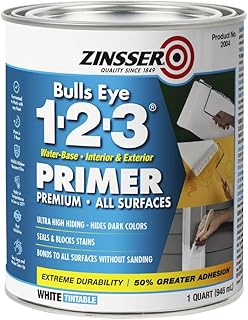
- Type: water based styrenated acrylic primer-sealer
- Coverage: 400 to 450 sq ft per gallon
- Drying: touch dry in about 30 minutes, topcoat in 1 hour, full hardness in 7 days
- Bonding: bonds glossy surfaces without scuff sanding
- Application: low application temperature of 35F
Bulls Eye 1-2-3 is the fast option in this roundup, and its speed is its main selling point. A touch dry time of about 30 minutes and a topcoat time of one hour mean that a wall primed in the morning can carry plaster in the afternoon, which suits a tight schedule or a small room where the work has to be finished in a day. The coverage of 400 to 450 square feet per gallon is also the highest in this guide, so a single gallon goes a long way.
The bonding claim is worth noting too. The maker states that the primer bonds glossy surfaces without scuff sanding, which makes it useful on a painted wall or a smooth, sealed surface where a masonry sealer might struggle to grip. It is a water based product, so cleanup is simple and the odour is low. For Venetian plaster over a sound but glossy surface, or for a job where speed matters, it is a strong pick.
Pros: Very fast drying with a one-hour topcoat time; high coverage per gallon; bonds glossy surfaces without sanding; water based with easy cleanup.
Cons: A general purpose primer rather than a dedicated masonry sealer, so it is not the first choice for very porous render; full hardness takes 7 days, so the finish should not be stressed early.
Larsen Weld-Crete
- Type: PVA homopolymer bonding agent
- Coverage: 200 to 300 sq ft per gallon
- Bond strength: tensile bond averaging 615 psi at 28 days to ASTM C932; shear 740 psi to ASTM C1042
- Drying: dry in 1 hour
- Use: interior and exterior; freeze and thaw stable for 5 cycles
- Colour: blue, so coverage is easy to see
Weld-Crete is the bonding agent in this roundup, and it is the product to reach for when the wall itself is the problem. Its published bond figures, 615 psi in tension and 740 psi in shear, are the strongest numbers in this guide, and they are measured to published standards rather than stated as a marketing claim. That matters on a smooth concrete wall, a dense render or a painted surface where a normal primer may not grip.
The blue colour is a practical detail that plasterers appreciate: it shows exactly where the agent has been applied, so no patch is missed. It dries in about an hour, it works inside and outside, and it is stable through freeze and thaw cycles. For Venetian plaster over a slick or doubtful surface, Weld-Crete gives the plaster a mechanical and chemical key that a thin sealer cannot match.
Pros: Strongest published bond figures in the roundup; blue colour shows coverage; fast one-hour drying; suits smooth, dense and painted surfaces.
Cons: Coverage is lower than the acrylic sealers, so more product is needed for a large wall; as a bonding agent it is a specialist product, not a general primer for every surface.
QUIKRETE Concrete Bonding Adhesive No. 9902

- Type: exterior grade synthetic emulsion bonding adhesive
- Pack sizes: 1 quart, 1 gallon and 5 gallons
- Coverage as primer: 600 to 1,200 sq ft per gallon; paint-on 35 to 75 sq ft per quart; slurry about 19 sq ft per quart
- Standard: ASTM C1059 Types I and II; slant shear above 400 psi Type I and above 1,250 psi Type II
- Drying: dry in 2 to 3 hours
QUIKRETE 9902 is the workhorse of this roundup. It is a bonding adhesive that can be used as a paint-on coat, as a slurry, or diluted as a primer, and the maker publishes a separate coverage figure for each method. As a primer it covers 600 to 1,200 square feet per gallon, which makes it one of the most economical options here for a large area. The ASTM C1059 rating and the slant shear figures give a plasterer a measured basis for trusting the bond, rather than a vague promise.
Its flexibility is the reason to keep a gallon on the shelf. The same product that primes a wall can be mixed into a slurry for a repair, or painted on neat as a bonding coat before a render. For Venetian plaster work, the primer dilution is the relevant method: it seals the suction of the wall, leaves a bonding film, and dries in two to three hours. It is a practical, widely available product that suits a buyer who wants one bonding product for several jobs.
Pros: Three application methods with published coverage for each; strong ASTM rating and shear figures; economical coverage as a primer; widely available in three pack sizes.
Cons: The coverage range as a primer is wide, so the true quantity depends on the porosity of the wall; drying takes two to three hours, slower than the fastest primers here.
Parex 310 Primer
- Type: prime coat in the Parex Acrylic Finish System
- System: used with Parex 121 base coat and 355 mesh
- Volatile organic content: system VOC under 100 g per litre
- Application: 40 to 80F
Parex 310 is the system primer in this roundup, and it should be judged as part of a system rather than as a standalone product. It is the prime coat in the Parex Acrylic Finish System, used over the Parex 121 base coat with mesh, and it is made to work with those materials rather than with any plaster. For a Venetian plaster job that sits within a Parex system, it is the correct primer, and using a different primer in that system would break the maker's specification.
The value of a system primer is consistency. The base coat, the mesh and the prime coat are made to bond to each other, and the system as a whole carries a VOC figure under 100 grams per litre. A plasterer working to a specification, or on a commercial job where the system is named, should use the primer the system names. For a standalone Venetian plaster over an ordinary wall, a general masonry primer from this guide is a simpler choice.
Pros: Correct primer for the Parex acrylic finish system; designed to bond with the Parex base coat and mesh; low system VOC figure; clear application temperature range.
Cons: Only the right choice inside a Parex system; less useful as a general purpose primer for other plasters; the data sheet gives no standalone coverage figure.
SikaWall-10 Stucco Prime
- Type: 100 percent acrylic primer for stucco
- Coverage: 750 to 1,250 sq ft per 5 gallon pail, or 150 to 250 sq ft per gallon
- Drying: dry within 24 hours at 70F and 50 percent relative humidity
- Application: 40 to 100F; protect from rain and temperatures below 40F for at least 24 hours
- Volatile organic content: under 100 g per litre; shelf life 2 years
- Purpose: for conventional stucco, SikaWall Stucco Base, poured concrete and unit masonry; minimises suction and reduces efflorescence
SikaWall-10 is the stucco primer in this roundup, and it is made for exactly the surfaces Venetian plaster is often applied over. Its stated purpose is to minimise suction and reduce efflorescence, which are the two problems that most often spoil a plaster finish on a masonry wall. A wall that sucks water out of the plaster too fast will dry unevenly and crack; a wall that brings salts to the surface will stain the finish. A primer that addresses both is doing the job it was made for.
The coverage of 150 to 250 square feet per gallon is modest, and the drying time of up to 24 hours is the slowest in this guide, so a buyer should allow a full day between priming and plastering. In return, the primer is a 100 percent acrylic product with a two-year shelf life, made by a maker whose stucco systems are widely specified. For a Venetian plaster over a stucco base or a masonry wall with a history of efflorescence, it is a sound and specific choice.
Pros: Made for stucco and masonry, with suction control and efflorescence reduction stated as its purpose; 100 percent acrylic; two-year shelf life; suits SikaWall bases and conventional stucco.
Cons: Slow drying, up to 24 hours before the finish; lower coverage per gallon than the fast primers; needs protection from rain and cold for a full day.
Romabio BioGrip Micro Primer
- Type: mineral primer with micro-fine aggregate
- Coverage: 1 litre covers 65 to 85 sq ft; 2.5 litres covers 165 to 215 sq ft; 15 litres covers 1,000 to 1,300 sq ft
- Application: 2 coats; dry 8 to 12 hours; dilution 20 to 30 percent
- Surfaces: unabsorbent and glossy brick, fibre cement board, concrete, stucco, painted drywall, brick and stone
BioGrip Micro Primer is the mineral option in this roundup, and it is the one that best matches the character of a lime plaster. It is a mineral primer carrying a micro-fine aggregate, which gives the surface a light tooth for the plaster to grip while remaining compatible with alkaline lime finishes. The maker lists it for unabsorbent and glossy surfaces, which are the hardest to prime, as well as for concrete, stucco and stone.
The coverage figures are given for three pack sizes, which makes it easy to buy the right quantity, and the two-coat method with an 8 to 12 hour drying time suits a careful, unhurried job. The dilution of 20 to 30 percent is stated on the maker page, so there is no guessing about how much water to add. For a Venetian plaster or a limewash over a glossy or unabsorbent wall, BioGrip is the primer that best bridges the gap between a mineral finish and a difficult surface.
Pros: Mineral primer that suits lime finishes; micro-fine aggregate gives a key on glossy and unabsorbent surfaces; clear coverage figures for three pack sizes; dilution stated by the maker.
Cons: Two coats needed, with 8 to 12 hours drying, so the job takes longer; coverage per litre is lower than the acrylic primers; a specialist product at a higher outlay per square foot.
Buying guide
Start with the wall. Run a hand across it and look at how it takes water. A porous render or a bare masonry wall will drink a primer quickly, and it needs a sealer that controls suction, such as Loxon or SikaWall-10. A smooth painted wall or a dense concrete surface will not absorb at all, and it needs a bonding agent that grips, such as Weld-Crete or BioGrip. A plasterboard wall falls in between, and a fast water based primer such as Bulls Eye 1-2-3 will usually serve. Matching the primer to the wall is the single most important decision in this guide, and it matters more than the brand on the can.
Read the coverage figure as a range, not as a promise. Every maker in this guide gives a range, because a porous wall takes more primer than a smooth one. Work out the area of the wall, take the lower end of the coverage range for a porous surface, and add a margin for a second coat if the maker calls for one. Running short halfway through a wall is worse than buying a little extra, because a half-primed wall will dry unevenly and the plaster will show it.
Check the drying time against your schedule. A primer that needs 24 hours, such as SikaWall-10, means the wall cannot be plastered the same day. A primer that is ready in one hour, such as Bulls Eye 1-2-3 or Weld-Crete, allows priming and plastering in a single day. Neither is better in itself; the right choice is the one that fits the time you have. Do not rush a slow primer. A primer that has not dried will not bond, and a plaster applied over a wet primer is a plaster that will fail.
Check alkaline tolerance wherever the maker publishes it. Venetian plaster is lime based, and a primer that cannot tolerate a high pH will break down beneath the finish. Loxon states a pH range up to 13, which is a clear, useful figure. Where a maker does not state a pH figure, prefer a mineral primer such as BioGrip, which is made for lime finishes, or ask the maker before buying.
Buy the system primer when the job names a system. If the specification calls for a Parex finish, use the Parex 310 primer with the Parex base coat and mesh. If the job calls for a SikaWall base, use the SikaWall-10 primer. Mixing systems is a common cause of failure, and the saving from substituting a cheaper primer is small beside the cost of redoing a wall.
Finally, buy for the area, not for the shelf. Primers have shelf lives, from one year to three years in this guide, and a can that sits unopened for two years may still be usable, but it is not a bargain if it is never opened. Measure the walls, work out the quantity from the coverage range, and buy that quantity with a small margin. A seasonal purchase makes sense when it covers a planned job; it makes less sense as a stockpile.
FAQ
Do I need a bonding primer under Venetian plaster?
Yes, in almost every case. Venetian plaster is applied in thin layers, and it needs a primed surface to grip, to dry evenly and to resist the suction of the wall beneath. An unprimed porous wall will draw water out of the plaster too fast, which leads to uneven drying and cracking. An unprimed glossy wall will not grip at all. A bonding primer solves both problems, and it is a small part of the total cost of a plaster job.
Can I use a normal wall primer instead of a bonding primer?
A normal wall primer is made for paint, not for plaster, and it may not control suction or bond to masonry in the way a plaster needs. Some water based multi-surface primers, such as Bulls Eye 1-2-3, do bond well and are listed here for that reason. But a primer made for masonry, such as Loxon or SikaWall-10, is a safer choice over render, stucco or concrete, because it is made for those surfaces and states its coverage and pH tolerance for them.
How long should I wait after priming before applying Venetian plaster?
Follow the maker figure for the primer you used. Bulls Eye 1-2-3 is ready for a topcoat in one hour, Weld-Crete dries in about an hour, QUIKRETE 9902 dries in two to three hours, and SikaWall-10 needs up to 24 hours. The wall should be dry to the touch and the primer fully set before plastering begins. Rushing this step is one of the most common causes of a failed bond.
How much primer do I need for one room?
Measure the wall area and divide by the coverage figure for your primer, using the lower end of the range for a porous wall. As a rough guide, a gallon of Loxon at 200 square feet per gallon covers a small room, while a gallon of Bulls Eye 1-2-3 at 400 square feet per gallon covers twice that area. Always add a margin for a second coat where the maker calls for one, and for the extra primer a porous wall will absorb.
Can bonding primers be used on exterior walls?
Some can, and some cannot. Loxon and Weld-Crete are listed for exterior use, and SikaWall-10 is made for exterior stucco. Others in this guide are interior products, or need protection from rain and cold after application. Check the maker page for the primer you choose, and do not use an interior primer on an exterior wall, since rain and frost will break the bond.
Conclusion
The best Black Friday bonding primer for Venetian plaster is the one that matches your wall. For a general job over sound masonry or render, the Sherwin-Williams Loxon primer-sealer is the strongest all-round pick, with published coverage for porous stucco and a pH tolerance that suits lime. For a glossy or painted wall, Larsen Weld-Crete gives the strongest measured bond. For speed, Zinsser Bulls Eye 1-2-3 is ready in an hour. For a stucco base, SikaWall-10 is the specialist. For a mineral finish over a difficult surface, Romabio BioGrip is the right tool.
Buy the primer the wall needs, in the quantity the area needs, and allow the full drying time the maker states. A seasonal purchase is a sound move when it covers a planned job, and a poor move when it is a guess. With the right primer beneath it, a Venetian plaster finish will hold its shine and its bond for years, and that is the result a careful purchase is really buying.
Related guides
More from Amazon
Programs that pair well with the guide above. Offers and eligibility are set by Amazon and may change.
Send a Prime gift membership to someone who would use free shipping and Prime Video.
Gift Amazon PrimeGive audiobooks to someone who loves to listen. Plans and prices are set by Amazon.
Gift AudibleFree shipping on eligible items, Prime Video and more. Eligible new members can start with a free trial.
Start a Prime free trialAudiobooks and podcasts to listen to on the go. Eligible new members can start with a free trial.
Try Audible freeAs an Amazon Associate we earn from qualifying purchases.
More ways to save on your next finish
Programs that pair well with the guide above. Offers and eligibility are set by Amazon and may change.
A free business account with business pricing and bulk-buying tools for work, shop or home office.
Create a business accountFast, free shipping on eligible items, plus Prime Video and more. Eligible new members can start with a free trial.
Start a Prime free trialRead from a huge library of eBooks, including how-to guides and cookbooks. Eligible new members can start with a free trial.
Try Kindle UnlimitedAudiobooks and podcasts for the commute, the garage or the kitchen. Eligible new members can start with a free trial.
Try Audible freeAs an Amazon Associate we earn from qualifying purchases. Using these links costs you nothing extra.










Write Your Review
No reviews yet. Be the first to share your experience!